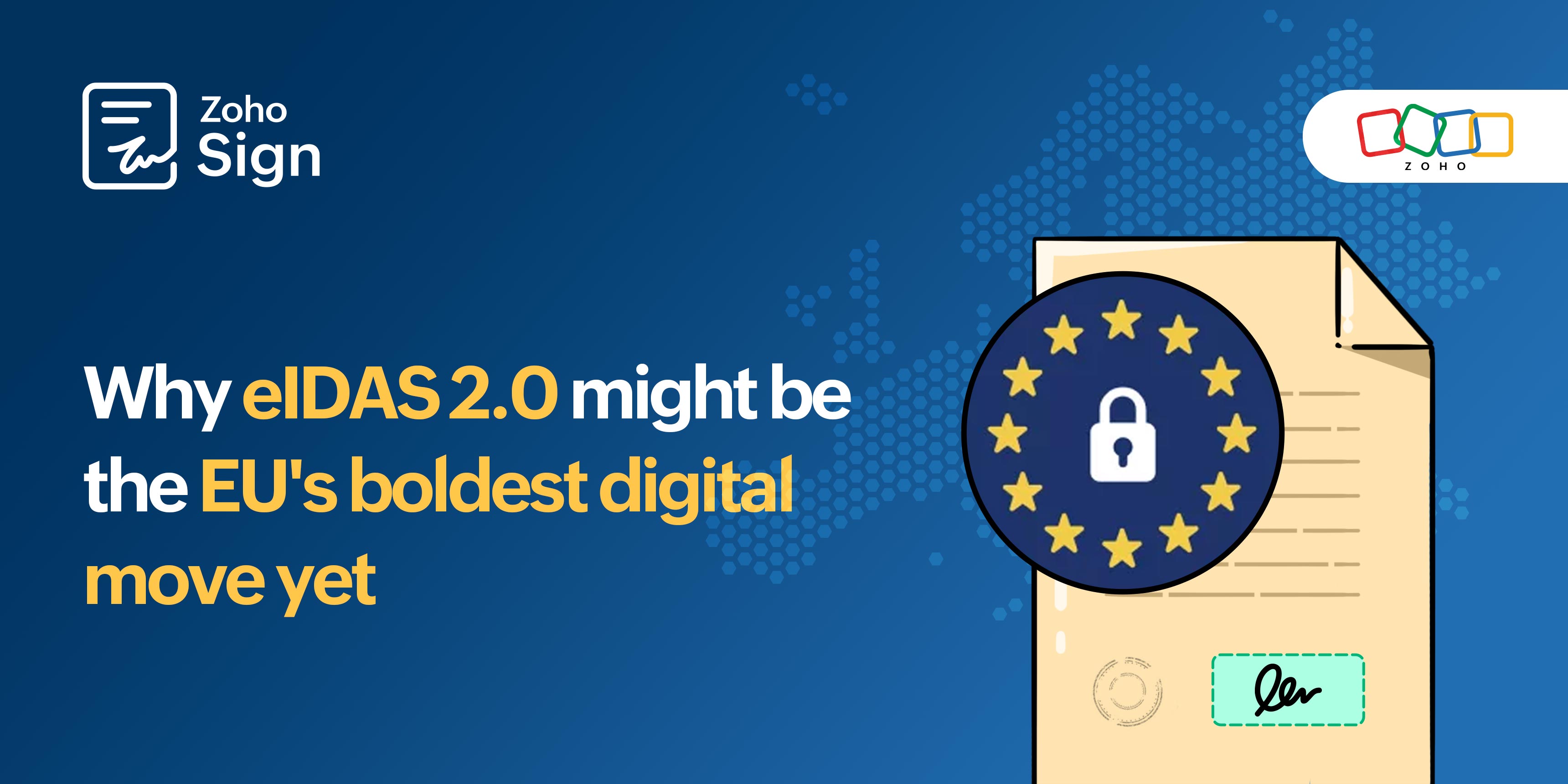
Why eIDAS 2.0 might be the EU's boldest digital move yet

eIDAS: The first building block of digital trust
More than a decade ago, the EU introduced the eIDAS regulation (Regulation [EU] No 910/2014) to help people, businesses, and governments interact online with the same trust and security they expect in person.
It set out to create one common framework so that a signature in Spain or a digital ID in Germany could be recognised and accepted anywhere across the Union. Although eIDAS got things started, the reality fell short of what was hoped for. Fewer than six in ten EU residents had reliable access to these digital tools, and progress looked very different from one country to another. The dream of a smooth, borderless experience across public and private services never quite materialised.
The EU hits refresh with eIDAS 2.0
Even with the framework in place, digital interactions across the EU were often frustrating. Systems didn't always communicate with each other, access varied from country to country, and people had little control over their own digital identities.
eIDAS 2.0 (Regulation (EU) 2024/1183) is intended to fix the gaps left behind. It makes using online services across the EU a smooth, secure experience that puts users in the driver's seat of their own digital lives. Logins work across borders, IDs are recognised, and navigating services is no longer confusing. In short, it turns the long-promised idea of a connected EU into a reality that works for everyone.
Feature / Aspect | eIDAS 1.0 | eIDAS 2.0 | Key impact |
Types of signatures | Simple, Advanced, Qualified | Same types, but adds Remote Qualified Electronic Signatures (RQES) | Users can now sign remotely while retaining QES legal validity. |
Qualified Electronic Signature Devices (QSCD) | Primarily physical devices (smart cards, USB tokens) | Supports remote/cloud QSCDs | Greater flexibility, no need for physical tokens. |
Identity Verification | Identity verification primarily relies on eID and physical proofing | Stricter identity proofing, supports remote verification using eIDs, mobile apps, and advanced authentication methods | Higher security and assurance of signatory identity. |
European Digital Identity | Not covered | Introduces European Digital Identity Wallet (EUDI Wallet) | Users store and share verified identity attributes, enabling secure e-signing and easier cross-border recognition. |
Interoperability | Member states implement eID and ES systems, but cross-border use is sometimes fragmented | Mandatory interoperability standards for electronic signatures and identity wallets | Ensures seamless EU-wide acceptance of signatures and identity verification. |
Legal effect | Qualified electronic signatures legally equivalent to handwritten signatures | Confirms legal equivalence of remote QES and signatures using EUDI Wallet | Remote signatures now have same legal recognition as traditional QES. |
Website authentication | Qualified Website Authentication Certificates (QWACs) optional | Emphasizes the use of QWACs to enhance website authentication. | Enhances trustworthiness and prevents phishing/fraud. |
User control and privacy | Limited | Users control which identity attributes are shared during signing | GDPR-aligned, more transparency and privacy protection. |
Trust services | Time stamping, certified email, website authentication, document validation | Extended to include: electronic archiving, electronic ledgers, remote signature management, electronic stamps | Supports broader digital business processes and compliance. |
Cross-border recognition | Some differences in implementation across Member States | Harmonized rules across all EU Member States | Removes legal uncertainty for cross-border electronic transactions. |
Security requirements | Basic requirements for signature creation and verification | Stricter security requirements for identity proofing, signature creation, and trust service providers | Reduces risk of fraud, misuse, and identity theft. |
eIDAS 2.0 bets on its star: The European Digital Identity Wallet
eIDAS 2.0 puts its trust in its crown jewel, the European Digital Identity Wallet. Once implemented, it will enable seamless cross-border use. It's a free, secure, and privacy-focused app that lets EU citizens, residents, and businesses store verified identity data, share only what they want, and even sign documents online.
The wallet puts users in control. Individuals and organizations decide what information to share and with whom, all while benefiting from strong encryption and designed to comply with GDPR requirements, ensuring user privacy and data protection in accordance with applicable EU data protection laws. Each country still manages its own eID data, but the wallet works seamlessly across borders, making services like healthcare, banking, and job applications simple and hassle-free.
And, it's not just for government use. The wallet extends to the private sector, acting as a trusted digital identity for everyday transactions. It makes it easy, safe, and convenient to do things like verifying a professional credential, checking in at an airport, or storing a prescription drug.
Trust services that redefine how we connect online
eIDAS 2.0 doesn't stop at digital identities. It raises the bar with a fresh set of trust services, making online interactions across Europe more secure, smooth, and reliable. Here's a closer look at what's new.
1. Qualified electronic archiving
Your digital vault that never forgets.
A small business can store all its invoices electronically, enabling instant retrieval of records, such as a payment receipt from three years ago, whenever needed.
2. Remote electronic signature and seal management
Sign and manage documents from anywhere.
A project manager traveling abroad can approve and sign a contract instantly using the European Digital Identity Wallet, without the need for physical signature devices like smart cards or USB tokens.
3. Qualified electronic attestation of attributes
Proof of who you are, without the hassle.
Qualified Electronic Attestation of Attributes enables the secure and trusted verification of specific identity attributes (e.g., diplomas, professional qualifications) by a Qualified Trust Service Provider (QTSP). This allows individuals to present verified credentials when needed (such as for job applications across the EU), reducing administrative burden and ensuring authenticity without repetitive manual checks.
4. Qualified electronic ledgers
Every record stays secure and transparent.
A logistics company can log each shipment handover in a qualified electronic ledger, ensuring an accurate and verifiable audit trail across multiple countries. The underlying technology (e.g., blockchain) may be used, but the key requirement is compliance with eIDAS 2.0 trust service standards, guaranteeing integrity and authenticity of the records.
Electronic signatures: The force driving eIDAS 2.0
Electronic signatures are no longer just a nice-to-have, they have become essential for secure digital workflows under eIDAS 2.0. With the same legal weight as a handwritten signature, Qualified Electronic Signatures (QES) enable people and businesses to sign documents digitally, ensuring authenticity, integrity, and legal recognition across the EU.
For businesses, this means contracts, employment agreements, and other key documents can go fully digital. E-signatures allow everything to happen quickly, from signing to verification to storage, as opposed to papers moving slowly through offices or getting misplaced.
Built with strong encryption and compliance measures, every e-signature is legally binding and tamper-proof, giving businesses confidence in every transaction.
How Zoho Sign helps businesses meet eIDAS 2.0 standards
Zoho Sign fully meets the requirements of eIDAS 2.0 through partnerships with Qualified Trust Service Providers (QTSPs) like Infocert, Uanataca, itsme, Swisscom, and Evrotrust to offer Qualified Electronic Signatures (QES), which carry the same legal weight as handwritten ones across the EU.
The platform uses EU eID verification, AES-256 encryption, and detailed audit trails to make sure every signed document is authentic, secure, and tamper-proof.
Our partnerships with Uanataca also enables offering qualified seals and timestamps, adding an extra layer of trust and compliance.
By focusing on security, privacy, and interoperability, Zoho Sign helps support eIDAS 2.0's vision of a unified, trusted digital identity ecosystem across the EU.
Working toward a secure and inclusive digital European Union
In the game of trust, eIDAS 2.0 is the EU's winning move. It transforms a patchwork of digital identity systems into a unified, user-first ecosystem. With its digital wallet, expanded trust services, and stronger standards, it's changing the way we connect, whether it's with governments, banks, or even with one another.
For people and businesses, it means digital life that's faster, safer, and simpler. And for the EU, it's a confident step toward a secure, independent, and inclusive digital future.
Zoho Sign is helping bring that same vision to your agreements.
Sign documents digitally, securely, and with confidence—aligned with global standards and designed for seamless collaboration. Getting started is easy:
Start your 14-day free trial
Check out our help guides to get started quickly
Write to us at support@zohosign.com or support@eu.zohosign.com (For EU)
Or leave a comment below, we'd love to assist!
Comments