- HOME
- Performance and Culture
- How to assess employee performance: Strategies that drive growth
How to assess employee performance: Strategies that drive growth
- Last Updated : December 11, 2025
- 1.5K Views
- 5 Min Read

Managing employee performance effectively can bring numerous benefits to your organization. Regular and meaningful performance reviews keep employees aligned with their goals, maintain their sense of direction, and show how their work creates an impact—all of which increase motivation and engagement. Clear expectations, constructive feedback, and regular recognition can also make employees feel valued, inspiring them to go the extra mile.
However, how HR teams and managers conduct performance reviews can be a dealbreaker. For example, unilateral, once-a-year performance reviews are no longer effective. As employee expectations evolve, HR teams need to set up more holistic, ongoing performance reviews that consider overall employee contributions, innovation, and collaboration efforts, rather than just output and results.
Here's how you can assess employee performance in a way that drives growth:
Key metrics to assess employee performance
There are five key metrics that can help your HR team run unbiased performance reviews:
Goal achievement
While running performance reviews, assess how effectively employees have met their KPIs, OKRs, and other objectives. When employees see progress in their work, it gives them greater clarity around how their contributions align with broader organizational goals. While the goal achievement rate can provide great insights, it's also important to consider the level of effort, collaboration, decision-making, and problem-solving that have gone into achieving those results.
Quality of work
Assessing quality of work means understanding how well employees perform their tasks and the kind of impact that work has on your organization's success. This could involve hitting sales targets, meeting deadlines, identifying challenges and solutions proactively, and contributing effectively to team goals. Everything from accuracy and autonomy to consistency and accountability matters when using quality of work as a performance metric. Since this metric is subjective, be sure to define what it looks like for each role, and keep your employees on the same page.
Customer experience
This can be a very powerful metric, as every business aims to offer value to its customers. It provides clarity on how employees contribute to customer satisfaction, engagement, morale, and loyalty. For example, you can get customer satisfaction scores using CSAT surveys, gauge how likely people are to recommend your business to their acquaintances using NPS surveys, take a look at the resolution time and satisfaction levels using ticket management systems, or even ask customers to directly rate employees in customer-facing roles. Recognize employees for using their communication and problem-solving skills effectively to add value to customers.
Team work
An employee's ability to coordinate well with their team has a great influence on project outcomes, team morale, and overall organizational success. Employees who work with a strong sense of teamwork usually:
- Freely share knowledge, ideas, and feedback during discussions.
- Help their peers solve challenges when they're working on tight deadlines.
- Keep their team informed about their progress and also show willingness to take feedback.
- Make efforts to adjust their priorities based on the needs of their team.
- Remain respectful and positive even during disagreements.
Innovation and creativity
Innovation and creativity are among the key attributes that drive growth and help organizations stay competitive. Innovative employees usually identify problems early on, come up with out-of-the-box solutions, and are never afraid of taking calculated risks. You can track their performance by recording the number of new ideas they've implemented, the process improvements they’ve introduced, and the strategies they’ve adopted to enhance team effectiveness and customer experience.
Different methods of assessing employee performance
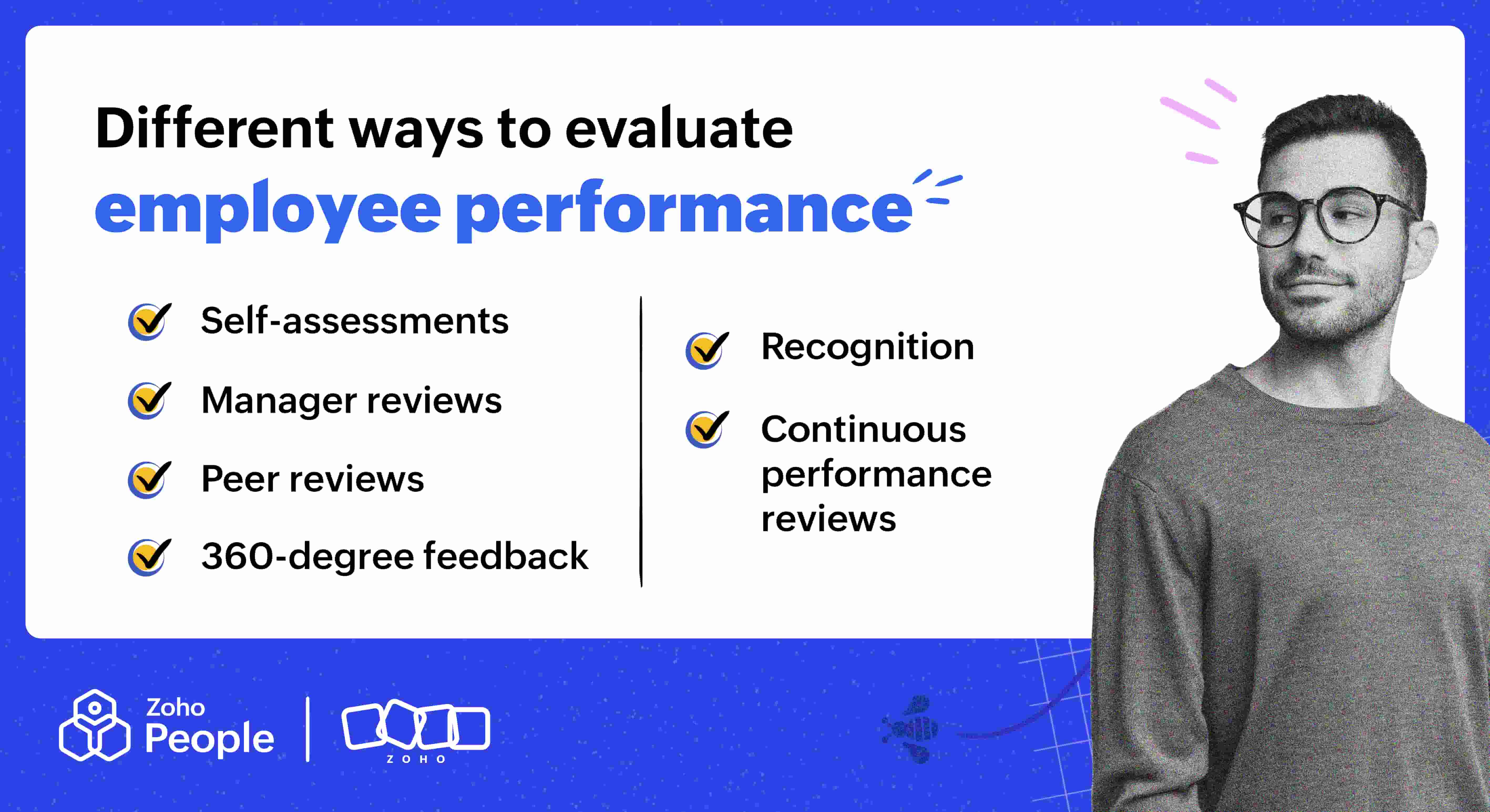
Here are some of the key ways to evaluate employees that align with common expectations:
Self-assessments
Self-assessments give HR teams valuable insights into how employees perceive their performance, encouraging employees to take an active role in their reviews and get clarity on their progress. Typically, employees are given a self-assessment questionnaire that helps them reflect on their strengths, weaknesses, goal completion, accomplishments, and alignment with company values so that they can provide an honest assessment of their performance.
Manager reviews
Manager reviews are a critical aspect of performance. Since managers work with their team closely, they're often the right people to assess how well employees have achieved their goals, collaborated with their peers, and aligned their performance with organizational goals. During their reviews, managers tend to revisit team goals, track progress against those goals, and receive input from their team to provide constructive performance reviews to each member.
Peer reviews
Peer reviews involve insights from the employee's coworkers. People who work with your employee every day can offer valuable information on how they collaborate with the team, how they help others grow, and how dependable they are. This helps managers avoid unconscious biases and offer more accurate and meaningful feedback. To collect peer reviews, performance questionnaires are usually shared with all relevant coworkers.
360-degree feedback
While peer reviews take feedback from individuals who are at the same level as the employee, 360-degree feedback provides comprehensive insights by getting performance feedback from their peers, cross-functional colleagues, subordinates, direct reports, interns, customers, and sometimes even partners. Getting feedback from a diverse group helps identify strengths and blind spots effectively. 360-degree feedback is usually collected through structured questionnaires that ask raters to evaluate employees on a mix of soft and hard skills, offering a balanced view of overall performance.
Continuous performance reviews
Continuous performance reviews are usually conducted once a month or every three months to track employee progress regularly and offer feedback without missing important touchpoints. Managers often set goals for a mutually agreed-upon performance period. At the end of the performance period, managers and their team meet to evaluate progress against the set goals, exchange feedback, and discuss the developmental steps for the next performance period. The cycle then starts again with the updated goals.
Management by objectives
Management by objectives, also known as MBO, encourages managers and employees to set clear, measurable goals that align with broader objectives for a specific period and track progress periodically. Since goals are set in advance, employees gain a clear picture of what is expected from them during that particular performance period. In the MBO framework, the HR team, managers, and employees collaborate to set SMART (specific, measurable, achievable, relevant, and time-bound) goals. Managers and employees have regular check-ins to address challenges and exchange feedback along the way. At the end of the review period, performance reviews are offered based on how effectively employees have met their objectives.
Wrapping up
Conducting meaningful performance reviews helps employees understand how their work connects to the larger picture, understand their strengths and weaknesses, and make continuous improvements. These performance appraisal methods will help you rate not just results but recognize effort, growth, and potential!
 Tarika
Content Specialist at Zoho People