- HOME
- Best practices & Guides
- Should you build it or should you just buy it?
Should you build it or should you just buy it?
- Last Updated : June 9, 2026
- 150 Views
- 5 Min Read
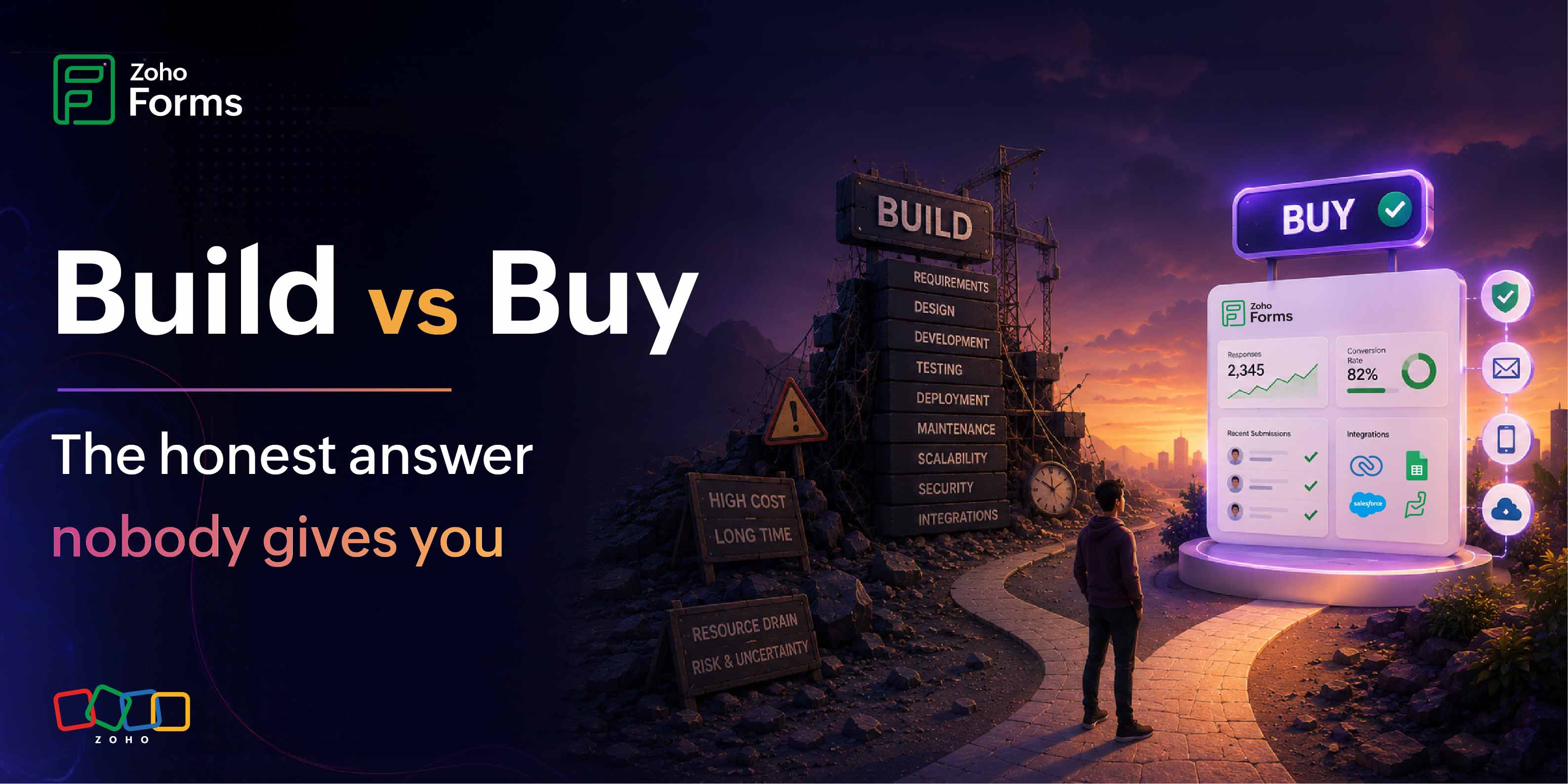
Every product team has seen that one morning when someone says, "We could just build this ourselves."
It sounds empowering. But here's the full, unfiltered truth about the build vs. buy decision.
It starts the same way most of the time.
A product manager walks into a sprint planning meeting with a deceptively simple request: "We need a customer review form on the our website. How long would it take to build?" A developer estimates 2 days. The PM nods. The ticket gets filed.
2 weeks later, the form is live. Yes, it collects submissions.
But...
- It breaks on mobile Safari.
- It has no spam protection.
- It does not send confirmation emails.
- The data lives in a custom table that only an engineer understands.
- And that engineer just put in their notice.
This is the kind of hidden cost of building, not the hours you estimated, but the months you didn't.
The build vs. buy debate isn't really about code. It's about where your team's creative energy should live and what happens when it gets trapped in the wrong problem.
The scale of the problem in cold numbers
Before we dive into the philosophical debate, let's anchor this in data. Because the build vs. buy question isn't just a feelings argument. There's a mountain of research showing exactly what it costs, and almost none of it favors the "let's build it" camp when it comes to commodity infrastructure like forms.
There is $21M average annual SaaS waste per enterprise from poor build vs. buy decisions.
It takes 60 months minimum dev time (5 engineers) to build a basic form builder without conditional logic.
Joyfill's independent analysis confirms that "a simple form builder might seem easy at first, but ensuring it meets modern user expectations demands significant development effort."
Building from scratch
There is something satisfying about building your own tools.
- Full control.
- Custom logic.
- No vendor dependency.
- You own every line.
And when it works, it feels like a superpower. We are not here to dismiss that feeling. It's real.
Full control in practice actually means owning a form ecosystem. Not just a form. An ecosystem of:
- Validation rules for every field type (email, phone, date, file upload, payment)
- Conditional logic that makes the form adapt based on previous answers
- Spam protection
- Confirmation and notification emails with deliverability actually working
- GDPR-compliant consent fields
- Mobile responsiveness across iOS Safari, Android Chrome, and other device variants
- WCAG 2.2 accessibility compliance
- An admin interface your non-technical team members can actually operate
- An analytics layer so you can see drop-off rates and conversion data
The real question no one asks
When engineering teams argue for building their own tools, the debate almost always centers on two things: flexibility and cost. "We need it to work exactly this way." "We'll save money not paying a subscription." These feel like rational, responsible objections.
But the question nobody asks is the one that changes everything: What is the opportunity cost?
Every hour your engineers spend building a form backend is an hour they are not spending on your actual product, the thing your customers pay you for, the thing your competitors are improving right now. You are paying premium engineering talent to rebuild infrastructure that already exists, already works, and already scales.
Factor | Build | Buy (Zoho Forms) |
|---|---|---|
Time to first form | Weeks | Hours |
Maintenance burden | High | Zero |
Unique business logic | Unlimited | Configurable |
Compliance (GDPR etc.) | DIY | Built-in |
Mobile & accessibility | Extra dev work | Included |
Build if your forms are deeply embedded in proprietary systems with complex state management and are so central to your product's core IP that vendor dependency would be catastrophic.
The 5-question decision framework
Before your team files another "let's build it" ticket, run through this five-question test. If you answer yes to three or more, you should be buying, not building.
1. Does this problem already have a mature, affordable SaaS solution?
If the answer is yes and for data collection, it unambiguously is the burden of proof sits with building. You need a compelling reason to reinvent a solved wheel.
2. Is this directly tied to your core competitive advantage?
If a customer can't see it, and your competitors don't differentiate on it, it's infrastructure, not product. Infrastructure is almost always better bought than built.
3. What is the true five-year total cost of ownership?
Include initial build, QA, accessibility compliance, mobile testing, security patching, onboarding new engineers, and the opportunity cost of what else your team could have built. Do this math before committing to build.
4. What happens when the engineer who built it leaves?
Custom code is organizational knowledge encoded in software. When its author leaves, that knowledge partially leaves with them. SaaS tools have documentation, support teams, and communities that outlast any one engineer.
5. How quickly do you need this to be production-ready?
Speed to value is a legitimate competitive advantage. A form your marketing team can launch in two hours is not just a convenience — it's a business capability that doesn't exist until it ships.
What Zoho Forms actually gives you back
Zoho Forms is not a just form builder. It is a data collection infrastructure platform. There is a meaningful difference.
A form builder lets you create a form with fields.
An infrastructure platform handles the entire lifecycle: collection, validation, routing, approvals, compliance, storage, reporting, and integration, all without a single line of custom code.
There's also the compounding effect of Zoho's ecosystem. Zoho Forms connects natively with Zoho CRM, Zoho Desk, Zoho Analytics, Google Sheets, Mailchimp, Salesforce, and thousands of other tools via Zoho Flow.
Beyond just the forms themselves, choosing Zoho Forms is a strategic decision about where your team's attention belongs. When you stop building infrastructure, you gain something more valuable than code: you get focus.
So what should you build?
Build the things your competitors can't copy. Build the product logic that makes your customers choose you. Build the experiences that couldn't exist without your specific insight into your market.
But don't build your form backend. Don't build your submission handling pipeline. Don't build your notification system or your approval workflows. Those problems are solved. Beautifully, reliably, affordably solved.
The engineers who built Zoho Forms have spent years on edge cases you haven't encountered yet. Let them own that problem so you can own yours.
Bottom line
The build vs. buy debate has a clear answer for data collection: buy, almost every time. Not because building is wrong, it's that building the wrong things is wrong. Zoho Forms handles the infrastructure, the compliance, the integrations, and the scale. You handle what only you can build.
Ready to get your team's time back?
 Samhita V
Samhita is a seasoned product expert at Zoho Forms who blends deep product expertise and user education to help businesses make sense of powerful features without the jargon. Known for her thoughtful storytelling and crisp communication, she adds a subtle creative flair to every piece she writes. With a knack for spotting real-world use cases and adding a touch of fun to her narratives, she’s on a mission to make even the most complex workflows feel approachable. Beyond the desk, she channels her creativity into dance and mural art, finding new ways to infuse her surroundings with color, rhythm, and meaning.