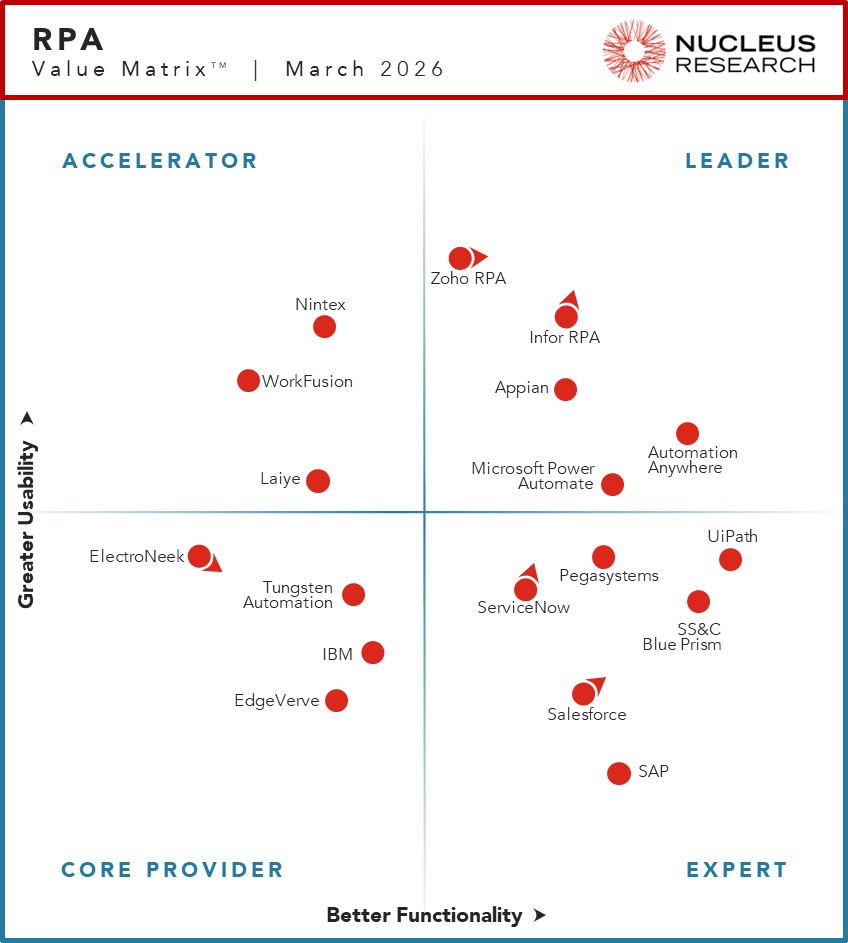
Zoho RPA named a Leader in the 2026 RPA Technology Value Matrix by Nucleus Research

Zoho RPA has been named a Leader in the 2026 RPA Technology Value Matrix, published by Nucleus Research, one of the most respected technology research and advisory firms in the industry. This recognition places Zoho among a select group of vendors that demonstrate both the functional depth and strategic vision required to lead the rapidly evolving robotic process automation market.
Read the full report →
What makes Zoho RPA a Leader?
Zoho RPA is a robotic process automation platform developed natively within the Zoho ecosystem rather than through acquisition or third-party integration. This distinction is important: native development means tighter architectural alignment, consistent user experience, and seamless interoperability with the broader Zoho One suite without the integration overhead or feature fragmentation common in acquired platforms.
At its foundation, Zoho RPA covers interconnected automation capabilities that together enable end-to-end automation across desktop and web environments. The platform also supports region-specific data storage through Zoho-owned data centers, an important consideration for organizations in regulated industries and geographies with strict data residency requirements.
Top 3 features of Zoho RPA that stood out
1. The ability to record and automate
The platform operates through UI-level automation with a built-in recorder that captures user interactions and converts them into structured automation workflows that can be subsequently edited, parameterized, and optimized. This lowers the barrier to automation development, enabling business users and citizen developers to build sophisticated workflows without deep technical expertise.
2. Intelligent document processing
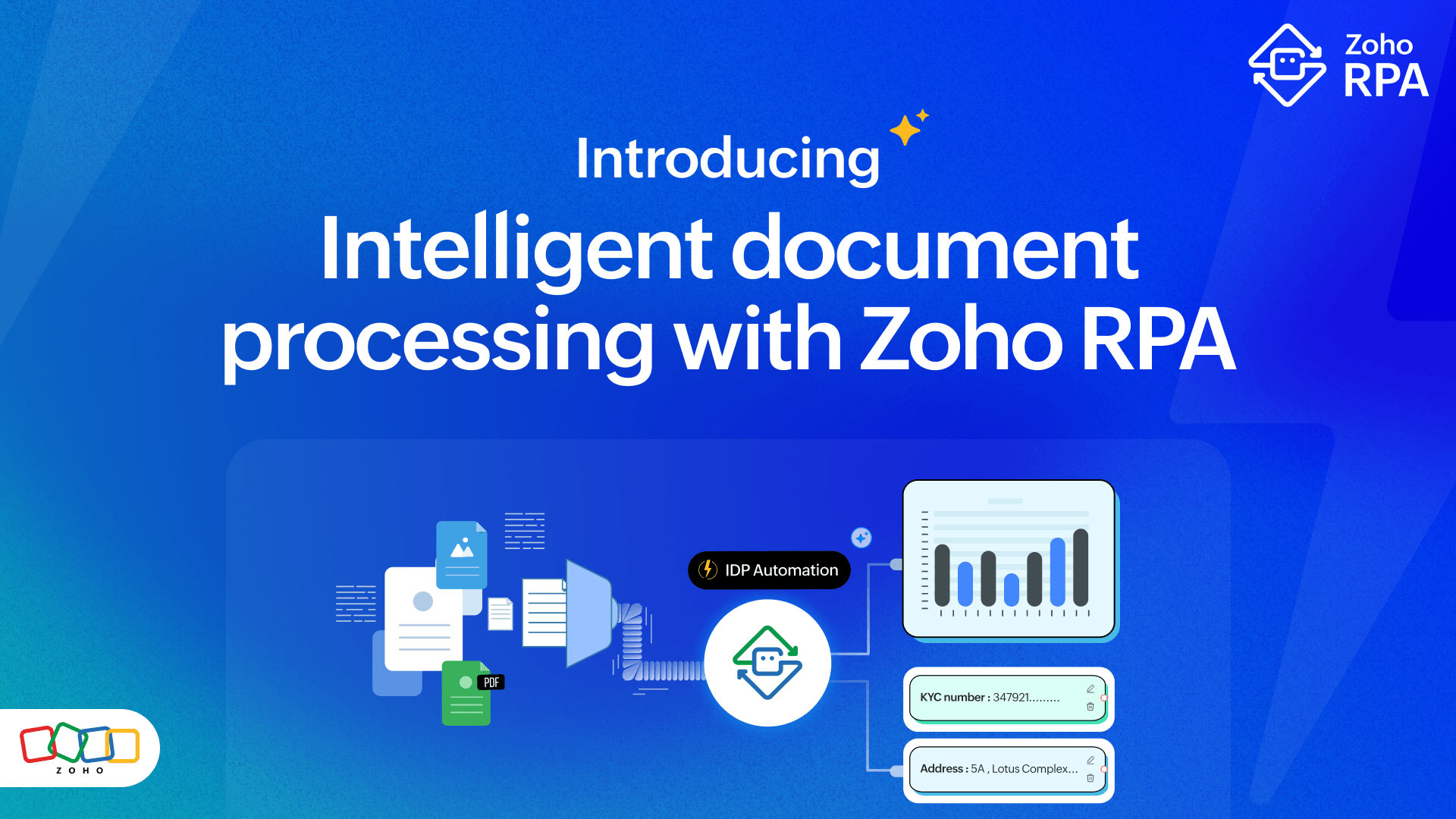
One of Zoho RPA's standout capabilities is its Intelligent Document Processing (IDP) functionality, which uses AI-powered recognition to extract and process data from diverse document types including PDFs, images, and handwritten content. IDP is increasingly critical for organizations seeking to automate document-heavy processes in finance, legal, HR, procurement, and compliance functions.
OCR automation supports three extraction modes:
Full-image extraction for complete document digitization
Specific area targeting for structured form processing
Relative key-based extraction for variable document layouts
PDF automation provides three extraction methodologies:
Keyword-based extraction for contextual data retrieval
Coordinate-based extraction for structured, positionally consistent documents
Table extraction for processing multi-row, multi-column data sets
These capabilities allow Zoho RPA to handle the unstructured and semi-structured data that has historically been difficult to automate expanding the scope of automatable processes significantly.
3. Multi-platform agent support
Zoho RPA supports agents on Windows, macOS, and Linux environments. This cross-platform support is increasingly important as enterprises operate in heterogeneous IT environments and as remote and distributed work models continue to evolve.
How is the evaluation done?
The RPA Technology Value Matrix reflects a market undergoing fundamental transformation. Automation is no longer evaluated on the basis of individual bot deployments or feature checklists; it is assessed through the lens of enterprise-wide impact, seamless orchestration, and verifiable return on investment.
The real differentiators today are how effectively vendors connect RPA to AI agents, how deeply they integrate across enterprise systems, and whether they offer orchestration frameworks that unify bots, human workers, and intelligent services into a cohesive automation fabric.
Conclusion
Nucleus Research's Leader designation reflects a combination of strong usability, depth of functional capability, meaningful AI integration, and a clear path to scalable ROI. Zoho RPA's placement validates its native ecosystem design, intelligent document processing, multi-platform support, and enterprise-grade automation capabilities. If you're interested to learn more in detail, you can download the report here.

Comments