
- HOME
- Procurement
- From purchases to intelligence: Rewiring procure-to-pay for 2026 and beyond
From purchases to intelligence: Rewiring procure-to-pay for 2026 and beyond
For decades, procurement has always been measured by a single question: How much did you save?
In 2026, that question feels almost quaint. Chief procurement officers are now answering to the board on supply chain resilience, to regulators on Scope 3 emissions, to the CFO on real-time spend visibility, and to employees who expect their buying experience to feel like a consumer app.
The macro shift: What's redefining procurement in 2026
The pressure is not coming from one direction. It's coming from all of them at once.
What's changed is the nature of procurement itself. It's no longer a transactional function bolted onto finance. It's a strategic, technology-driven discipline that sits at the intersection of cost, risk, sustainability, and supplier intelligence. The CPOs winning in 2026 are the ones who recognized this shift early and rebuilt their operating model around unified platforms, agentic AI, connected supplier ecosystems, and continuous visibility from requisition to payment.
This article will unpack the forces driving that shift, the framework leading procurement teams are adopting, and the priorities every CPO needs on the table this year.
Forces that are reshaping procurement
Six forces are converging in 2026, and together they're rewriting what "good" procurement looks like.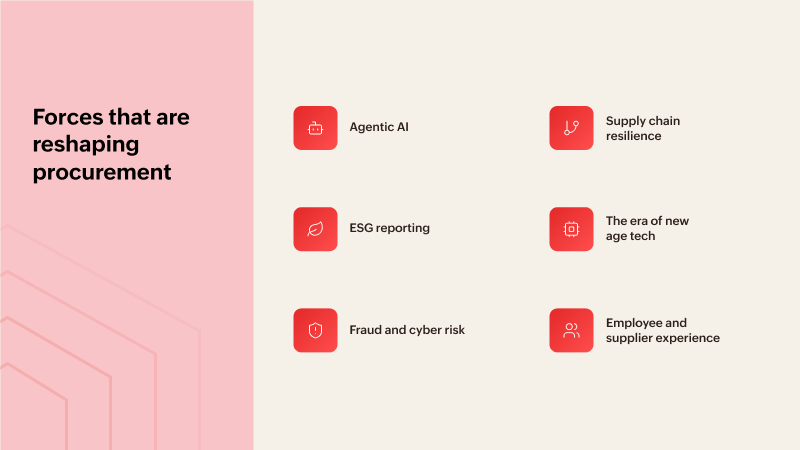
Agentic AI
Agentic AI has moved from pilot to production. Last year, most teams were experimenting with copilots that drafted RFPs or summarized contracts. This year, AI agents are autonomously triaging requisitions, performing three-way invoice matching, flagging maverick spend in real time, and even negotiating routine renewals within pre-approved parameters. The conversation has shifted from "AI-assisted" to "AI-acting."
Supply chain resilience
Supply chain resilience is now a board-level metric. Geopolitical friction, climate disruption, and concentrated supplier dependencies have made resilience as critical as cost savings. Boards are asking CPOs questions they used to reserve for CFOs: What's our exposure to a single-region shutdown? How fast can we qualify an alternate supplier? What share of our critical spend has a documented backup?
Environmental, social, governance (ESG) reporting
Environmental, social, governance (ESG) reporting has become audit-ready. With CSRD in Europe, tighter SEC climate disclosures in the US, and similar regimes emerging in Asia-Pacific, procurement is now responsible for sourcing the Scope 3 emissions data that finance has to publish. Suppliers who can't provide verifiable emissions, certifications, and diversity data are being sometimes deprioritized silently, sometimes formally.
New age technology
In the era of new age tech, the standalone P2P stack is dying. The era of bolting together best-of-breed tools one for sourcing, one for invoicing, one for supplier management is ending. The cost of integration, data reconciliation, and user training has caught up with the promise. Unified platforms are winning because they eliminate the seams where data breaks and workarounds breed.
Fraud and cyber risk
Fraud and cyber risk now live inside procurement. With business email compromises, fake vendor invoices, and payment redirection scams, procurement is one of the most-targeted functions for financial fraud; generative AI is making the attacks more convincing. Vendor master data has become a security perimeter.
Employee and supplier experience
Employee and supplier experience are competitive advantages. Requesters expect buying to feel like a consumer app. Suppliers especially in tight markets increasingly choose who to prioritize based on payment reliability and onboarding friction. The procurement team's relevance now depends on how invisible it can make itself for the routine 80% while focusing human judgment on the strategic 20%.
These six forces don't operate in isolation. They reinforce each other. Resilience requires visibility. Visibility requires unified data. Unified data requires a single platform. A single platform unlocks AI. AI delivers the speed and insight that ESG, fraud detection, and self-service buying all demand.
The 2026 procure-to-pay framework: Building an intelligent procurement ecosystem
The leading procurement teams in 2026 are organizing their P2P lifecycle around four connected layers. Each layer reinforces the others, and together they form what we call the intelligent procurement ecosystem.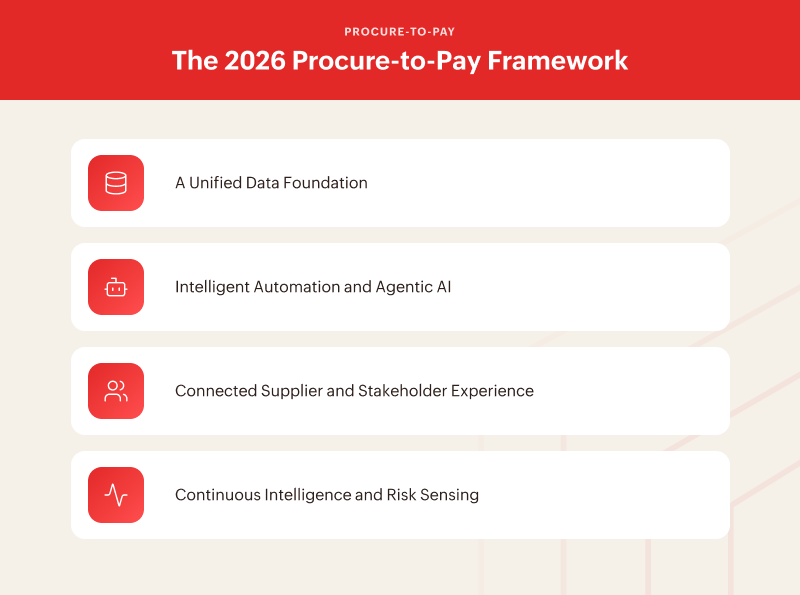
A unified data foundation
Everything starts here. One supplier record. One contract repository. One PO. One invoice trail. One source of truth is from requisition through payment. Without this, AI has nothing reliable to act on, dashboards lie, and audit trails fracture. The single most important architectural decision a CPO makes in 2026 is whether their data model is unified or stitched together.
Intelligent automation and agentic AI
On top of a unified data foundation, AI agents handle the high-volume, low-judgment work: invoice matching, vendor onboarding checks, catalog management, anomaly detection, contract renewal triage. Humans handle exceptions, strategic sourcing, and supplier relationships. The split isn't AI versus people, it's AI doing the work that doesn't need a person, freeing people to do the work only they can do.
Connected supplier and stakeholder experience
Suppliers self-serve their onboarding, invoicing, and payment tracking. Requesters use guided buying with pre-approved catalogs and embedded policy checks. Approvers see only the genuine exceptions. Finance sees real-time spend. Everyone works in the same system with the same data. Friction at the seams disappears because the seams disappear.
Checkout our ultimate guide to supplier management to get broader view on the best practices for supplier onboarding and stakeholder experience.
Continuous intelligence and risk sensing
The ecosystem doesn't sleep between quarterly reviews. Spend dashboards update in real time. Sanctions and adverse-media screening run continuously, not just at onboarding. Supplier risk scores adjust as news breaks. ESG data flows automatically into sourcing decisions. The procurement function is always on, always watching, and always learning.
These four layers describe the destination. Most procurement organizations in 2026 are somewhere on the journey, not at the start, not at the finish. The point of the framework is to give CPOs a clear way to assess where they are and what to build next.
What CPOs must prioritize in 2026
Frameworks are useful, but priorities are what get funded. Here's what CPOs need on their roadmap this year in roughly the order most teams should tackle them.
Consolidate the stack. Audit how many systems a single PO touches today. If the answer is more than two or three, you're paying for integration complexity that a unified platform would eliminate. Stack consolidation is the prerequisite for almost everything else on this list.
Build AI guardrails before you build AI use cases. Define which decisions an agent can make autonomously, which require human approval, and how exceptions are escalated. Start with high-volume, low-risk workflows like three-way matching and vendor onboarding before moving to anything that touches negotiation or strategic sourcing.
Map your supplier risk beyond tier one. For your top 20% of spend, build multi-tier supplier visibility, qualify backup suppliers before you need them, and run quarterly disruption simulations. Resilience is a capability you develop in peacetime, not in crisis.
Embed ESG into onboarding, not annual reviews. Capture emissions data, certifications, and diversity attributes at the point of vendor registration so data flows into every downstream sourcing decision automatically. Retrofitting ESG into spend analytics in Q4 is the slowest, most expensive path.
Redesign intake around the requester. Pre-negotiate catalogs for the top 80% of recurring purchases, embed policy checks into the request form, and route only genuine exceptions to procurement. The goal: 90% of routine purchases should never need a procurement team member to touch them.
Demand real-time spend visibility through live dashboards across category, supplier, business unit, and contract compliance. The most valuable number isn't last quarter's savings; it's the spend that's about to happen and whether it's on contract, on budget, and on policy.
Harden vendor master data as a security perimeter. Enforce dual-control on bank detail changes, run continuous sanctions and adverse-media screening, and use anomaly detection on invoice patterns. As AI lowers the cost of fraud, your controls have to keep pace.
Measure supplier experience the way product teams measure customer experience time-to-onboard, invoice-to-pay cycle time, supplier-reported friction. Suppliers who can self-serve cost less to manage and stick around longer. In tight markets, that's a real advantage.
Future of procurement: Connected, intelligent, and continuous
If you look past 2026 and ask where this is all heading, three words capture the direction: connected, intelligent, and continuous.
Connected. The boundaries between procurement, finance, supply chain, and risk are dissolving. So are the boundaries between buyer and supplier. In the future, a supplier's emissions data, financial health, delivery performance, and risk score are all visible inside the same system where a requester drafts a PO, because they're the same data.
Intelligent. Agentic AI will keep absorbing routine work. The procurement team of the future is smaller in headcount but higher in leverage, orchestrating AI agents, owning supplier relationships, and making the judgment calls that machines can't. The human role doesn't disappear; it concentrates on the parts that actually need a human.
Continuous. Procurement stops being a series of episodic events—quarterly reviews, annual RFPs, monthly closings—and becomes an always-on function. Spend is monitored continuously. Risk is screened continuously. Suppliers are evaluated continuously. The cadence of procurement matches the cadence of the business it serves.
This isn't a five-year vision. The platforms, the data, and the AI to deliver it exist today. What separates the leaders from the laggards is whether they've made the structural decisions unified platform, clean data, and clear AI guardrails that let them act on it.
Conclusion
The procurement function in 2026 is being pulled in more directions than ever before—cost, risk, resilience, sustainability, fraud, experience, speed. The temptation is to treat each pressure as a separate initiative, each with its own tool, its own owner, and its own dashboard. That path leads to the fragmented stacks and brittle workflows that defined the last decade.
The CPOs who will lead this year are taking the opposite path. They're consolidating onto unified platforms, building data foundations that AI can actually use, and designing P2P workflows that are connected, intelligent, and continuous by default. They're not chasing trends one at a time. They're rebuilding the function so every trend becomes easier to absorb.
That's the foundation Zoho Procurement is built on a unified source-to-pay platform connecting requisitions, purchase orders, vendor management, invoices, and payments in a single data model. It's one source of truth, with the automation, visibility, and controls modern CPOs need to deliver on every priority outlined in this article.
The procurement teams that will win in 2026 aren't necessarily the ones with the biggest budgets or the largest teams. They're the ones who've stopped tolerating friction.