- HOME
- Expense Management
- What is mileage reimbursement? 2026 rates & how to calculate
What is mileage reimbursement? 2026 rates & how to calculate
Mileage reimbursement sounds simple: multiply the miles driven for business by a fixed rate. But in 2026, there's an important detail employees and employers need to account for. The IRS increased its business mileage rate from 72.5 cents to 76 cents per mile effective July 1, changing how reimbursements must be calculated for trips taken throughout the year.
Whether you're an employee claiming travel expenses or an employer managing mileage reimbursements, knowing which rate applies, what expenses it covers, and what records to maintain can make a real difference. Here's a breakdown of the 2026 mileage reimbursement rates, how to calculate them, and how to make mileage tracking easier.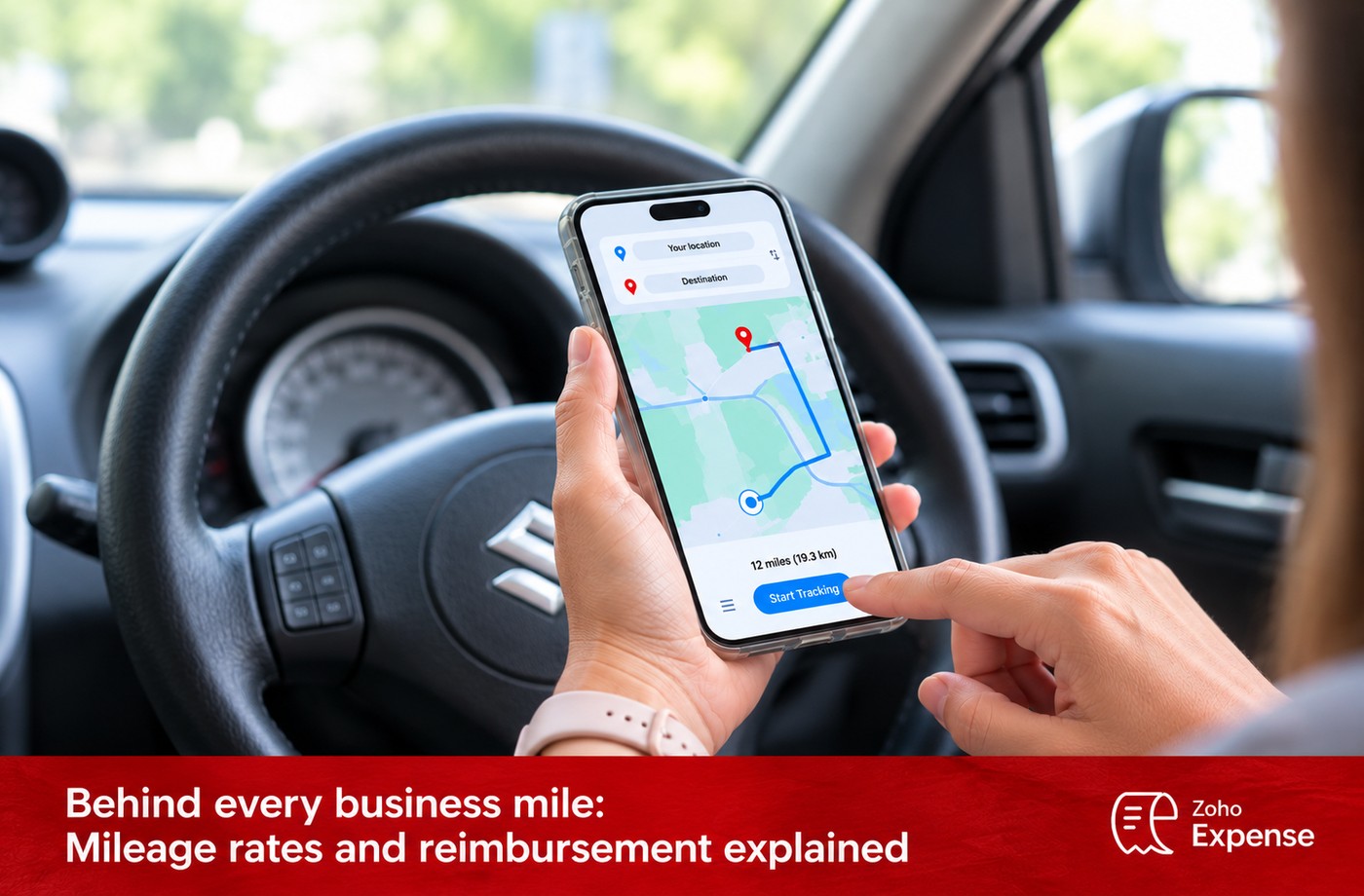
What is mileage reimbursement?
Mileage reimbursement is money an employer pays an employee for using a personal vehicle for business travel, calculated by multiplying business miles driven by a set per-mile rate. If your employer reimburses at the current IRS rate of $0.76 per mile and you drive 500 business miles, you receive $380.
The arrangement exists because employees would otherwise personally absorb the fuel, maintenance, insurance and depreciation costs of driving their own car for the company. Reimbursement moves that caost back to the business, where it belongs.
Eligible business mileage typically covers driving to visit clients or customers, traveling between company locations, attending off-site meetings, visiting job sites, making business deliveries, and traveling to conferences. What it does not cover is the daily commute. Under US tax rules, driving between your home and your regular workplace is personal travel, not business travel, no matter how far it is. This single distinction accounts for most rejected mileage claims.
Employers are free to design their own policy. Most apply a flat per-mile rate; some use an actual-expense method that reimburses documented vehicle costs instead.
What is the mileage reimbursement rate for 2026?
The 2026 IRS business standard mileage rate changed mid-year: 72.5 cents per mile from January 1 through June 30, and 76 cents per mile from July 1 through December 31. The increase came through Announcement 2026-11, which modified Notice 2026-10, and it was the first mid-year revision the IRS has made since 2022.
Fuel drove the change. AAA data showed the national average gasoline price climbing from $2.819 per gallon on January 8 to $3.890 by July 15, a roughly 38% increase over six months, which the IRS cited as the reason for adjusting the rate outside its normal annual cycle.
Purpose | Jan 1 – Jun 30, 2026 | Jul 1 – Dec 31, 2026 |
Business | 72.5¢ | 76¢ |
Medical / moving | 20.5¢ | 23.5¢ |
Charitable | 14¢ | 14¢ |
For context, the business rate was 70 cents per mile in 2025 and 67 cents in 2024. The rate applies to cars, vans, pickup trucks and panel trucks, and treats gasoline, diesel, hybrid and fully electric vehicles identically.
One distinction matters here. The IRS standard rate is a federal figure; your employer's reimbursement rate is a policy decision. Most companies adopt the IRS rate because reimbursing at or below it keeps the payment out of taxable wages under an accountable plan, but no rule forces them to.
How to calculate mileage reimbursement
Multiply eligible business miles by the applicable reimbursement rate. An employee who drives 750 business miles in the second half of 2026 at the IRS standard rate receives 750 × $0.76, or $570.
{Reimbursement} = {Business miles} * {Rate per mile}
The complication in 2026 is the July 1 rate change, and it is where most claims go wrong. You cannot apply one blended rate to a period that spans the change. Miles have to be separated by trip date and priced at the rate in force on the day they were driven.
Take an employee with 1,200 business miles for the year, 700 of them before July 1 and 500 after. The correct calculation is 700 × $0.725 = $507.50, plus 500 × $0.76 = $380.00, for a total of $887.50. Applying $0.76 to all 1,200 miles produces $912 instead, over-reimbursing by $24.50. Under an accountable plan, that excess has to be returned or treated as wages, so the shortcut creates a payroll problem rather than saving time.
With multiple trips, each is priced individually and then totaled. Three trips of 125, 180 and 95 miles in the second half of the year come to $95.00, $136.80 and $72.20 respectively, or $304.00 across 400 miles.
Need a quicker way to estimate your reimbursement? Use our mileage reimbursement calculator to calculate business mileage costs using the applicable reimbursement rate.

How mileage reimbursement works, and what the rate covers
The process is consistent across most companies. An employee drives for an eligible business purpose, records the trip, and submits it; the company applies its rate, reviews the claim against policy, and pays. A sales representative who drives 350 miles visiting customers in September 2026 submits those miles and receives $266.
What makes that payment tax-free is the structure behind it. Under an IRS accountable plan, three conditions apply: the expense must have a business connection, the employee must adequately account for it within a reasonable period, and any excess reimbursement must be returned. Reimbursements that meet these conditions are generally not treated as wages. Arrangements that do not meet them generally are.
The standard rate is widely misunderstood as gas money. It is not. The IRS builds the business rate from an annual study of the total cost of operating a vehicle, combining fixed costs such as depreciation, insurance and registration with variable costs such as fuel, oil, tires and repairs. Fuel is one input among several, which is precisely why a 38% move in gasoline prices was enough to force a mid-year revision of a figure that normally changes only in January.
The practical consequence is that if you use the standard mileage rate, you cannot separately claim fuel, repairs, insurance or depreciation for the same miles. Those costs are already inside the rate. Tolls and parking fees are the exception. They sit outside the standard rate and can generally be claimed in addition, subject to the applicable rules and your company's policy.
What a mileage log needs
A mileage log is the record that substantiates a business trip, and it needs five things at minimum: the date, the starting point, the destination, the business purpose, and the miles driven. Business purpose is the field most often left blank and the one most often questioned, because miles alone never explain why a trip happened.
The IRS standard is that transportation expenses be supported by timely, accurate records rather than estimates. A log written the day of the trip carries weight that one reconstructed in April does not. This is the real argument for a mileage tracking app over a spreadsheet: not convenience, but the fact that GPS-based tracking produces a contemporaneous record automatically, while a spreadsheet updated monthly produces a reconstruction from memory. A tracker also applies the correct rate by trip date, which in 2026 means it handles the July 1 split without anyone remembering to.
Mileage reimbursement vs. car allowance
Mileage reimbursement pays for actual miles driven; a car allowance pays a fixed sum regardless of them. An employee driving 5,000 business miles receives $3,800 under reimbursement at $0.76 per mile, while a $500 monthly car allowance pays $6,000 whether that employee drives 200 miles or 20,000.
The difference that matters is tax treatment. A car allowance that is not structured under an accountable plan is generally treated as taxable wages in full, which means the employee nets substantially less than the headline figure. Reimbursement at or below the IRS standard rate under an accountable plan generally is not taxed. Structure either arrangement against current IRS guidance with professional advice.
Make mileage reimbursement easier with Zoho Expense
Calculating mileage manually gets complicated when employees make multiple trips, reimbursement rates change, and finance teams have to verify every claim. Zoho Expense simplifies this process with automatic mileage tracking and reimbursement calculations.
Employees can track business trips using GPS or enter trip details manually. Zoho Expense calculates the distance traveled and applies the configured mileage reimbursement rate to determine the claim amount. Finance teams can review mileage expenses, enforce company policies, and process reimbursements through the same platform.
Instead of managing mileage logs and calculations across spreadsheets, businesses can track, calculate, and reimburse employee mileage in one place.
Frequently Asked Questions on Mileage Reimbursement
Not under an accountable plan. Reimbursements at or below the IRS standard rate that meet the accountable plan conditions are generally not treated as taxable wages. Reimbursements under a non-accountable plan, and amounts paid above the standard rate, generally are taxable.
For business use, 72.5 cents per mile from January 1 through June 30, 2026, and 76 cents per mile from July 1 through December 31, 2026.
Multiply eligible business miles by the applicable rate. At the current rate, 600 miles × $0.76 = $456.
The standard rate accounts for the total cost of operating a vehicle, including fuel, depreciation, insurance and maintenance, not fuel alone. You cannot claim those costs separately if you use the standard rate. Tolls and parking are handled separately.
Split them by trip date. Miles driven before July 1 are reimbursed at $0.725, miles from July 1 onward at $0.76. A blended rate across the change will over- or under-reimburse.
Can I use a mileage tracker app instead of a mileage log?
Yes. A tracking app is a mileage log kept digitally, and it satisfies recordkeeping requirements as long as it captures the date, start point, destination, business purpose and distance.
No. Driving between home and your regular workplace is personal travel under US tax rules, regardless of distance.
Yes. An employer sets its own policy, but the tax treatment depends on how the arrangement is structured. Reimbursing above the IRS standard rate generally makes the excess taxable to the employee.