Half of all CRM implementations fail; here's how to make sure you're on the winning side
- Last Updated : October 12, 2026
- 8 Views
- 8 Min Read

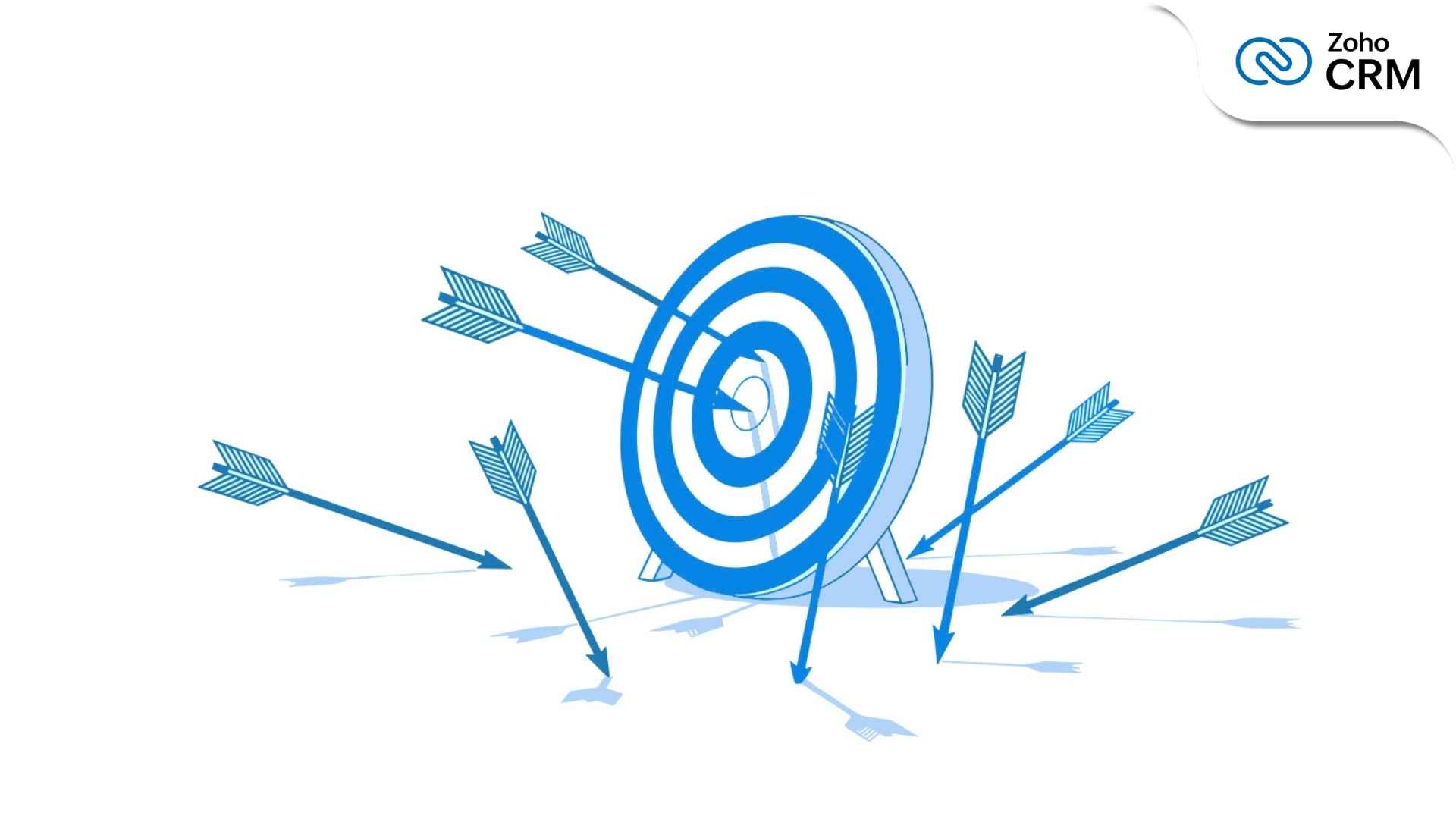
Adopting a new CRM, or migrating to a new one, with all your customer data and workflows intact, is no small feat. Technical complexities aside, the financial investment in purchasing a CRM is huge, making this process a risky move for businesses. Despite the high stakes, many CRM implementations fail. In fact, Forrester estimates put this number somewhere between 30% and 70%, averaging at 50%.
Even CRM implementations that look great on the surface can hide underlying issues, such as poor integrations with sales applications, poor adoption, bloating, or too much or too few customization capabilities, and end up running in parallel to shadow spreadsheets.
So the math here is simple: CRM implementations that fail do so at the onset, or they slowly fade into oblivion until the next CSO takes charge and decides to implement a new CRM, starting the cycle all over again.
In this blog, we're going to break down the top reasons why CRM implementations fail, and share how to avoid the trap by making a few practical changes.
Top reasons why CRM implementations fail and what you can do about it:
Choosing the wrong CRM
Finding one CRM that fits all your business requirements is impossible. A CRM with endless features might end up becoming a money guzzler when your sales team uses only one-tenth of those features; another CRM that's lightweight with an easy-to-use UI might struggle to support diverse sales needs; and a CRM that has all the right features and simple UI might not scale to meet enterprise demands. Whatever CRM you choose, the application must fit around your unique business process, and not force you to change the way you sell.
Do this instead: Off-the-shelf CRMs rarely accommodate a business' unique operational needs. Instead, choose a CRM that covers your core sales needs, and customize the rest on top of its platform. For example, if you're in manufacturing, you need a CRM that offers capabilities for sales, service, and channel partner management. So choose a CRM that offers great sales features and supports partner portals; the service part of your operations can be managed by integrating that CRM with your help desk application.
Migrating with bad data
Missing fields, incorrect data, and duplicate entries that creep into a new CRM during migration breaks it almost instantly. But its effects aren't visible until you start reporting on that data. Once you do, you notice revenue numbers don't quite add up and forecasts are always wrong.
Do this instead: Fix your data before moving it into a new CRM. Run validation checks to weed out incomplete fields, scan for duplicates, and verify existing data for accuracy before migrating to a new CRM.
Stuffing random customization
Customizations help mold the CRM around your business process—but what happens when customization becomes the go-to solution for every need, without checking for native solutions? If you need a process flow, customize it via code; if you need a module to manage products and its spare parts, customize one.
The result is a CRM with overly-customized capabilities that exist alongside equivalent native functions.
Do this instead: Establish a rule: Customization is for competitive differentiation; in all other cases, configure standard functionalities. This keeps your CRM from becoming a Frankenstein system with patched-up custom functionalities.
Integration debt
Your CRM is a system that needs to work in tandem with all the apps in your tech stack. Without integrations with legacy systems or enterprise apps, work gets interrupted.
Do this instead: Include the middleware when estimating the cost of your CRM. In cases where native integrations aren't available and you rely on native on API connections, take into account API rate limits. Where MCP is used to connect the AI layer with your software, consider the total cost. This way, nothing gets missed and your CRM will operate as one ecosystem of connected apps.
Continuing with old sales processes and workflows
Picture this: Before the CRM upgrade, your sales team used to export leads from ad platforms into the CRM manually. After the upgrade, your sales team continues to follow the same process, even when the new CRM integrates with all the ad platform directly.
Antiquated sales processes and workflows must be retired to make way for new processes that make work easier and faster.
Do this instead: Map salespeople's daily activities, perhaps even by drawing it on a whiteboard. Identify areas where automation can replace manual work; include approvals and manual intervention wherever needed, then replicate the map as workflows in the new CRM.
Treating automation as the silver bullet
After buying a CRM, it can be tempting to solve every problem with automation. Got a lead from social media? Trigger an instant sales pitch. Prospect doesn't make a purchase even after three months? Trigger a nurturing sequence from all channels. A customer reaches out for support? Put them through a bot sequence first. Over-automating de-humanizes your sales efforts, draining your sales pipeline, and renders your CRM ineffective.
Do this instead: Strike a balance between human interactions and automation-driven efficiency. Automation shouldn't erode the quality of human interactions or make it difficult for customers to reach you.
Cluttered CRM views
A customer calls to repeat a bulk order. Your salesperson opens up the CRM and finds 17 custom fields, three different shipping addresses, and notes from a dozen sales reps. By the time he scrolls to find the products section, it's been two minutes. Sound familiar? More data isn't always good. When your CRM pages are abundant with information, finding the right information can prove to be a headache.
Do this instead: Create role- or profile-based conditional layouts in your CRM so that each person's view is customized to help achieve their goals. Give your sales reps the freedom to customize their views to make selling easier.
Alternately, Zoho CRM offers Canvas, the first-ever design studio, which enables users to create custom views and design every square inch of what they see on their CRM screens.
Data security
Implementing a CRM, opens up another gateway for your customer data. Securing it with necessary roles and permissions becomes critical. There are two types of risks involved. First, access given to personnel involved in the implementation never gets revoked. Second, access permissions and roles never evolve beyond the initial setup.
Do this instead: Revoke temporary access to all CRM users as soon as you complete implementation. SSO-based authentication and MFA ensure only trusted, intended users access your CRM. As companies grow, so do the number of roles—and the permissions associated with each role. As a rule, prepare a role-based hierarchy and plan the level of permissions associated with those roles. Adhere to the rule anytime a rep is onboarded to the CRM.
CRM built for reporting, not selling
CRM implementations are often driven by top management, which means CRMs are often chosen based on reporting needs and not sales needs. Although leadership therefore gets to see forecasts and pipelines, the sales team hates the CRM—because the system that was supposed to help them sell better and easily slowly becomes a surveillance tool. Reps will therefore use the CRM, but only just enough to fill it with data to avoid scrutiny. The real work—that is, big deals that take months to close, or renewals that require additional convincing—are all handled in a parallel with the CRM, either in spreadsheets or—worse—on sticky notes.
Do this instead: If you're setting up the CRM, configure it to make salespeople's lives easier. If you've already set up the CRM, re-design it to deliver outcomes. As for reporting, instead of merely chasing forecasts, track the metrics that give you an idea of revenue-generating sales activities.
No CRM success metrics
CRM implementations often don't have well-defined success metrics beyond the "grow revenue" metric. In fact, CRM implementations themselves are treated as success metrics. Without measuring things like increase in CRM usage, time spent on each activity, time to first contact, etc., there is no way to tell if CRM implementations are truly successful.
Do this instead: When implementing a CRM, create a dashboard to track CRM success metrics. The objective of the dashboard isn't to track the actual sales but to track how they sell.
Create a post-launch operating model, complete with CRM training and certification schedules, CRM usage audits, and security audits. Collaborate with your vendor or implementation partner, or hire an external consultant to evaluate your CRM usage and tell you how you can sell better. The best partner to do this with is always your account manager who has your best interests in mind.
What it takes for successful CRM implementations
CRM implementations rarely fail due to technical shortcomings. Most CRM applications available in the market are technically sound. It's up to each individual business to find the right CRM that fits their business needs with minimal customizations.
Implementation failures are often a result of poorly-defined objectives, bad, incomplete, or inaccurate data, no change ownership, not designing the CRM around sales needs, not designating a decision-making authority, migrating existing CRM problems into the new CRM, or lacking post-implementation success tracking.
CRM implementations can be successful when they begin with clear objectives, well-defined ownership with decision-making authority, migrating only clean data into the CRM, and continuously tracking implementation success years after the initial go-live.
Here's how you can succeed with Zoho CRM
Zoho CRM offers a rich feature set to address most of the problems discussed above. Let's explore how you win when you implement Zoho CRM:
| CRM implementation pitfalls | How Zoho CRM helps you avoid them |
| Choosing the wrong CRM |
|
| Bad data |
|
| Random customizations |
|
| Integration debt |
|
| Cluttered CRM pages |
|
| Data security |
|
| CRM for reporting, not sales |
|
Why Zoho CRM is worth a look
We've explored why CRM implementations fail, whether they occur at the onset or happen gradually over time. Zoho CRM takes a different approach by giving you complete control to navigate around these pitfalls so that your CRM implementation succeeds. With different pricing tiers to suit various business needs, an interface that has a short learning curve, and integration capabilities that connect your entire tech stack and turn it into one connected unit, Zoho CRM offers an alternative to businesses that want to get up and running immediately.
Still wondering if Zoho CRM is the right option for your business? Sign up for free and find out.