

- HOME
- Financial Management
- How to manage cash flow for small businesses in the UK
How to manage cash flow for small businesses in the UK
Late payments alone cost the UK economy £11 billion every year, according to the Small Business Commissioner. It also estimates that around 14,000 businesses close in the UK each year, and poor cash flow is one of the most cited causes. Many of those businesses were profitable. The problem was not what they earned, it was when the money arrived relative to when it was needed.
Cash flow management is how you close that gap. This guide covers both sides: how to get money in faster and how to keep tighter control over what goes out.
What is cash flow management?
Cash flow is the movement of money into and out of your business over a given period. When more comes in than goes out, you are in positive cash flow. When the reverse is true, you are in negative cash flow. The distinction that trips up most business owners is that cash flow is not profit. Profit is calculated when an invoice is raised. Cash flow is what is physically in your account (working capital) to use when you need it. A business can show strong revenue on paper and still be unable to pay its staff, because the invoices it has raised have not been paid yet while the week's payroll is due today.
Why small businesses are the most affected by mismanagement
Large businesses absorb it more easily. They have credit facilities, finance teams, and enough clients that one slow payer does not destabilise the whole operation. Small businesses rarely have any of those. A single invoice sitting 45 days overdue can represent the difference between making payroll and missing it.
The dynamic is made worse by the imbalance in negotiating power. Small suppliers frequently accept 60- or 90-day payment terms from large clients because they do not want to lose the contract. The result is that you are effectively extending interest-free credit to organisations, while running on tight margins themselves.
In a small business, the owner is often also the one delivering the work, managing clients, and doing the books. Cash flow tracking gets deprioritised in a busy week, invoices go out late, follow-ups get missed, and by the time the pattern surfaces, the shortfall has already hit.
Monitoring: What is a cash flow statement & how is it calculated?
A cash flow statement is a financial report that shows exactly how much cash entered and left your business over a given period, and where it came from or went to. Unlike your profit and loss report, which records income when an invoice is raised, the cash flow statement only counts money that has actually moved. It is broken into three sections.
Operating activities: Cash generated from the day-to-day running of the business. Client payments coming in, and costs like rent, payroll, and supplier payments going out.
Investing activities: Cash tied up in or released from longer-term assets. Buying equipment or a vehicle sits here, as does selling an asset you no longer need.
Financing activities: Money moving between the business and its lenders or owners. A bank loan drawn down, a director's investment into the business, or a loan repayment going out.
Calculating cash flow
Start with your net profit for the period. Then adjust for anything that affected profit but did not actually move cash: an invoice you raised but have not collected yet, a depreciation charge on equipment, a loan repayment that reduced your bank balance without touching the P&L. What remains after those adjustments is your true cash position for the period.
Done manually, this takes time and is easy to get wrong. Most successful small businesses rely on accounting software that gets this done in no time and is always available with updated numbers for review.
Zoho Books generates your cash flow statement automatically, alongside the invoicing, expense tracking, and bank reconciliation data that feed into it.
Where to start
Cash flow has two sides.
Money enters the business through sales and client payments. Money leaves through expenses like rent, payroll, suppliers, tax, and subscriptions. Your job is to manage both ends, speed up and increase what comes in, control what goes out, and keep enough in the middle to cover the gap between them.
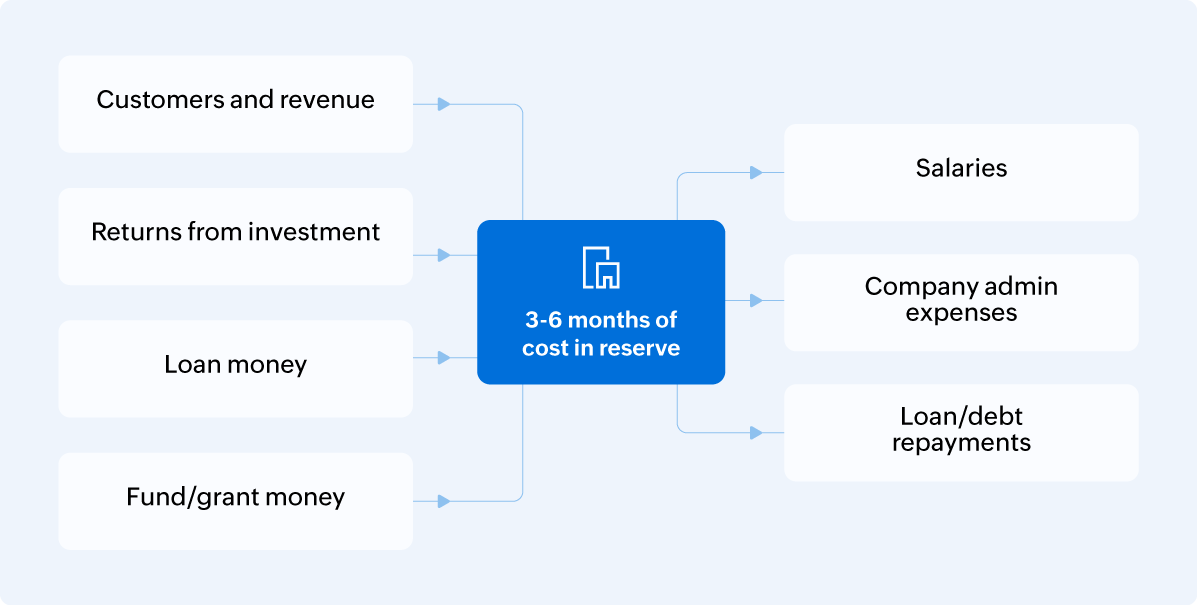
The sections below address each side through the processes you put in place, the systems you use, and the culture you build around money inside your business.
Increasing and maintaining income
Processes
Clear contract terms
Cash flow management starts before you sign a deal. The payment terms, late fees, milestone structures, and dispute clauses you agree to upfront determine how much control you have over cash flow for the entire duration of that contract. A client who agrees verbally to 14-day terms but signs a contract stating 60 days will be entirely within their rights to pay in 60 days. You should ensure that the terms are set in writing before the work starts.
Invoice on the day work is completed
A business that batches invoices at month's end, for work completed in the first week, has handed its clients two to three weeks for free. So, send the invoice the same day. It should include the due date, the amount owed, and your bank details. Leaving no room for a client to claim they were unclear on when payment was expected is important to reduce delays.
Shorten payment terms
Thirty-day terms have become the default, which means many clients treat them as a floor rather than a target.
Where the relationship allows, 14-day terms move cash in faster.
One tool many small businesses overlook is the Late Payment of Commercial Debt Act, 1998. This entitles UK businesses to charge statutory interest on overdue invoices automatically. This is 8% above the Bank of England base rate, plus a fixed compensation of £40 to £100 per invoice, depending on its value. No contract clause is required. Referencing the Act in your payment terms alone changes how seriously clients treat your deadlines. There is a new bill being discussed, aimed at benefiting small businesses being impacted by late payments, too. Read more on the late payment charges here.
Follow up on a fixed schedule
A reminder a few days before the due date catches clients who have simply forgotten. A short, factual message on the day an invoice becomes overdue catches most of them. Most invoices are settled during this window, before any escalation is needed.
The key here is consistency, because ad hoc chasing lets invoices slip. A defined schedule, reminders before a due date, follow-ups on the due date, and escalation after seven days, means nothing slips your eye.
Offer an early payment incentive
A 1–2% discount for settlement within 7 days often costs less than the interest on a short-term overdraft taken to cover the same gap .
It may not be appropriate for every relationship, but incentives are worth considering for accounts that have a consistent pattern of slow payment.
Systems
Automate payment reminders
Cloud accounting software sends payment reminders on schedule without anyone needing to act on them manually. That removes the most common reason overdue invoices go uncollected: someone intended to follow up but did not get to it.
Add preferred payment options
Every additional step between a client receiving an invoice and being able to pay it adds friction. Invoices with embedded payment links, bank transfer, card, or direct debit options are settled faster than those requiring clients to take separate actions.
Use ageing reports
An ageing report shows every outstanding invoice sorted by how long it has been unpaid. It turns a vague awareness that some clients are slow into a specific, ranked list you can act on that day. Most accounting platforms generate these automatically.
Cash flow forecasting
Accounting software records what has already happened. A forecasting tool shows what is likely to happen over the next 30, 60, or 90 days. Connecting your invoice pipeline, recurring costs, and payment history gives you a projected cash position before a shortfall actually arrives, which is the only point at which you still have options.
Bank feed integration
Manually reconciling transactions is where errors creep in and where business owners lose hours they do not have. A live bank feed connected to your accounting software means your cash position is always current, without anyone needing to update it. What you see in the software matches what is in the account in real time.
Culture
Treat collecting payments as part of delivering the work
Many owners feel awkward chasing invoices, but the mindset shift is absolutely necessary; a completed job is not the finish line. The cash in the account is. Businesses that collect the fastest, chase late payments promptly and without hesitation.
Avoid dependence on one or two clients
A business with two large accounts making up most of its revenue is exposed in a way that is invisible until one of them has a difficult quarter. Spreading income across more clients, or adding a retainer or subscription element, reduces the cash flow impact of any single account paying late.
Here's a breakdown of things you can do to ensure prompt payments:
Action | What it fixes | Implementation effort |
Invoice same day | Removes delay before payment clock starts | Low |
Shorter payment terms | Gets cash in faster | Low–medium |
Reference Late Payment Act in terms | Creates perception on how seriously deadlines are treated | Low |
Automated reminders | Ensures every invoice is chased | Low (one-time setup) |
Ageing reports | Prioritises what to chase and when | Low–medium |
Online payment links | Reduces friction between invoice and payment | Low |
Early payment discount | Speeds up slow accounts | Medium |
Client diversification | Reduces exposure to single late payers | High |
Checking spending
Processes
Run a monthly cost audit
List every recurring outgoing payment including rent, payroll, insurance, software licences, subscriptions, and supplier contracts and check each against what the business actually used last month.
There could be instances where the software seat for a person who left three months ago is still running, or a subscription for a service that made commercial sense at launch but does not any more. The reason they escape scrutiny is because they are minor and only show their true colours when compounded.
Align when you pay with when you are paid
Where suppliers offer flexibility on payment dates, negotiate terms that correspond with when your own clients typically pay you. The goal is to avoid cash leaving the account before it has arrived.
Review your cash position weekly if possible
Businesses that manage cash flow well treat it as a routine check, not a crisis response. A weekly scan of what is due in and due out over the next 30 days catches problems while there is still time to address them. By the time a shortfall shows up in a quarterly review, the options are significantly narrower.
Systems
Keep business and personal finances separate
For sole traders, mixing personal and business accounts is one of the most common early mistakes. Without a dedicated business account, reconciliation becomes guesswork and it is far harder to understand what is actually being spent and why. A separate business bank account is not a legal requirement for sole traders, but it is one of the simplest and highest-impact changes small businesses can make.
Categorise every transaction from the start
Uncategorised spending is invisible spending. When transactions are automatically sorted into categories like payroll, rent, software, travel, professional services, it becomes possible to spot patterns. For example, it's easier to notice a category creeping over budget, or a cost that has increased without a corresponding business reason.
Culture
Borrow deliberately, not reactively
Debt is not automatically a problem. A loan for equipment with a clear repayment plan, or an overdraft facility arranged before it is needed are normal parts of managing a growing business. The issue is debt taken on reactively, borrowed under pressure to plug a gap that better forecasting would have identified months earlier, at worse terms and higher cost.
Here is a breakdown of ways to help improve cash flow:
Action | What it prevents | How to start |
Monthly cost audit | Slow drain from unused outgoings | List every standing cost and review monthly |
Align payment timing | Self-created cash gaps | Map when clients pay vs. when suppliers expect payment |
Cash flow forecasting | Being surprised by shortfalls | Use accounting software with a forecasting function |
Weekly cash review | Catching problems too late to fix easily | Add it to a fixed point in the working week |
How to manage cash flow better with Zoho Books
Every process in this guide requires consistent execution. Zoho Books helps you handle all of this in one place.
Payment reminders go out automatically at intervals you set.
Invoices include online payment links so clients can settle in a click.
Bank feeds connect directly to your account and reconcile transactions in real time, so your cash position is always current.
Ageing reports show every outstanding invoice sorted by how long it has been unpaid, updated continuously.
Expenses are categorised automatically as transactions come in, so you can see exactly where money is going and find patterns.
For UK businesses, Zoho Books is also HMRC-recognised and MTD-ready, covering VAT submissions and, as of April 2026, Making Tax Digital for Income Tax. Explore the Zoho Books UK pricing for the to compare the features covered in this guide and find the plan that best fits your business.
FAQ
What is the difference between cash flow and profit?
Profit is what remains of revenue after costs are deducted, calculated when invoices are raised. Cash flow is what is in your account. A business can be profitable and still be unable to pay its bills if the invoiced amounts have not been received yet.
How much should a small business keep in reserve?
Three to six months of operating expenses is ideal. Build it gradually by setting aside a fixed percentage of monthly income once core costs and tax are covered.
What is the fastest way to improve cash flow without increasing sales?
Invoice the day work is completed, shorten payment terms, and follow up on every overdue invoice on a consistent schedule. These implementations cost nothing and do not require winning any new business.
How often should I review my cash flow?
Weekly is recommended. Monthly is the minimum. The earlier you spot a shortfall, the more options you have.
What if a client refuses to pay?
The Late Payment of Commercial Debt Act, 1998 entitles you to charge statutory interest automatically on any overdue commercial invoice. The Small Business Commissioner offers a free dispute service for issues with larger businesses. For amounts under £10,000, the small claims track is designed to be navigated without a solicitor.
Does cash flow management differ for a sole trader versus a limited company?
The principles are identical. The main practical difference is that a limited company's finances are legally separate from the owner's, which creates clearer visibility by default. Sole traders need to build that separation deliberately, a dedicated business account is the first step in doing this.