

- HOME
- Accounting trends & insights
- How Zoho Books and Zia run your accounting on autopilot
How Zoho Books and Zia run your accounting on autopilot
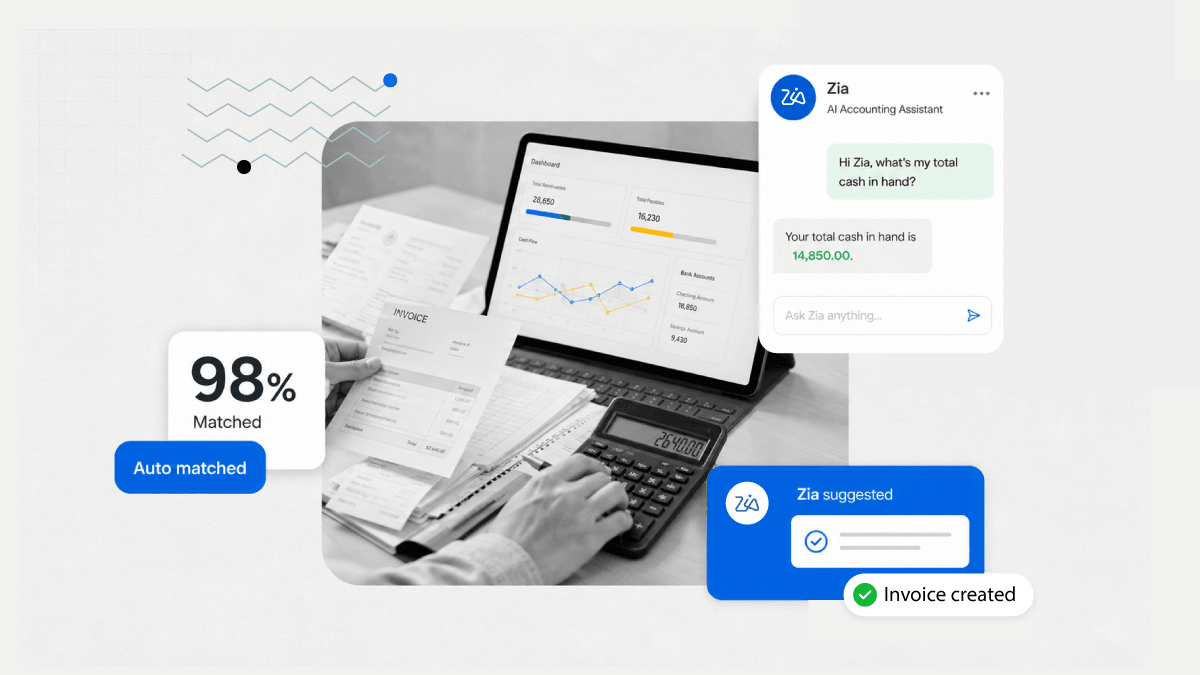
Accounting has always been essential to running a business. But for many business owners, it has also been one of the most time-consuming parts of the job. Not because accounting is difficult, but because it's constant.
Every day brings invoices to create, expenses to categorize, bank transactions to reconcile, customer payments to follow up on, reports to review, and approvals to manage. None of these tasks are particularly complex. Together, they take up hours that could be spent serving customers, planning growth, or making better business decisions.
For years, accounting software has helped businesses move away from manual bookkeeping. It digitized records, automated calculations, simplified tax compliance, and made financial data accessible from anywhere.
Today, businesses expect something more. They don't just want software that records transactions. They want software that understands what they're trying to achieve and helps them get there faster. That's the idea behind Zia, the intelligent AI built into Zoho Books.
Accounting on autopilot doesn't mean giving up control
When people hear "AI" and "autopilot" in the same sentence, it's easy to imagine software taking over decisions. That's not what accounting on autopilot is about. It's about removing the repetitive work that surrounds every financial task, while leaving the important decisions where they belong: with the people running the business.
Think about how much time goes into everyday accounting. You search for reports. You enter the same information repeatedly. You switch between screens to find customer details. You draft payment reminders. You review hundreds of transactions looking for one unusual entry. These small tasks don't create value on their own, they simply consume time. AI changes that.
Instead of asking users to do all the navigation, searching, and repetitive data entry, it quietly handles much of the groundwork, allowing finance teams to focus on analysis, planning, and decision-making. That's what accounting on autopilot looks like.
AI should work where your accounting already happens
Businesses today have access to countless AI tools. Some help write content while others summarize meetings or generate reports. They're useful but they often require switching between applications and moving data from one place to another.
Accounting doesn't work that way. Financial information is connected. Every invoice affects receivables, every payment impacts cash flow, and every transaction influences reports. The intelligence that helps businesses make financial decisions should live where that data already exists. That's why Zia is built directly into Zoho Books.
Rather than acting as a separate chatbot or an add-on, Zia works across the accounting experience. Whether you're creating invoices, reviewing reports, reconciling transactions, or following up on overdue payments, AI is available exactly where you need it.
The result is an experience that feels less like using another tool and more like having an intelligent assistant built into your everyday workflow.
Less searching. More doing.
One of the biggest shifts AI brings to accounting is changing how people interact with software. Traditionally, finding information meant navigating through menus, opening reports, applying filters, and searching for the right numbers.
With Ask Zia, that changes. Instead of figuring out where information lives, you simply request the information:
"How much revenue did we generate this month?"
"Which invoices are overdue?"
"Show me unpaid bills."
Zia understands the prompt and retrieves the information instantly.
The same idea extends beyond finding information. With CoCreate, users can describe what they want in plain language instead of manually entering every detail. Need to create an invoice for a customer with specific products and payment terms? Simply describe it, and Zia prepares the transaction for review.
Don't want to describe it by typing? You can use Speech Assistant and create that invoice by just speaking into your microphone. Simple voice commands makes performing everday acounting tasks a breeze.
These experiences may seem small individually, but together they fundamentally change how people use accounting software. Instead of learning where every feature lives, users simply focus on what they want to accomplish.
AI becomes even more valuable after the work is done
Most accounting software tells you what happened. Your reports show revenue, expenses, profits, and cash flow after transactions have already been recorded.
But businesses don't make decisions about the past. They make decisions about what comes next.
Should you invest in new equipment?
Can you hire another employee?
Will cash flow remain healthy over the next quarter?
This is where AI moves beyond automation.
Zia continuously analyzes accounting data to identify trends, generate financial forecasts, and surface insights that help businesses plan with greater confidence. Instead of manually comparing reports every month, businesses gain a clearer picture of where they're heading. The goal isn't to predict the future perfectly. It's to help businesses make decisions using data instead of assumptions.
Sometimes, the most valuable insight is the one you weren't looking for. A sudden increase in operating expenses. A drop in revenue from a key customer. An unusual transaction that doesn't match previous patterns. These issues often go unnoticed until someone spends time reviewing reports. With Anomaly Detection, Zia continuously monitors accounting data and highlights unusual financial patterns as they emerge. Rather than searching for problems, finance teams can focus on solving them.
The biggest productivity gains often come from the smallest tasks
Accounting isn't just about reports and financial statements. Much of the work happens in the small tasks repeated every day.
Writing invoice emails.
Extracting information from receipts.
Categorizing transactions.
Creating approval workflows.
Following up on customers.
Each task takes only a few minutes, but together, they take hours. Zia reduces that effort across your workflow.
Need to send a payment reminder? AI-powered Email Generation creates a professional draft that can be reviewed and sent in seconds.
Working with invoices, receipts, or supporting documents? AI-powered Fields extract relevant information and help convert unstructured data into usable accounting records.
Setting up a purchase approval process? Instead of configuring every step manually, simply describe the workflow and let AI-powered Blueprint Generation create the initial structure for you.
These capabilities aren't designed to replace human review. They're designed to eliminate repetitive work so finance teams can spend more time on higher-value activities.
Making accounting smarter, not harder
Ask any accountant which task they'd happily spend less time on, and bank reconciliation is likely to be near the top. Reconciling accounts is essential, but reviewing every imported transaction manually can become increasingly time-consuming as businesses grow.
With AI-assisted Bank Reconciliation, Zia learns from previous bookkeeping patterns and recommends appropriate categories, accounts, vendors, and ledger mappings for incoming transactions.
The accountant still reviews every recommendation. They simply spend less time starting from scratch. The same thinking extends to receivables. Healthy cash flow depends on timely collections, but manually reviewing aging reports every day isn't the best use of anyone's time.
The Zia Invoice Agent proactively identifies overdue invoices, outstanding balances, and customers who need attention, helping finance teams prioritize collections before delayed payments affect cash flow.
Zia isn't replacing financial discipline. It's helping businesses stay ahead of it.
The future of accounting isn't more automation—it's better intelligence
Automation has been part of accounting software for years. Recurring invoices, payment reminders, bank feeds, and approval workflows have already reduced manual work. Zia takes that to the next level. Automation follows predefined rules. Zia understands intent.
Instead of telling software exactly what to do every time, businesses can ask questions, describe actions, receive recommendations, and discover insights they may not have noticed themselves.
That shift changes the role of accounting software. It stops being a system that simply records financial activity and becomes a system that actively helps businesses operate more efficiently.
A smarter way to run your business
Within Zoho Books, AI isn't treated as a single feature. It's woven into the entire accounting experience. Whether you're asking a question with Ask Zia, creating transactions through CoCreate, forecasting business performance, detecting anomalies, generating customer emails, extracting data from documents, building workflows, simplifying bank reconciliation, staying on top of receivables, or interacting through voice, every capability is designed around the same goal.
That goal is to reduce effort and increase clarity to help businesses focus on decisions instead of administration. That's what accounting on autopilot really means.
Not software that replaces accountants. Software that removes friction, surfaces insights, and quietly handles the repetitive work behind the scenes.
As businesses continue to grow and financial operations become more complex, the role of accounting software will continue to evolve.
It won't just help businesses close their books; it will help them make better decisions every single day.
With Zia built into Zoho Books, that future isn't something businesses need to wait for.
It's already here. Get started now!