- HOME
- Billing basics
- Balance forward billing: A complete guide to carrying over unpaid balances
Balance forward billing: A complete guide to carrying over unpaid balances
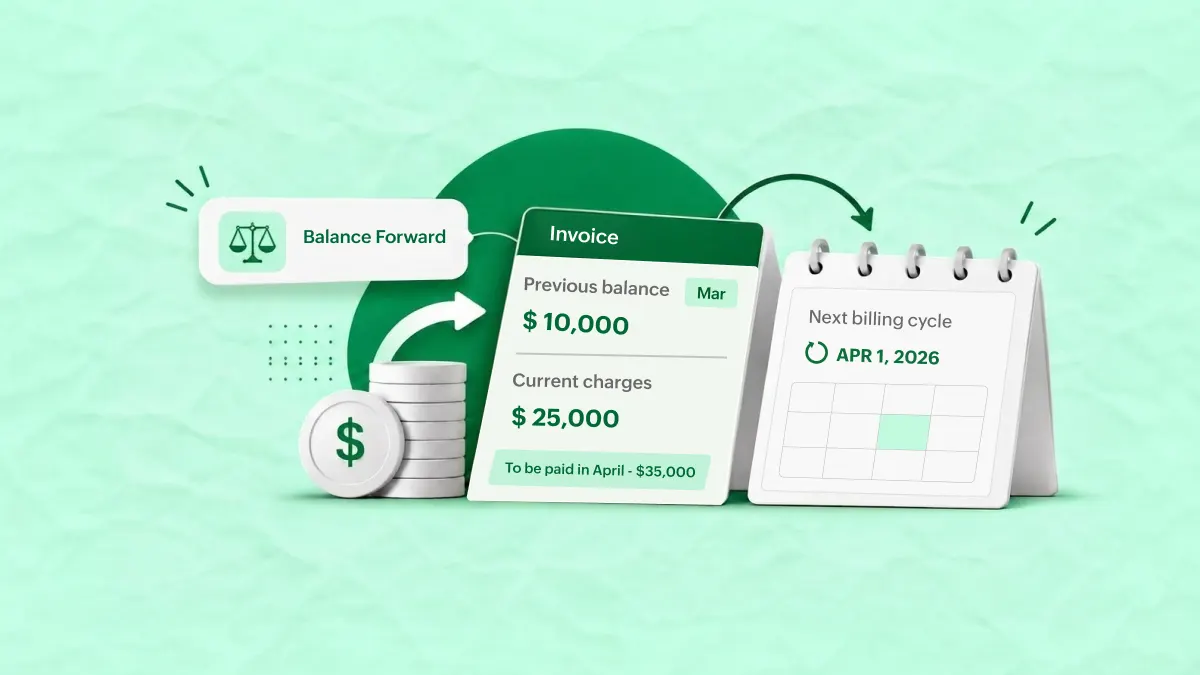
Your customer opens their monthly bill and sees a line called "Balance forward: $400." They are confused by it and want to ensure they are not being charged twice. You want to know why the previous month's balance is still unpaid.
That one line is what balance forward billing is all about: a method commonly used by telecom companies, property managers, and more subscription businesses. This guide covers what balance forward billing is, how it works, how it compares with open-item billing, and how to decide which one is suitable for your business.
What is balance forward billing?
Balance forward billing is a method where an unpaid amount(s) from the previous billing period(s) is carried into the current invoice as a single opening figure. The current period's charges are then added to that figure to give one total amount due.
Instead of treating each invoice as a separate document, balance forward billing treats the customer's account as one continuous running record. Each statement answers three questions:
What was owed?
What changed this period?
What is owed now?
What does "balance forward" mean on a bill?
A balance forward (also called "previous balance") is the amount that was left unpaid when the previous billing period closed. It is mostly displayed at the top of the new invoice in one summarized line.
If the balance forward line is not shown or listed as zero, it means the customer had cleared all the previous invoices. A positive balance means money is owed from a previous invoice(s). A negative balance is usually shown as a credit and it means the customer overpaid or received a credit that hasn't been utilized yet.
How balance forward billing works
Every billing cycle follows the same four steps:
Start with the closing balance from the previous period. This becomes the balance forward or opening balance.
Subtract payments received during the period. Payments are usually applied to the oldest outstanding amount first.
Add new charges. These include subscription fees, usage, one-time purchases, late fees, and taxes.
Apply credits and adjustments. This covers refunds, service credits, discounts, or billing corrections.
The result is the new amount due. If it isn't fully paid by the next cycle, it becomes the next balance forward and the cycle repeats.
Balance forward billing example
Consider an internet service provider. One of its customers, a travel company, pays a $1,000 monthly subscription plus overage charges for any extra data usage.
February: The customer is billed $1,000 only, as there is no overage, and pays $600. The remaining $400 carries forward.
March statement:
| Line item | Amount |
| Balance forward (from February) | $400.00 |
| Payment received, 4 March | –$400.00 |
| March subscription | $1,000.00 |
| Data overage (200 GB at $1/GB) | $200.00 |
| Service credit for 12-hour outage | –$100.00 |
| Total amount due | $1,100.00 |
The customer can see right away that February is settled and that March's charges come to $1,100. They don't need to cross-check two separate invoices.
Let's say the customer pays only $600 in March. The April statement opens with a $500 balance forward and then April's charges get added to it. The account history stays continuous, and the customer always has one number to pay.
Balance forward vs. Open-item billing
The other main approach is open-item billing. Here, each invoice remains as an "open item" until it's paid fully. Payments are matched to specific invoices.
Here's the same customer under open-item billing. In March, their statement would list two open items: Invoice #1042 (February, $400 remaining of $1,000) and Invoice #1078 (March, $1,100).
| Factor | Balance forward billing | Open-item billing |
| How unpaid amounts appear | Merged into one balance forward line item | Each unpaid invoice is treated separately |
| Payment application | Applied to the oldest balance first | Matched to specific invoices chosen by the customer or finance team |
| Handling disputes | Harder, because a disputed charge sits inside the total | Easier, because a disputed invoice can be set aside while others are paid |
| Aging reports | Shown at the account level | Tracked invoice by invoice |
| Best suited for | Subscriptions and recurring billing | Project-based, transactional, or approval-driven B2B billing |
There is no best method across the board. The right choice depends on your type of business and how your customers pay you.
How payments are applied under balance forward billing
While processing payments, balance forward systems generally use the oldest first rule. Suppose a customer owes $300 from January, $400 from February, and $500 from March, and pays $600. The payment is applied to January entirely and $300 to February. That leaves $100 from February and $500 from March, so the next balance forward is $600.
This keeps aging accurate without manual matching. It also means you can't easily leave one disputed charge aside while collecting the rest. This is one of the main reasons why dispute-heavy businesses prefer open-item billing instead.
Benefits of balance forward billing
Simpler bills for customers: As previous pending payments are rolled into one, it makes it easier for customers to get a summarized total and clear payments altogether.
Less work for the billing team: Payments received needn't be reconciled against invoices. They are applied at the customer-account level, making the process simpler.
Credits and adjustments are easy to absorb: Refunds, credits, and overpayments are adjusted from the balance forward.
Built for ongoing relationships: When charges, payments, and usage happen continuously, a running account matches how the customer thinks about the relationship.
Fewer missed payments: Customers who skip an invoice don't lose track of it as every new invoice carries the balance forward.
When balance forward billing is a poor fit
Customers frequently dispute charges: When a disputed $200 balance forward sits along with a $2,000 invoice, the whole amount doesn't get processed until it's resolved.
B2B customers pay against purchase orders: Finance teams in enterprise companies usually pay invoices against POs. They expect open-item invoices so it's easier for their processes.
Billing is project-based or one-off: If a customer buys once a quarter or per project, there isn't a continuous account to carry forward.
You need invoice-level revenue or tax tracking: Some tax regimes and audit requirements expect every invoice to be traceable to its own payment.
Industries that commonly use balance forward billing
Utilities and energy: Monthly charges are enforced based on meter readings and frequent partial payments are the norm.
Telecom and internet providers: Monthly subscriptions, roaming, additional data, and add-ons roll into one monthly bill.
Property management: Rent, monthly maintenance, and late fees accumulate on a tenant's running account.
SaaS and usage-based subscriptions: Base fees plus metered usage, credits, and proration adjustments fit naturally into a running balance.
Wholesale and distribution: Traders usually buy on account and settle monthly.
Education, clubs, and memberships: Tuition, fees, and dues are tracked as one account per member or student.
Best practices for a clear balance forward statement
Label the balance forward clearly: Use simple wording such as "Balance forward (from February)," so customers don't misinterpret it as an additional charge.
Show the full calculation: Individually list each line item — opening balance, payments received, new charges, refund credits, and overall amount due.
Include the statement period and payment dates: Customers need to see that their payment was received, even when it arrived after the last statement.
Keep detailed history accessible: Display recent charges on the statement, but let customers see past transactions through a portal or on request.
State your payment application rule: If payments are applied to old pending transactions, mention that clearly in your terms.
Watch account-level aging: A small balance forward may look harmless, but can hide a long-overdue amount. Review aging reports periodically and act on them before they grow.
How Zoho Billing helps you manage carried-forward balances
Zoho Billing gives businesses the tools to keep every customer's account continuous, transparent, and easy to collect on.
Customer statements with opening balances: Generate statements for any customer and date range. It shows the opening balance from the previous period, every invoice and payment in between, and the closing balance.
Self-service statements in the customer portal: Customers can view all their transactions with you and download their statements, which cuts "what do I owe?" queries.
Pay all pending invoices from one link: Each invoice email sent through Zoho Billing includes a link where customers can clear their total outstanding balance across all pending invoices in a single transaction.
Consolidated billing: Combine a customer's multiple subscriptions into a single invoice, so they get a consolidated amount to pay each cycle.
Receivables reports: Use aging summary, aging details, and customer balance summary reports to see what each customer owes and how long balances have been outstanding.
Dunning and payment reminders: Automate follow-ups so carried-forward balances get collected instead of quietly growing.
Whether you send customers one running statement or keep invoice-level detail for enterprise accounts, Zoho Billing lets you do both from the same system. You can get in touch with our team for an exclusive demo of Zoho Billing.
Frequently asked questions (FAQ)
Balance forward is a billing method where unpaid amounts from previous invoices are carried into the next invoice as the opening balance. New charges and payments are then added or subtracted to calculate the total due amount.
Balance forward billing combines all unpaid amounts into a single balance and usually applies payments to the oldest balance first. Open-item billing keeps each invoice separate and matches payments to specific invoices.
Yes, "balance forward" and "balance brought forward" both describe the unpaid amount carried from one period into the next. They are also commonly known as "previous balance."
Businesses whose customers often dispute individual charges, pay against purchase orders, or work on a project basis should avoid balance forward billing. They are usually better served by open-item billing.
Yes. Zoho Billing's customer statements show the opening balance, every transaction in the selected period, and the closing balance. You can email, print, or download them, and customers can access them from the customer portal.
Yes. With consolidated billing turned on, a customer's subscriptions can be combined into a single invoice. They get one bill each cycle instead of multiple bills.
Yes. When customers open an invoice from the email Zoho Billing sends, they are given the option to pay their total outstanding balance across all pending invoices in a single payment instead of settling each invoice separately.