High-performance remote desktop software for low-bandwidth connections
- Last Updated : September 18, 2026
- 110 Views
- 9 Min Read

A slow or unstable internet connection should not prevent technicians from supporting remote users. High-performance remote desktop software uses bandwidth efficiently, reduces latency, and adjusts session quality based on changing network conditions.
Zoho Assist helps technicians establish responsive remote connections even in bandwidth-constrained environments. With optimized compression, efficient resource usage, automatic reconnection, and performance-focused routing, technicians can continue troubleshooting without placing unnecessary demands on the network.
This article explains what affects remote desktop performance, which capabilities to look for, and how to make remote sessions more usable when network capacity is limited.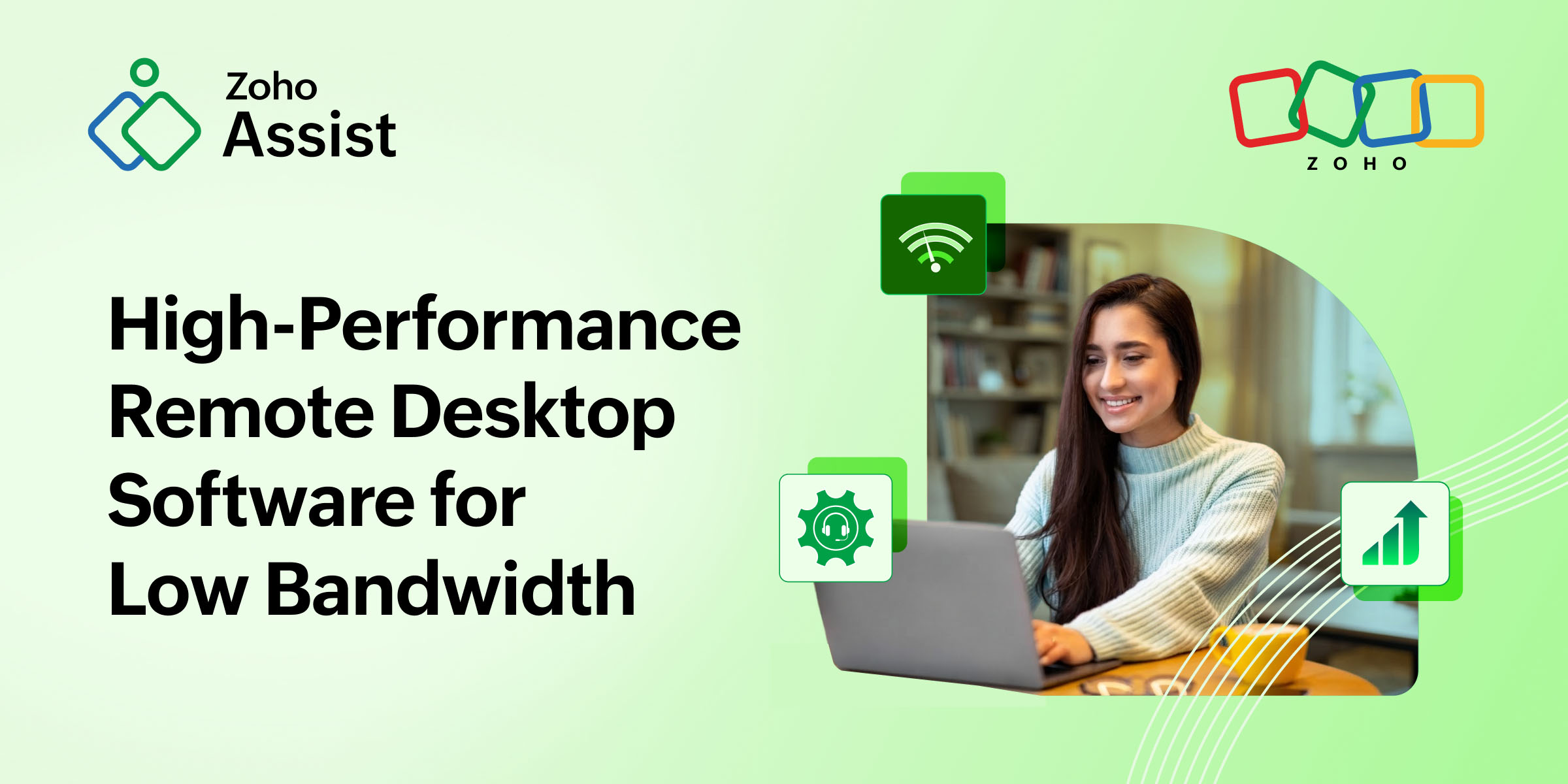
Key takeaways
Low bandwidth and high latency affect remote sessions differently.
Screen activity determines how much bandwidth a session consumes.
Compression and adaptive streaming help maintain session responsiveness.
Lowering visual quality can improve performance on slow networks.
Wired connections generally provide greater stability than Wi-Fi.
Background downloads can increase latency, jitter, and packet loss.
Zoho Assist recommends a connection speed of 1 Mbps or higher.
Actual performance depends on the network and remote workload.
What is the best remote desktop software for low-bandwidth connections?
The best remote desktop software for low-bandwidth connections should compress screen data, adjust visual quality to available bandwidth, minimize latency, and recover from temporary network interruptions. Zoho Assist is one such solution, offering bandwidth-efficient remote access, optimized routing, automatic reconnection, and responsive controls for supporting devices over slow or unstable internet connections.
No remote desktop solution can completely eliminate the limitations of a poor network, so test it with the applications and connection conditions your team uses.
Why a remote desktop can feel slow
A remote desktop connection can feel slow even when a speed test shows sufficient bandwidth. This is because session performance depends on more than the available internet speed.
Network factor | What it means | Effect on remote desktop sessions |
Bandwidth | The amount of data the connection can carry | Low bandwidth may reduce image quality or screen refresh speed |
Latency | The time data takes to travel between devices | High latency causes a delay between an action and its response |
Jitter | Variation in the time taken for packets to arrive | High jitter can cause uneven screen updates and audio quality |
Packet loss | Data packets that fail to reach their destination | Packet loss may lead to freezing, distortion, or disconnections |
Network stability | The consistency of the connection over time | An unstable network can repeatedly interrupt a session |
Why low-bandwidth performance matters for remote desktop
Remote desktop software transfers screen updates and user input between connected devices. Clipboard sharing, audio, and file transfers add traffic when those features are used. When bandwidth is limited, every additional data stream competes for the same network capacity.
Software that does not manage this traffic efficiently may produce:
Delayed mouse and keyboard responses
Slow or incomplete screen updates
Reduced audio quality
Interrupted file transfers
Frozen or disconnected sessions
Longer troubleshooting times
Remote desktop software for slow internet should prioritize essential session activity. For example, keyboard input and control commands should remain responsive even if the screen resolution or refresh rate needs to be reduced temporarily.
Common scenarios where low-bandwidth remote access matters
Supporting users in remote locations
Rural areas and locations with limited broadband infrastructure may depend on low-speed connections. Technicians still need a reliable way to diagnose applications, update settings, and resolve device issues.
Managing devices over mobile networks
Employees and field teams may connect through mobile hotspots or shared cellular networks. Available bandwidth can change as signal strength and network congestion fluctuate.
Accessing devices through satellite internet
Some satellite connections, particularly geostationary services, can have high latency despite adequate download capacity. Technicians may therefore notice delayed responses even when bandwidth appears sufficient.
Supporting branch offices
Small offices may share one internet connection across several employees and applications. Remote support must share this capacity with other business activities, making efficient bandwidth usage particularly useful.
Maintaining industrial and field devices
Manufacturing sites, warehouses, construction locations, and field installations may have limited network infrastructure. IT teams may still need remote access to Windows over a low-bandwidth connection to troubleshoot supported computers and business applications.
Working during network congestion
Even a normally fast connection can become slow when multiple users are downloading files, joining video calls, or accessing cloud applications simultaneously.
What makes remote desktop software perform well on slow internet?
Efficient screen-data compression
Remote desktop software should compress visual information before transmitting it. Efficient compression reduces the amount of data sent while keeping text, controls, and other important screen elements visible.
Transmission of screen changes
Instead of repeatedly sending the complete screen, bandwidth-efficient software can prioritize the portions that change. Static areas require fewer updates, helping conserve bandwidth during routine administrative tasks.
Adaptive session quality
Automatic or manual controls for resolution, image quality, and frame rate can help match a session to available bandwidth. This helps maintain responsiveness when network capacity changes during a session.
Low-latency routing
A direct and efficient network path reduces unnecessary delays. Low-latency remote desktop software should use an efficient available route, although routing alone cannot remove delays caused by distance or congestion.
Efficient resource usage
High CPU or memory usage on either device can make a network problem appear worse. High-performance remote desktop software should use system and network resources efficiently.
Workload-aware performance
Text-based applications, system settings, command-line tools, and administrative consoles generally require less bandwidth than video, animation, design software, or frequently changing dashboards. The remote workload should therefore be considered when evaluating performance.
Key features to look for in low-bandwidth remote desktop software
When comparing remote desktop software for a poor internet connection, consider the following capabilities.
Adjustable display quality
The ability to reduce image quality or prioritize speed can improve responsiveness when bandwidth becomes limited.
Automatic session reconnection
The session should reconnect after a short interruption without requiring the technician and user to restart the entire process.
Stable keyboard and mouse control
Control commands should remain responsive even when visual updates are temporarily reduced.
Cross-platform access
The solution should support the operating systems used by technicians and remote users, including Windows, macOS, Linux, Android, and iOS.
Session diagnostics
Connection indicators and session information can help technicians distinguish network delays from high CPU usage or problems on the remote device.
Secure data transmission
Bandwidth efficiency should not come at the expense of security. Look for encryption, multi-factor authentication, access controls, and session activity logs.
Essential troubleshooting tools
Built-in chat, file transfer, reboot and reconnect, multi-monitor support, and diagnostic tools can reduce the need to run separate applications during a session.
Scalable deployment
For unattended access, organizations should be able to deploy the required agent across remote devices and organize those devices for easier management.
How Zoho Assist optimizes remote access on low-bandwidth networks
Compression, routing, and reconnection
Zoho Assist uses optimized compression and bandwidth management to reduce data demands, along with routing capabilities designed to minimize avoidable delays. It also supports automatic reconnection after a temporary network drop. Learn more about its fast and low-latency remote desktop capabilities.
Adjustable session quality
The web technician console offers color-quality and screen-resolution options. On Windows, the Automatic color-quality setting adjusts according to internet speed, helping technicians balance responsiveness and readability. See the web client guide.
Browser-based technician access
Technicians can begin and manage sessions from a supported web browser. Customers follow the connection steps provided for their device and session type.
Unattended remote access
Organizations can install the unattended access agent on remote Windows and other supported devices in advance. Authorized technicians can then access those devices when maintenance or troubleshooting is required.
Secure remote sessions
Zoho Assist uses 256-bit AES encryption and TLS to protect session data. It also supports two-factor authentication, technician permissions, and administrative action logs.
Check the Zoho Assist system requirements when planning deployment. Actual performance also depends on latency, packet loss, screen activity, system resources, and other network traffic.
Best practices for delivering remote support on slow internet connections
Check both ends of the connection
Test the network used by the technician and the remote user. A slow upload speed, packet loss, or congestion at either end can affect the complete session.
Prefer a wired connection
Use Ethernet where possible. Wired connections are generally less affected by interference, distance, and signal fluctuations than Wi-Fi.
Pause bandwidth-intensive activities
Temporarily pause large downloads, cloud backups, system updates, and video streaming on both devices.
Reduce screen resolution
A lower display resolution means fewer pixels need to be transmitted. This can improve responsiveness when bandwidth is restricted.
Limit visual effects
Animations, transparency effects, videos, and frequently changing backgrounds all generate extra screen data that consumes bandwidth. Disabling unnecessary effects can speed up a remote desktop connection in Windows.
Work on one monitor where possible
Multiple active monitors increase the screen area that may need to be transmitted. Display only the monitor required for the current troubleshooting task.
Avoid unnecessary file transfers
Large file transfers can compete with screen-sharing traffic. Schedule them separately or use an approved cloud storage service when appropriate.
Close unused applications
Background applications can consume bandwidth, CPU, and memory. Closing them may improve both device and session performance.
Prioritize essential communication
If the connection cannot support remote control, voice, and video at the same time, use text chat or another low-bandwidth communication method.
Test with realistic workloads
The lowest-bandwidth remote desktop option cannot be identified through bandwidth figures alone. Test the solution using the actual applications, locations, devices, and network conditions your team encounters.
Configuring RDP for low-bandwidth connections
Windows Remote Desktop Protocol bandwidth requirements vary significantly by workload. Text-based applications and system administration usually consume less data than video, animations, multiple monitors, or rapidly updating graphics.
When configuring RDP for low-bandwidth connections:
Lower the remote desktop resolution.
Use a reduced color depth where available.
Disable desktop backgrounds and animations.
Turn off font smoothing and transparency effects.
Avoid redirecting audio, printers, and local devices unnecessarily.
Limit the session to one display.
Close applications that generate frequent visual updates.
Use the most direct approved network route.
These adjustments may help reduce bandwidth consumption, but organizations should assess their security, firewall, access, and deployment requirements before exposing or configuring native RDP.
Choose remote access that adapts to changing networks
Low-bandwidth remote access is not simply about finding the software with the lowest advertised data usage. A reliable solution should balance compression, responsiveness, connection stability, security, and usability.
Zoho Assist provides high-performance remote desktop capabilities for attended support and unattended access. Its optimized bandwidth usage, low-latency connections, automatic reconnection, cross-platform compatibility, and security controls help technicians support users across varying network conditions.
Frequently asked questions
Why is my remote desktop so slow?
A remote desktop may become slow because of limited bandwidth, high latency, packet loss, Wi-Fi interference, network congestion, high screen resolution, or heavy CPU usage. Test both connections and reduce unnecessary screen activity before restarting the session.
How much internet speed do I need for a remote desktop connection?
Requirements depend on the software and workload. Zoho Assist recommends 1 Mbps or higher according to its system requirements. Video, multiple monitors, file transfers, and rapidly changing visuals may need more capacity. Latency, packet loss, and competing traffic also affect the experience.
How do I reduce bandwidth usage in RDP?
Lower the display resolution and color depth, disable animations and desktop backgrounds, avoid audio and device redirection, use one monitor, and close bandwidth-intensive applications. These changes reduce the amount of screen and peripheral data transferred.
How much bandwidth does a remote desktop need?
There is no universal bandwidth requirement. Administrative work and text-based applications use less bandwidth than video or graphics-intensive software. Connection quality also depends on latency, jitter, packet loss, resolution, frame rate, and simultaneous network activity.
What is the best low-latency remote desktop software?
The best low-latency remote desktop software should provide efficient routing, optimized compression, adaptive session quality, responsive controls, and automatic reconnection. Zoho Assist offers these capabilities for remote support and unattended access across supported platforms.
Can I use Zoho Assist remote desktop over a slow internet connection?
Yes. Zoho Assist offers adjustable session quality for constrained connections, helping you maintain a smoother and more productive remote support experience even when bandwidth is limited.
How do I optimize remote desktop speed in Windows 11?
Reduce the display resolution, disable animations and transparency effects, close background applications, pause downloads, use Ethernet where possible, and limit the session to one monitor. Updating Windows, network drivers, and remote access software may also improve performance.
Does low bandwidth always cause high latency?
No. Bandwidth measures how much data a connection can carry, while latency measures how long data takes to travel. A connection may offer limited bandwidth with acceptable latency or high bandwidth with noticeable delays caused by routing or congestion.
Can remote desktop software work over unstable internet?
Yes, but the experience depends on the severity of the interruptions. Software with adaptive performance and automatic reconnection can handle brief changes more effectively. Persistent packet loss or frequent disconnections may still require the underlying network to be investigated.
Why do videos perform poorly during low-bandwidth remote sessions?
Video and animation change large areas of the screen repeatedly, requiring more data than text or static interfaces. Lowering video quality, frame rate, resolution, or the frequency of screen updates can reduce the network demand.