


- HOME
- Payroll operations
- How Does Direct Deposit Work? The journey from payroll approval to payday
How Does Direct Deposit Work? The journey from payroll approval to payday
The short answer is deceptively simple. On payday, your employee's salary leaves your business bank account, travels through an electronic network the Federal Reserve has been running since the 1970s, and lands in their bank account, usually overnight.
The longer version, which actually matters when you are trying to figure out why a deposit is late or why your provider needs the file three days ahead, has four distinct steps, a handful of settlement windows, two different speeds, and a calendar that stops hard on federal holidays. Once you have seen how the moving parts fit together, you stop treating payday timing as mysterious and start reading it the way your payroll provider does.
This guide is written for anyone working in payroll who wants to understand what actually happens between the moment you approve payroll on a Tuesday afternoon and the moment your employees see the deposit on Friday morning.
We will walk the ACH journey end to end, cover the two settlement speeds and why cutoff times exist, explain early direct deposit (it is a bank-side decision, not an employer-side one), look at the things that slow a deposit down. All this with a concrete worked example so you can have smooth sailing paydays for your employees.
The step-by-step direct deposit payroll journey
Step 1. The employer approves payroll. Your payroll system calculates each employee's gross-to-net pay, applying federal and state tax withholding per IRS Publication 15, Social Security, Medicare, pre-tax deductions, and any garnishments. Once the numbers look right, you (or someone on your finance team) approve the pay run.
Step 2. The payroll provider assembles the ACH file. The system generates a NACHA-formatted file containing one entry per employee, each with a routing number, account number, net pay amount, and a specified settlement date (usually the payday). The provider transmits this file to their partner bank.
Step 3. The Originating Depository Financial Institution (ODFI) processes the batch. This is your employer-side bank, or your payroll provider's. The ODFI reviews the file, debits your business bank account for the total, and forwards the batch to an ACH operator.
Step 4. The ACH operator routes the payments. There are two ACH operators in the US: FedACH, run by the Federal Reserve, and the Electronic Payments Network (EPN), run privately by The Clearing House. One of them receives the batch, sorts it by destination bank, and forwards each entry to the right receiving bank.
Step 5. The Receiving Depository Financial Institution (RDFI) posts the funds. This is your employee's bank. The RDFI receives the entry, confirms the account is valid, and credits the employee's account on the settlement date. By NACHA rule, standard ACH credits must be made available by 9 a.m. local time on the settlement date.
Step 6. The employee sees the deposit. Online banking reflects the credit, mobile notifications fire, and payday is done. For most employees on next-day ACH, the deposit appears in online banking the evening before payday, which we will come back to when we talk about early direct deposit.
Here is the flow at a glance, in the order payments travel:
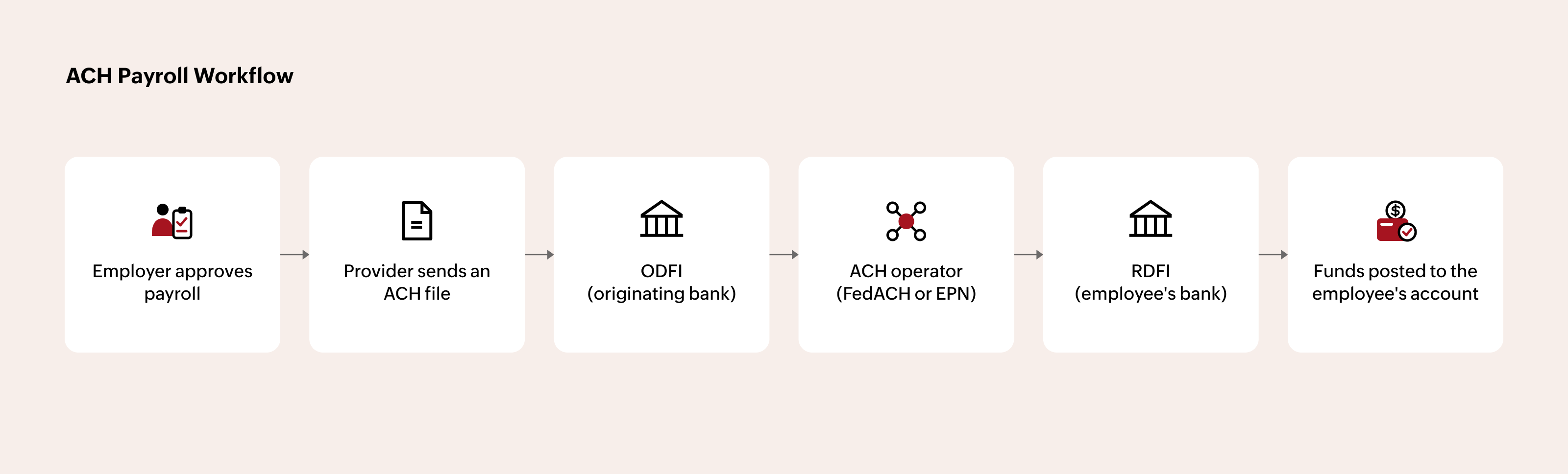
That sequence is the same whether you have three employees or three thousand. It is also the same sequence the Social Security Administration uses to pay monthly benefits, and the one the IRS uses to deliver tax refunds. What changes between businesses is how fast each step runs.
Standard ACH vs Same Day ACH, and why approval deadlines exist
The ACH network offers two speeds, and the differences shape every cut-off time your payroll provider enforces.
Standard ACH is the routine. You submit the file, and it settles one to two business days later. For a Friday payday, your provider typically transmits the file on Wednesday, the ODFI processes it Wednesday night, the ACH operator distributes it Thursday morning, and the RDFI posts it by 9 a.m. local time Friday. This is the default for routine payroll because it is cheap, it has effectively no per-payment network limit, and the extra day of lead time is no inconvenience when you are planning payroll a week ahead.
Same Day ACH compresses the full cycle into a single business day. The Federal Reserve's FedACH service runs three Same Day settlement windows daily, with funds available to the receiving bank by 1:00 p.m., 5:00 p.m., and 6:00 p.m. ET. The current per-payment limit is $1 million, and NACHA has already approved an increase to $10 million effective September 17, 2027. Same Day earns its keep for off-cycle runs, bonus payouts, or catching up on a missed employee. It carries a small Same Day Entry Fee (currently 5.2 cents per payment, paid between banks), which most providers absorb into their pricing rather than billing as a line item.
Why your provider's cutoff is earlier than NACHA's. You will notice that your payroll provider's "approve by" deadline is typically earlier than the raw NACHA deadline. That is because the chain between you and the ACH operator has multiple handoffs. Your provider needs time to assemble the file, transmit it to their partner ODFI, have the ODFI run its own fraud checks and prefunding verifications, and submit to the operator before the window closes. Every handoff adds a buffer. The earlier cutoff is not arbitrary friction; it is how the schedule stays reliable when any of those steps runs long.
Why some banks show pay up to two days early
This is the piece of direct deposit most employees do not understand and most employers get asked about anyway. Early direct deposit is not your employer paying anyone ahead of schedule.
It is the employee's bank choosing to release funds the moment it receives the ACH file, instead of waiting for the official settlement date. When your payroll provider submits the file, the batch contains two dates (the receiving date when the employee's bank sees it, and the settlement date when the money officially transfers), and the gap between them can be up to two business days because ACH credits can be dated up to two banking days ahead.
A bank offering early direct deposit treats that ACH notification as a reliable enough signal to credit the employee's account immediately from its own funds, then reconciles when the official settlement happens on payday.
Three things are worth knowing. First, how early is entirely up to the receiving bank: some release funds a full two business days early, some one day, some only a few hours. Second, the employee still has to bank somewhere that offers the feature. If their bank waits for the official settlement date (as many do), they see the money on payday morning like everyone else. Third, there is nothing you can do on the employer side to guarantee early access for your employees. The decision belongs entirely to their bank.
What you can do, and what matters for employee experience, is submit the file on time. If your payroll provider transmits the ACH batch two days ahead of payday, banks that offer early direct deposit can act on it immediately. If you cut it close and transmit the night before, there is no time for early release even at banks that support it.
What slows a deposit down
When a direct deposit does not land on time, the cause is almost always one of five things.
Weekends. The ACH network does not settle on Saturdays or Sundays. A Friday payday with a file submitted Friday morning cannot settle until Monday.
Federal Reserve Bank holidays. FedACH does not process on the nine or ten weekdays per year when the Federal Reserve is closed. In 2026, those are New Year's Day (January 1), Martin Luther King Jr. Day (January 19), Presidents' Day (February 16), Memorial Day (May 25), Juneteenth (Friday, June 19), Labor Day (September 7), Columbus Day (October 12), Veterans Day (Wednesday, November 11), Thanksgiving Day (November 26), and Christmas Day (Friday, December 25). The full Federal Reserve holiday schedule shows exactly when FedACH processing ends and resumes for each. A pay run that would normally settle on a holiday settles on the next business day, which is why providers often prompt you to move submission dates up around holidays.
Cutoff times. If you miss your provider's approval deadline, the file goes into the next processing window, which is usually the next business day. A payroll approved at 6 p.m. Wednesday against a 5 p.m. Wednesday cutoff is effectively a Thursday approval.
Wrong account details. A typo in a routing or account number is the single most common cause of a misrouted deposit. The RDFI returns the entry, your provider surfaces the return, and you have to collect the correct details and resubmit. This is the specific problem micro-deposit verification is designed to prevent, which we cover in detail in our companion piece on what direct deposit is and how to set it up.
Returns. ACH returns happen for other reasons too: a closed account, an account that does not exist at the receiving bank, or a stop payment order. Each return has a specific NACHA return code (R01 insufficient funds, R02 account closed, R03 no account, and so on), and your payroll provider's dashboard will surface the reason so you can act on it.
The practical implication is that your payroll calendar needs to account for Federal Reserve closures as well as weekends. Any pay date that falls on, or a settlement that would need to cross, a Federal Reserve holiday needs its submission moved up accordingly. Modern payroll platforms handle this automatically by warning you when a holiday falls in the settlement window and prompting the earlier submission date.
Verifying accounts before the first deposit
Before any live payroll runs through a new employee's account, a good platform runs micro-deposit verification. The system sends two small test deposits (typically a few cents each) to the account the employee has entered. The employee logs back into the self-service portal and confirms the exact amounts. If they match, the account is verified and marked live for payroll. If they do not, the enrollment is paused and the employee is asked to re-check their routing and account numbers.
This small step prevents an enormous category of errors. Routing numbers are nine digits, account numbers can be anywhere from five to seventeen, and a single transposed digit is enough to send a paycheck into a stranger's account. Micro-deposit verification catches the typo while the test deposit is still trivial, rather than when the real paycheck disappears on a Friday.
A worked example for a Friday payday
The easiest way to feel how the timing works is to walk through a single pay cycle at the three processing speeds you will see in the US market. Assume the payday is Friday, and no Federal Reserve holiday falls in the week.
The standard 3-day flow. You approve the pay run on Tuesday. Your payroll provider assembles the NACHA file and transmits it to the ODFI the same day. The ODFI debits your business bank account on Thursday. The ACH operator routes the batch overnight, and the funds settle in your employees' accounts by 9 a.m. local time on Friday. This is the default flow for most US businesses and the one the ACH network was designed around. It gives both sides of the chain comfortable room to catch any issues before they reach an employee's bank account.
The 2-day flow for established originators. You approve on Wednesday. Your business bank is debited on Thursday, and the funds post Friday morning. Most providers offer this speed once your business has a track record of clean pay runs with low return rates, because the shorter buffer only works when the ODFI trusts that you will not be sending a batch that turns out to be unfunded or riddled with errors. New businesses usually qualify within the first few months.
The 1-day flow for urgent or off-cycle runs. You approve on Thursday. Your account is debited on Thursday, and the funds post on Friday. This path uses Same Day ACH under the covers rather than standard next-day ACH, which is why it carries a higher per-payment cost and why NACHA's Same Day settlement windows (1 p.m., 5 p.m., 6 p.m. ET) set the cutoffs. One-day processing is the safety valve for off-cycle payments, bonus runs, and catching up on a missed employee, not something you would use every pay period.
For a Friday payday, those three speeds give you three different approval deadlines: Tuesday for 3-day, Wednesday for 2-day, Thursday for 1-day. If a Federal Reserve holiday falls in the cycle, each deadline moves up by one business day. The holidays listed earlier in this guide are the ones your calendar has to absorb.
The practical takeaway: on a routine pay schedule, the 3-day flow works perfectly for almost every US business. The 2-day flow is a useful upgrade once your business qualifies, and the 1-day flow is a tool for the occasional off-cycle situation. Understanding which one applies to any given pay run is a matter of counting business days backwards from the payday, accounting for weekends and Federal Reserve closures, and respecting your provider's cutoff for the speed you need.
The practical bottom line
Direct deposit is not magic, and it is not opaque. It is a reliable six-step journey from your payroll approval on one end to your employee's account on the other, running through an infrastructure the Federal Reserve has been operating for over five decades. Once you understand the two settlement speeds, the early direct deposit mechanics, the role of Federal Reserve Bank holidays, and the five main reasons a deposit can be late, you stop reacting to payday timing and start planning around it.
The practical takeaway for any US employer is simple. Count business days backwards from payday, taking weekends and Federal Reserve closures out of the count. Match your pay-run approval to the submission deadline for the processing speed you want to use. Submit the file on time, every time, so that banks offering early direct deposit can act on the notification and so that returns and corrections have room to be resolved before the money is supposed to land. Do that consistently, and payday stops being a thing you worry about and starts being a thing that just happens.
If you are evaluating a platform to run this on, Zoho's Payroll Software built for the US market handles the ACH submission, holiday-adjusted cutoffs, and returns dashboard inside one workflow, with transparent pricing and a 14-day free trial. If you are earlier in your evaluation of how to run payroll at all, our companion guide on what cloud payroll is and why it matters for US businesses picks up from here.
Frequently asked questions
How long does direct deposit take?
For standard next-day ACH, one to two business days from submission to settlement. For Same Day ACH, the same business day through one of the three settlement windows at 1:00 p.m., 5:00 p.m., or 6:00 p.m. ET.
When does a direct deposit hit the employee's account?
By 9 a.m. local time on the settlement date for standard ACH, per NACHA rules. Banks that offer early direct deposit may release funds up to two business days earlier.
What is early direct deposit?
A feature offered by the employee's bank, not the employer. The bank releases funds the moment it receives the ACH file notification from the employer's bank, rather than waiting for the official settlement date. The advance is typically one to two business days.
Why does my payroll provider need the file three days early?
Because the chain from your approval to the employee's account involves multiple handoffs: your provider, their ODFI, the ACH operator, and the employee's RDFI. Each needs time to process, verify, and forward. The earlier cutoff is the buffer that keeps payday reliable.
What happens if payday falls on a Federal Reserve holiday?
The deposit settles on the next business day, unless you submit earlier so it can settle the business day before the holiday. Modern payroll platforms warn you automatically when a holiday falls in the settlement window.
What causes an ACH return?
Common reasons include insufficient funds (R01), a closed account (R02), no account at the receiving bank (R03), an invalid account number (R04), or a stop payment order. Each return has a specific NACHA code, and your payroll provider will surface the reason in the pay run dashboard.
Can I switch to Same Day ACH for all my payroll?
You can, but it is usually not necessary. For a regularly scheduled payroll, standard next-day ACH is cheaper, has no per-payment network limit, and settles reliably. Same Day ACH is best reserved for off-cycle runs, bonus payouts, or correcting missed employees.
What processing speeds do US payroll providers offer?
Most providers offer three: a standard 3-day flow (approve three business days before payday), a 2-day flow for originators with an established track record, and a 1-day flow for urgent or off-cycle runs that uses Same Day ACH under the covers.
What slows a deposit down most often?
Weekends, Federal Reserve holidays, missed submission cutoffs, and incorrect account details. Of these, incorrect account details are the most preventable, which is why micro-deposit verification matters.
Is direct deposit different for 1099 contractors?
Mechanically, no. The ACH journey is identical. The tax treatment is different (no federal income tax withholding), but the file format and settlement timing are the same.
Does the ACH journey change if my employees are in different states?
The ACH mechanics are federal, so the journey itself is identical regardless of where your employees bank. What does change state by state is the withholding calculation, SUI handling, and in some states the written consent requirements for direct deposit itself. Our deeper guide on multi-state payroll for US businesses walks through the compliance picture for employers operating across jurisdictions.