


Layout Rules for Custom Modules

With layout rules, you can control which fields are shown or hidden, enabled or disabled, and made mandatory on a custom module’s record form. When a user creates or edits a record, the form changes based on the conditions in your layout rules.
Scenario: Zylker uses a custom module called Purchase Requests to manage procurement across departments. The Marketing team needs a Campaign Name field on the form, while the Sales team needs a Client Name and Deal Reference field. Bailey, Zylker’s Procurement Manager, creates separate layout rules for each department. For the first rule, she sets the condition Department is Marketing to show the Campaign Name field. In the second rule, she sets the condition Department is Sales to show the Client Name field and set Deal Reference as mandatory. Now, when a user selects a department on the form, only the relevant fields are displayed.
Note: This feature is available only for certain plans of Zoho Books. Visit the pricing page to check if it’s available in your current plan.
Create a Layout Rule
You can create a layout rule for a custom module by defining conditions and associating layout actions. Here’s how:
- Go to Settings on the top right corner of the page.
- Select the required custom module under Custom Modules.
- Go to the Rules tab.
- Select Layout Rules.
- Click + New Layout Rule in the top right corner.
- Enter a Layout Rule Name.
- Click Next.
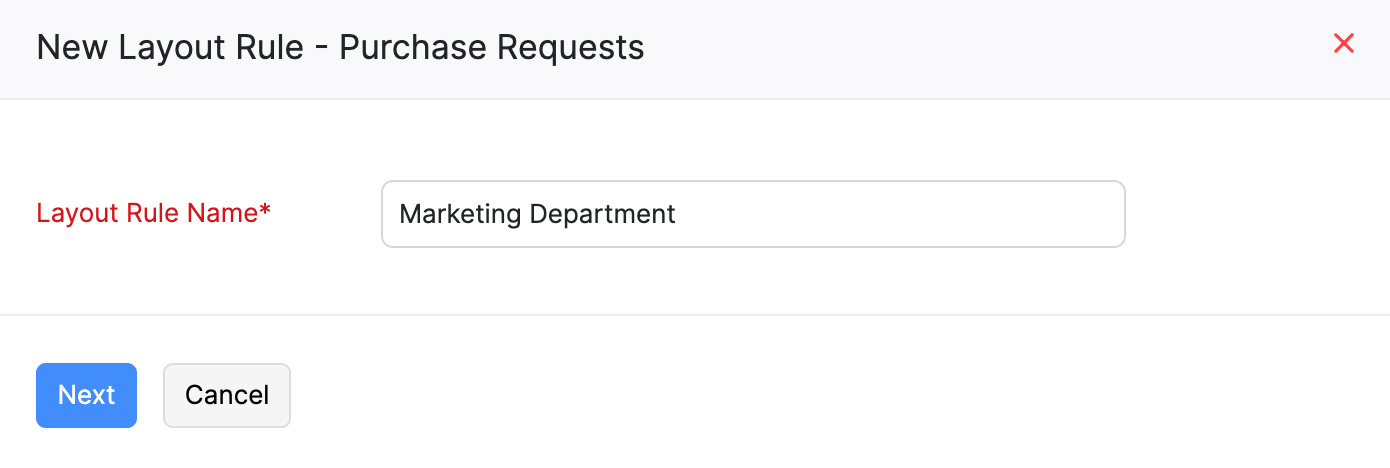
You will be redirected to the layout rule configuration page where you can define conditions and configure actions.
Define Conditions
A condition determines when layout actions take effect. Each condition consists of one or more criteria based on the fields in your custom module.
- Click New Condition on the layout rule configuration page.
- In the side pane that opens, select a field from the dropdown.
- Select a comparator (e.g., is, isn’t, is empty, is not empty).
- Select or enter a value for the condition.
- Click Done.
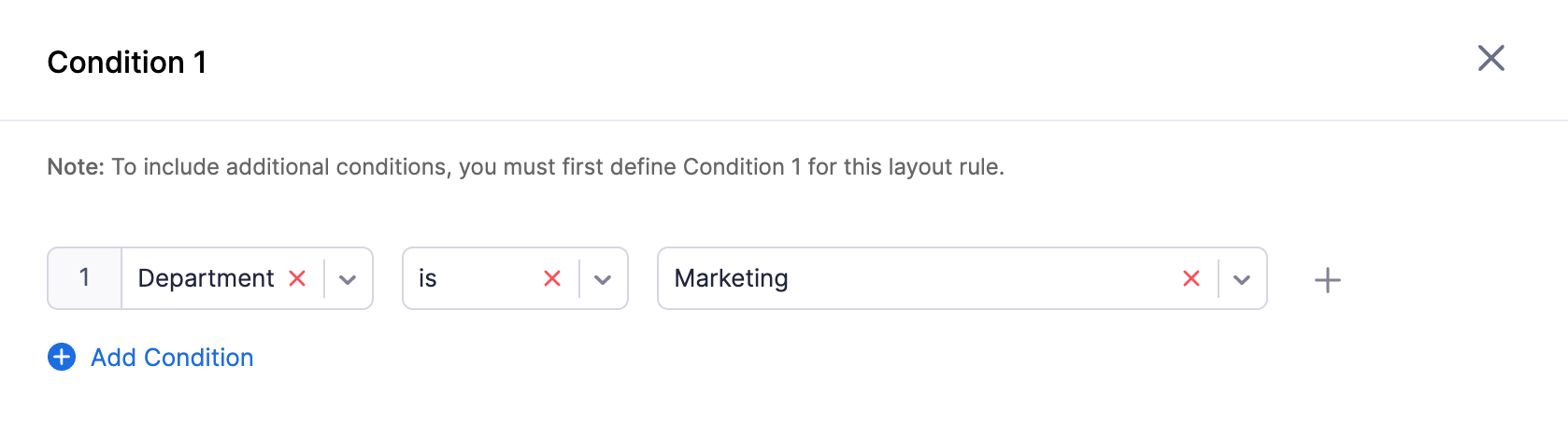
The condition will now appear in the When section of the layout rule (e.g., “Department is Sales”).
Note: You must define Condition 1 before you can add additional conditions.
Add multiple criteria within a condition:
If you want the condition to be based on more than one criterion, click Add Criteria in the condition side pane and configure the additional criteria.
Add multiple conditions:
If you want to define additional conditions for the same layout rule, click New Condition and repeat the steps above.
Configure Layout Actions
After defining a condition, you can associate layout actions that apply when the condition is met.
- Click Layout Actions next to the True label under the condition.
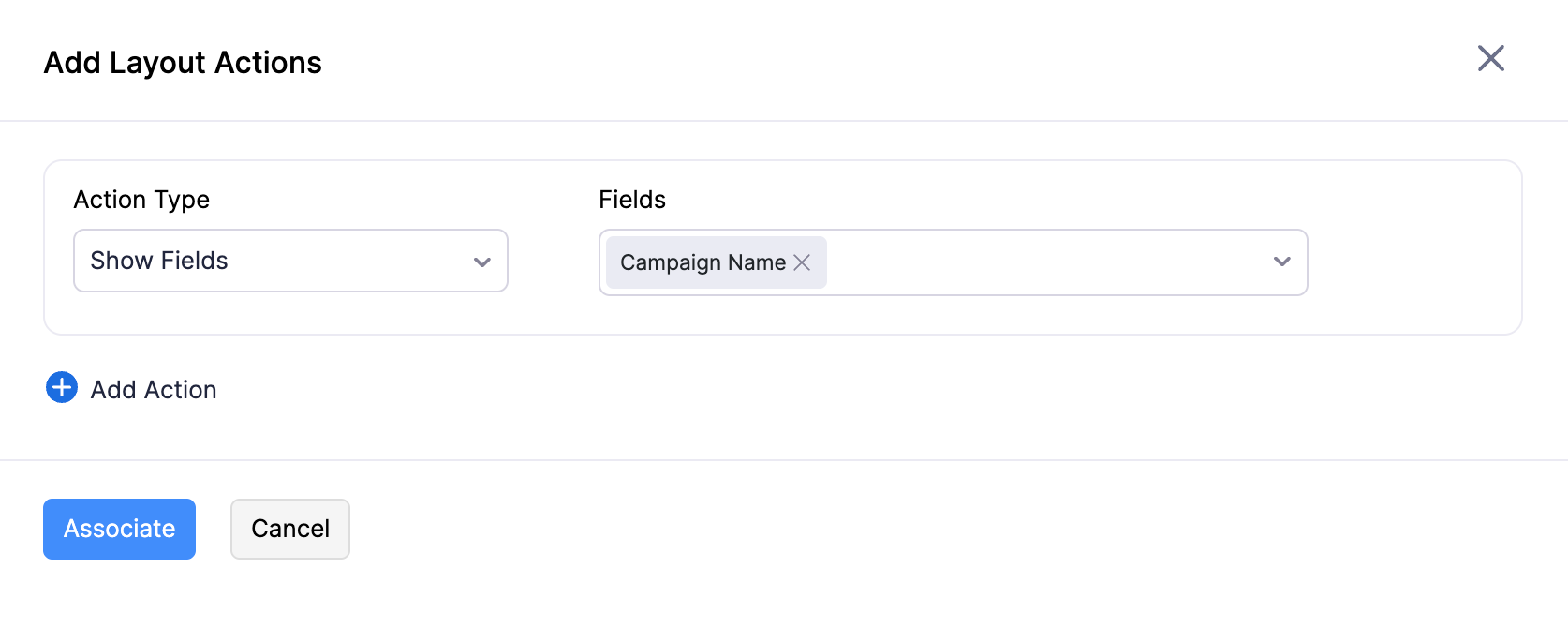
- In the side pane that opens, select an Action Type from the dropdown:
| Action Type | Description |
|---|---|
| Show Fields | Shows selected fields when the condition is met. If the condition is not met, those fields are hidden. |
| Enable Fields | Enables selected fields when the condition is met so users can edit them. If the condition is not met, those fields stay disabled. |
| Set Field Value | Automatically sets a specific value for a field when the condition is met. |
| Set Field as Mandatory | Makes one or more fields mandatory when the condition is met. |
- Based on the selected action type:
- For Show Fields, Enable Fields, or Set Field as Mandatory: Select the required fields from the multi-select Fields dropdown.
- For Set Field Value: Select a Field from the dropdown and enter or select the Value to be set.
- To add more actions, click Add Action and repeat the steps above.
- Click Associate.
- Click Save on the layout rule configuration page.
Note: You can associate multiple actions of different types within the same condition. For example, you can show a field and make another field mandatory when the same condition is met.
Edit a Layout Rule
You can modify the conditions and actions of a layout rule. Here’s how:
- Go to Settings on the top right corner of the page.
- Select the required custom module under Custom Modules.
- Go to the Rules tab.
- Select Layout Rules.
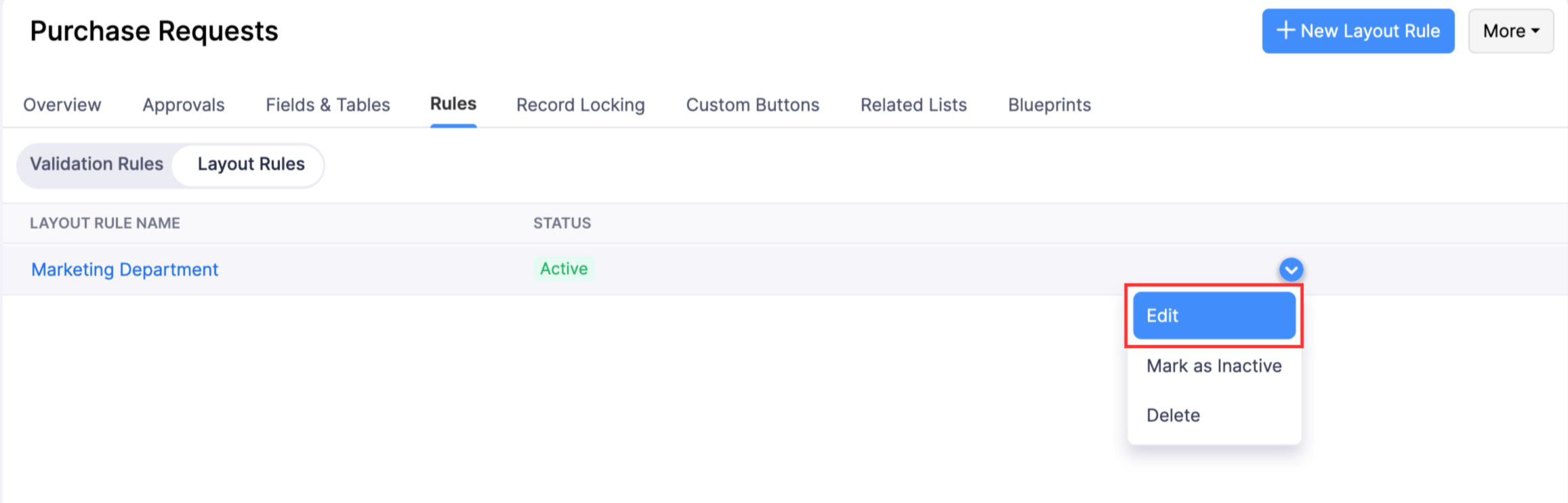
- Click the layout rule name you want to edit. Alternatively, click the More icon next to the rule and select Edit.
- Make the necessary changes to the conditions or actions.
- Click Save.
To rename the layout rule, click Edit Layout Rule Details on the layout rule configuration page, update the Layout Rule Name, and click Save.
Mark a Layout Rule as Inactive
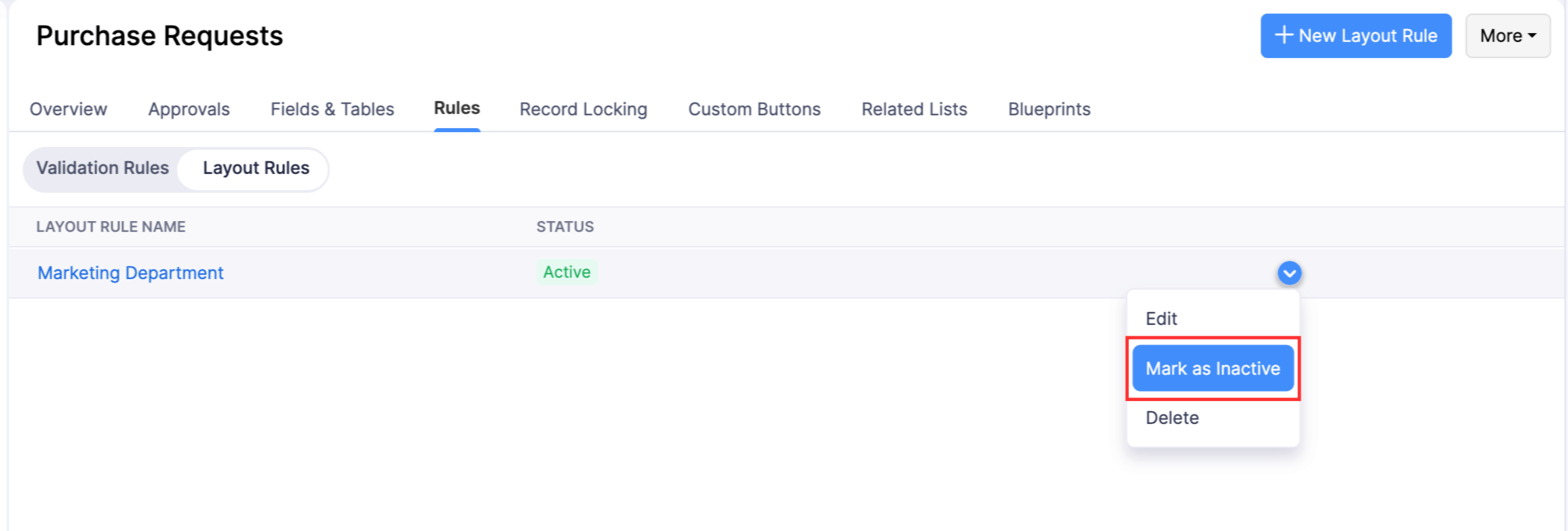
You can temporarily disable a layout rule by marking it as inactive. An inactive rule will not apply when users create or edit records. Here’s how:
- Go to Settings on the top right corner of the page.
- Select the required custom module under Custom Modules.
- Go to the Rules tab.
- Select Layout Rules.
- Click the More icon next to the layout rule you want to disable.
- Select Mark as Inactive.
Mark a Layout Rule as Active
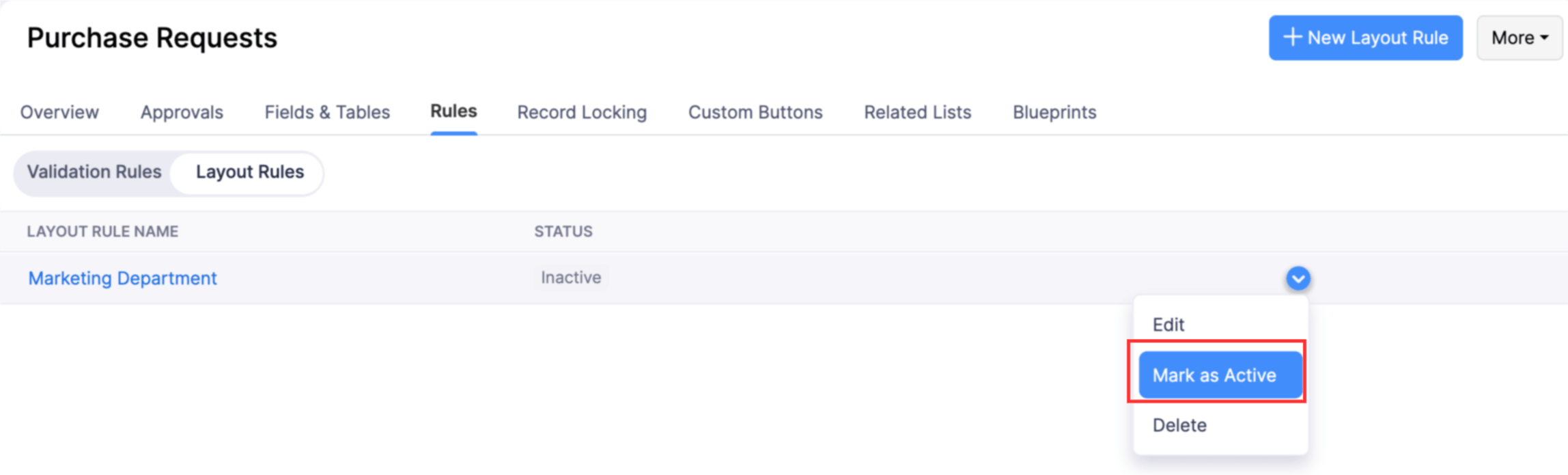
You can re-enable an inactive layout rule by marking it as active. Here’s how:
- Go to Settings on the top right corner of the page.
- Select the required custom module under Custom Modules.
- Go to the Rules tab.
- Select Layout Rules.
- Click the More icon next to the inactive layout rule you want to enable.
- Select Mark as Active.
Delete a Layout Rule
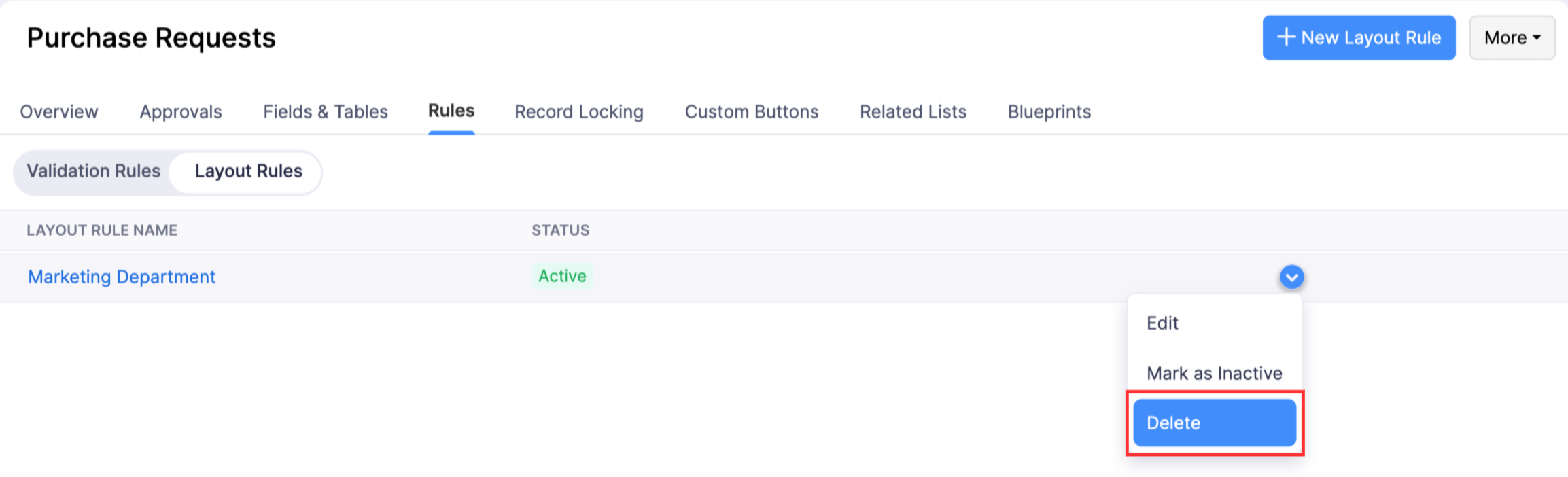
You can permanently delete a layout rule that is no longer needed. Here’s how:
- Go to Settings on the top right corner of the page.
- Select the required custom module under Custom Modules.
- Go to the Rules tab.
- Select Layout Rules.
- Click the More icon next to the layout rule you want to delete.
- Select Delete.
- Click Yes, Delete in the pop-up to confirm your action.
 Yes
No
Yes
No
Thank you for your feedback!