- HOME
- Contract Management
- Why do sales teams lose deals at the contract stage?
Why do sales teams lose deals at the contract stage?
- Last Updated : July 30, 2026
- 173 Views
- 7 Min Read
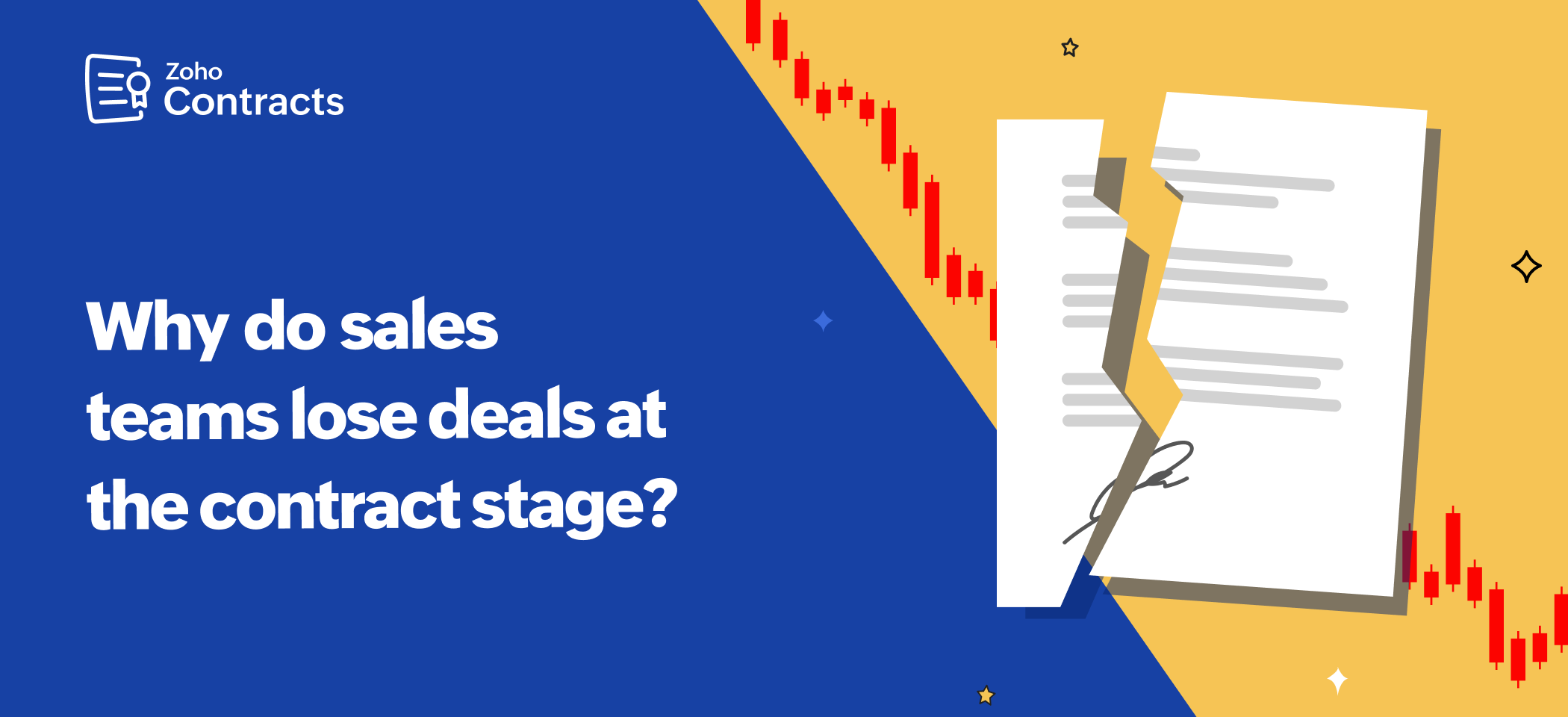
The deal is on. The verbal agreement is secured. The contract is drafted, and the next phase begins. Suddenly, momentum stalls. Legal introduces new clauses that weren’t discussed. Finance and Compliance are brought in for additional review. Soon, the deal is placed on hold.
Many organizations lack a structured process to move from verbal agreement to a signed contract. This is where the salesperson suddenly has to chase decisions they don’t own, and deals slip away.
This article looks at why that gap exists, how common it really is, and what to do about it.
Key takeaways
Much of the total B2B sales cycle time is concentrated in the contract stage, with most stakeholders only engaging at the end.
Deals fall apart at the contract stage for three reasons: structural, execution, and psychological.
Most businesses use CRM, but only 31% of the organizations currently use a contract lifecycle management (CLM) tool.
Gaps between the CRM and the signed contract add hidden cost to every sales cycle.
Fixing the contract stage isn’t about rewriting contracts. It’s about keeping all stakeholders aware from the beginning.
A CLM platform gives all stakeholders a common view of the same deal at the same time.
What contract data reveals about late-stage deals
Every layer adds another week
Forrester’s 2026 State of Business Buying report found that the typical B2B buying decision now involves 13 internal stakeholders and nine external influencers. That number rises for more complex purchases. Most of those approvers don’t engage until the contract stage.
This is why so much of the total cycle time is spent in the contract stage. A deal that sails through internal sales approval often stalls when it hits legal, finance, and compliance review, with each approval layer adding to the time taken.
The signer was never in the room
Gartner research on enterprise tech purchases shows that 67% of decision makers don’t sit in IT. This means most signers and approvers haven’t joined earlier conversations. They arrive at the contract stage with fresh eyes and new objections. They have no relationship with the value the team has built for months. By the time they question price, terms, or renewal, the deal has been in the works for weeks.
Regret often peaks at the signature
Gartner research shows that 56% of organizations report high regret over their largest tech purchase. Regret peaks at the moment of signature, before implementation even begins. Long contract cycles and late-stage objections add to buyer doubt. When a signer hasn’t been part of earlier conversations, the effect grows. By the time the contract is in front of them, many buyers are doubting the deal, and the doubt grows with the size of the ticket.
For the salesperson, every day the contract sits unsigned is a difficult conversation waiting to happen.
How the contract stage slows deals down
The slowdown happens in three places.
Structure: Stakeholders enter the deal in the wrong order. Trust slips, communication breaks, and insight gets lost between the teams that built the deal and the teams that finish it.
Execution: Assumptions become clauses and optional becomes binding. New terms appear that were never raised earlier, and the ones that don’t survive the translation are usually where deals start to slip.
Psychology: The buyer starts to doubt the deal. Stalling builds suspicion, even when the original terms still make sense.
Most organizations fight all three at once, with each one feeding into the next.
Here’s where each one breaks down.
Structural failures
Teams working in silos
Sales teams track deals in the CRM. Legal focuses on contract review in the document management system. Procurement concentrates on vendor approval and cost in the spend platform. Finance evaluates revenue through the ERP.
Each function looks at the deal from its own specialized platform, yet there’s no shared visibility into terms, changes, or status. Revenue stalls at the intersection where these streams should converge. The onus sits with the sales representative, who’s constantly chasing the deal forward with nothing but emails and follow-up calls to track its status.
The salesperson becoming the project manager
When teams work in silos, someone has to coordinate them. That someone is the salesperson. They spend their day tracking statuses, chasing approvers, scheduling reviews, and reminding people of deadlines. The work they were hired for (closing deals) gets crowded out by the work they weren’t (managing other teams’ workflows). The job slowly stops being selling and starts being internal logistics.
Execution failures
Sales promises not matching the contract
A sales rep agrees to something in a call: white-glove onboarding, a custom integration, or a flexible exit clause. The buyer hears the promise, takes it as fact, and signs off internally. The sales contract that arrives two weeks later says none of it. No one lied, but the promise only lived in the conversation. It never made it into the document. The buyer finds the gap, pushes back, or starts to doubt the seller’s reliability. Trust slips here, and the deal slows.
CRM data not matching the contract
The CRM reflects the deal as the sales team perceives it. The contract, shaped by legal, finance, and the buyer, often looks different. These versions seldom align. A deal listed at $200,000 in the CRM is signed at $180,000. A close date set for the 28th of the month moves to the 7th of the next month. The buyer named as Head of Procurement later turns out to be the CFO. This gap between CRM and contract isn’t a paperwork issue. It’s where forecasts diverge, renewals start incomplete, and customer success inherits only part of what was sold.
Psychological failures
The contract makes the decision personal
A contract turns an agreement into a personal commitment. The stakeholder’s name will be on it, and that changes how they read the document.
Behavioral research on loss aversion shows that people weigh losses more heavily than gains at the point of commitment. The signer and the approvers are usually reviewing many contracts at once, and they scan for red flags and missing standard terms because that’s how they catch mistakes at scale. A contract that doesn’t match what they expect slows down, regardless of how good the deal is underneath.
The salesperson watches a buyer who was enthusiastic last month turn cautious this week, as new objections enter the conversation.
What the contract stage reveals about the sales process
The contract stage is a health check
The contract stage works as a stress test for the sales process. If discovery missed a stakeholder, it’s revealed now. If the qualification didn’t find the signer, they appear now. If sales made promises that the law cannot defend, the contract stage exposes this. Strong sales processes produce fast-closing contracts because upstream work has settled the questions. Weak processes mean contracts stall. Questions arrive all at once with no system to resolve them.
Why the usual fixes don’t work
Most teams try to fix contract-stage friction by fixing the contract itself. They rewrite templates, reword clauses, and simplify the MSA. None of these fix what’s actually breaking. The contract is the symptom. The sales process is the system. Fixing a sales process that spans CRM, document management, the spend platform, and ERP isn’t really a process problem. It’s a workflow infrastructure problem. The systems exist. What’s missing is the connective tissue that links them.
This is exactly what a CLM tool is built for. It gives sales, legal, finance, and the buyer a single view of the same deal. The fragmentation that creates contract-stage friction collapses. Every team works from a shared source of truth.
According to Zoho’s State of Contract Management report, only 31% of respondents involved in contract management currently use a CLM tool.
How to fix the contract stage
Integrate the CRM and the CLM
The deal lives in the CRM. The contract lives in the CLM. When the two don’t talk to each other, the salesperson becomes the bridge, copying information across systems, chasing status updates, and switching between applications just to know where the contract is.
Using a tool that integrates the CRM and the CLM lets salespeople initiate contract requests directly from any module, including Accounts, Contacts, Deals, Vendors, and custom modules. Customer information from the CRM record auto-transfers into the contract template, the contract is auto-assigned to an owner, and the document is attached to the deal record. Zoho Contracts handles this natively through its CRM integration. Find out how.

They can track the contract’s status from the deal record and request next steps from there, including sending the contract for negotiation, signature, or post-execution actions like amendments, renewals, and extensions. They don’t have to leave the CRM to know where the contract stands.

Build templates that update with your business
Most contract stalls trace back to the same predictable points: missing clauses, outdated language, and incorrect indemnity terms. These aren’t mysterious errors. They come from stale templates or contracts rebuilt from scratch every time.
Sales agreements, MSAs, NDAs, and renewals carry different clauses, different risk profiles, and different review needs. A single template can’t cover all of them without creating gaps.
In Zoho Contracts, legal updates each template once and every new contract pulls the latest version. Mapped CRM fields mean that the salesperson’s request generates a populated draft in minutes, with no waiting on legal to start from scratch.

![[Image: Displays how fields can be mapped to Zoho CRM from Zoho Contracts]](https://download-accl.zoho.in/webdownload?x-service=writer&event-id=jbeip47b8d096010f4bd98581236328b14808&x-cli-msg={%22imgurl%22:%22r-jbeip47b8d096010f4bd98581236328b14808-6dd005f8ed3f498ea6ee7395b8351544m7kurnbgops3%22,%22rid%22:%22jbeip47b8d096010f4bd98581236328b14808%22,%22module%22:%22image%22})
Don’t chase the follow-up, automate it
Sales pipeline management treats the verbal yes as a milestone, but the days that follow are when most deals quietly cool. The seller assumes it’s moving. The buyer assumes someone will reach out. And the deal sits.
Configured reminders fix this. Inside Zoho Contracts, automated nudges go to the right approver, reviewer, or signer at the right time, on both sides of the deal. The counterparty doesn’t need an account to see the contract status, and they’re prompted when their action is required. The verbal yes becomes the start of a tracked workflow.
Conclusion
Most sales teams treat a stalled contract as a legal or timing problem. It’s neither. It’s a process problem that was always there, waiting for the contract stage to surface it.
The fix isn’t rewriting clauses. It’s giving every stakeholder a shared view of the same deal simultaneously when the CRM and the CLM are connected. When follow-up is automated and templates are current, the contract stage stops being where deals stall and starts being where they close.
Stop losing deals at the finish line.
 Kendrick Jerry
A CLM Specialist at Zoho Contracts, who works across content strategy, product positioning, and SEO to help teams understand more about contract management. Outside of work, he loves basketball, great conversations, and finding new ways to tell a story.