

- HOME
- Revenue Recognition
- What is deferred revenue? Definition, cases and automating recognition process
What is deferred revenue? Definition, cases and automating recognition process
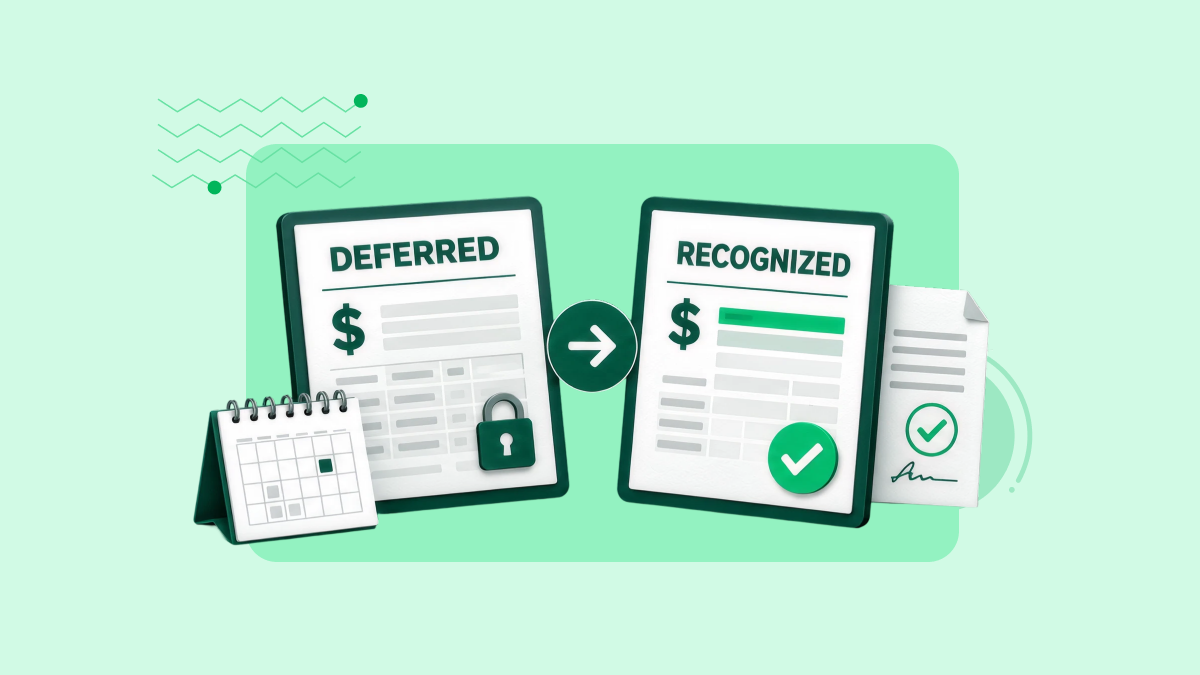
Getting paid and earning that payment as a business are two very different things due to the complexity involved in modern business dealings. Back then, these were straightforward. A good or money is traded for another good which is immediately handed over upon payment. The value is materialized immediately. But these days, there are multiple services that are paid for upfront or much later, which affects an important factor: when that money is actually earned.
What is deferred revenue?
A customer pays upfront for a year of service, and the moment that money lands, your bank balance looks great. But accounting doesn't let you celebrate just yet. Until you've actually delivered what you promised, that cash sits on your balance sheet as a liability, not revenue.
This is deferred revenue.
And it's essentially money you owe in the form of a product or service. It's less "revenue we made" and more "amount we're on the hook for." The business of tracking this, and figuring out exactly when it flips over to being truly earned, is where a lot of nuances apply. Operationalizing it across hundreds or thousands of contracts is a different beast altogether.
This article walks you through what deferred revenue actually is, what triggers it to become "earned," where the process tends to fall apart, and how you can codify it so it isn't rebuilt from scratch every quarter close.
Why deferred revenue is a liability
Say a customer pays $12,000 upfront for an annual subscription. On day one, you've collected the full amount, but you've only delivered one day of service. So, roughly, $11,967 of that is still owed to the customer in the form of continued access. If they cancel tomorrow and ask for a refund on the unused months, you'd have to give some of it back as per the agreed contract terms. That obligation is why it stays as a liability rather than income, you haven't earned the right to call it yours yet.
It's a distinction that trips up teams used to thinking purely in terms of cash flow. Cash in the bank feels like a win. But recognized revenue only happens once the performance obligation—the actual thing you promised—has been delivered.
The lifecycle: cash in, obligation open, obligation closed.
Think of it as a three-stage journey:
Cash received – The invoice is paid. Nothing has been earned yet.
Deferred (obligation open) – The money is a liability while the service or product is yet to be delivered.
Recognized (obligation closed) – As the obligation gets fulfilled, in full or partially, revenue moves from the liability side to the income statement, in full or in parts accordingly.
That middle stage is where most of the operational work happens, and where things tend to go sideways if there isn't a system enforcing it. You may refund the money, the contract may get adjusted, and this should automatically reflect in your records. This is where the infamous 5 step model comes into play to standardize how it should be done across the globe.
What flips the switch
Recognition doesn't happen on a single, universal date. It depends heavily on what you're selling and how you're billing for it.
Time-based (subscriptions)
Revenue is recognized by rate, spread evenly across the subscription period, regardless of when the invoice was raised. A 12-month plan paid upfront releases roughly one-twelfth of that revenue every month. If this is done wrong, you end up overstating revenue in the month you got paid while understating it for the rest of the year.
Milestone-based (projects, implementation fees)
Recognition happens at agreed checkpoints, like kickoff, mid-point delivery, or final sign-off. In such cases, the milestones should be clearly defined in the contract and agreed upon by both parties.
Usage-based
Revenue is recognized as consumption actually occurs, not as it's billed. If a customer is billed in arrears for last month's usage, recognition timing needs to track the usage period, not the invoice date.
Bundled or multi-element deals
A single contract might include software access, onboarding, and support, all priced together. Each component has its own delivery timeline and needs to be split out and recognized separately. Lump them together, and you risk recognizing revenue for services you haven't delivered yet.
Where the process may slip
While in theory it sounds clear, in practice, a few things routinely throw off the schedule.
Manual tracking in spreadsheets: It works completely fine when businesses start out. But when a few dozen contracts get activated, missed cell values and rows start compounding, and nobody notices until the auditor does.
Mid-term upgrades and downgrades: A customer moves plans halfway through their term, and now there are two schedules to reconcile instead of one, plus a proration calculation that needs to be accounted for.
Early cancellations and refunds: When a contract ends early, whatever hasn't been recognized yet needs to be reversed out of deferred revenue too, and that's easy to miss if it isn't tied to the billing event automatically.
Multi-year contracts with built-in price escalations: A three-year deal with a 5% annual bump doesn't recognize revenue in a straight line. The schedule needs to account for the step-up each year. As mentioned earlier, when there are many contracts to juggle, this becomes almost impossible to manage manually.
Ideagen's Audit Analytics restatement research, which tracks two decades of SEC filings, found revenue recognition was the second most common driver of financial restatements in 2025, behind only debt and equity issues. It's a reminder that this isn't a hypothetical risk sitting in a compliance manual; it's a common reason companies end up refiling their numbers. That's why codifying them in the day-to-day process is part of the essentials, not a luxury.
Codifying it into a system
The fix isn't more work from finance, it's removing the dependency on manual recalculation altogether. That means:
Auto-generated recognition schedules that get created the moment a billing event happens, not built after the fact.
Rules-based triggers per revenue type (ratable, custom recognition schedule and more) so recognition timing doesn't rely on someone remembering the contract terms.
Automatic handling of amendments, so an upgrade, downgrade, or cancellation with advanced allocation methods such as retrospective and prospective models.
A complete audit trail for every adjustment, so when the question "why did this number change?" comes up, the answer is easy to fetch.
This is what Zoho Billing's Revenue Recognition module handles, generating and adjusting schedules automatically as billing events happen, so finance isn't reconstructing the waterfall by hand every close.
Why this isn't just finance's problem
Recognized revenue, not billed revenue, usually feeds into board reporting, sales commissions, and compliance disclosures. If commissions are tied to booked revenue, while the board deck reports recognized figures, the two numbers won't agree, and someone will eventually ask why. For more on how recognized revenue shapes board-level conversations, our guide on revenue reporting for CFOs and CROs is worth a read alongside this one.
A quick self-check
If this happens, here's what should trigger automatically:
Customer pays upfront for a year → Schedule starts, ratable recognition begins
Customer upgrades mid-term → Schedule recalculates from the upgrade date
Customer cancels early → Unearned portion reverses out of deferred revenue
Contract includes onboarding + subscription → Revenue splits and each portion follows its own schedule
The sooner an organization realizes the underlying executional complexity in revenue recognition, the better prepared it is to build guardrails before the gap turns into a restatement. If you're looking to move from manual revenue recognition tracking to a system that codifies this for you, connect with our experts to see how Zoho Billing fits into your existing revenue stack.
Frequently Asked Questions
It's a liability, not an asset. Even though the cash is sitting in your bank account, you still owe the customer the product or service they paid for, so it counts as something you're obligated to deliver, not something you've earned YET.
No, deferred revenue sits on the balance sheet as a liability, not on the income statement. It only moves to the income statement once you've actually delivered what was promised, at which point it becomes recognized revenue.
Yes, they mean the same thing. Both terms describe money a business has received but hasn't yet earned by delivering the paid-for product or service.
It becomes recognized the moment you actually deliver on what you promised, whether that's a single event / milestone, a usage period, or a stretch of time like a subscription month. Until that delivery happens, the money stays parked as a liability instead of counting as revenue.