- HOME
- Payment collection and compliance
- EU withdrawal law explained: The 14-day right and the new withdrawal button
EU withdrawal law explained: The 14-day right and the new withdrawal button
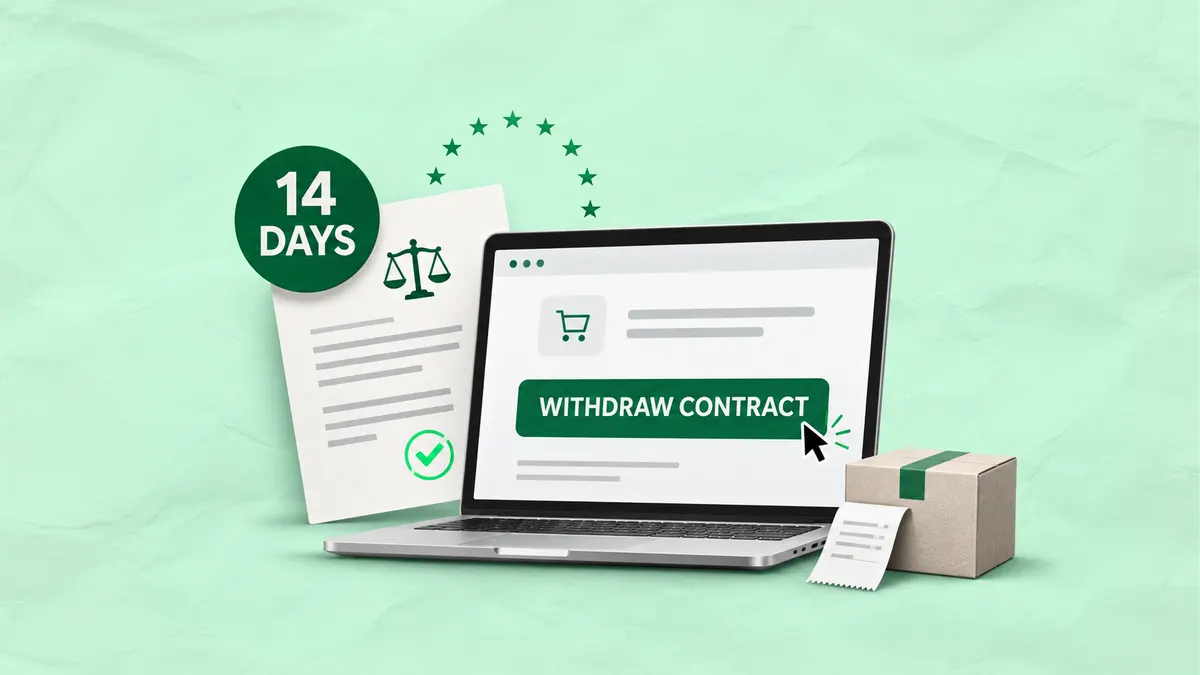
A customer who signs up for an annual software plan may feel a small wobble of doubt after a week of using it, and goes looking for the way out. If that customer lives in the EU, the EU withdrawal law gives them a window to change their mind on most online purchases "without owing an explanation."
This has been in effect for a while. What has changed this year is how easy that exit has to be. Since 19 June 2026, businesses selling online to EU consumers have been required to offer a proper withdrawal function, so this guide walks through what the right of withdrawal covers, how the new withdrawal button works, and how all of it lands on the way you handle cancellations and refunds.
What does the EU withdrawal law actually say?
This is not something new, but it helps to keep things clear. The right of withdrawal comes from the Consumer Rights Directive and, in plain terms, it lets a consumer cancel an online purchase or subscription within 14 days without giving any reason, which is why it’s called the cooling-off period. It doesn’t apply to things bought in a store. It protects consumers rather than companies, so a contract between two businesses falls outside it; goods bought from a private individual aren't covered either.
When does the 14-day clock start?
This one depends on what you sell.
For goods, the 14 days run from the date of delivery, while for services they run from the day the contract was agreed upon, so a subscription to a digital service starts counting the day the customer signs up rather than the day they first log in.
There is a catch here that plenty of businesses miss. If you fail to disclose the right to withdraw to the customers in the first place, the window doesn't close after 14 days but stretches by up to 12 months, which makes the information you show at checkout more important than it looks. (Refer to Article 10, Omission of information on the right of withdrawal). There are some exceptions, such as perishable goods, custom-made items and more. Learn more about them here.
What happens to the money when someone withdraws?
The customer gets the purchase price back, and the refund is due within 14 days of them telling you they’re withdrawing. For services it is a tad complicated, because the customer pays for what they have already used before withdrawing.
Let's say a customer on a monthly subscription plan withdraws on day four. The business keeps the value of those four days and returns the rest (prorated refunds), but only if the customer asked for the service to begin during the withdrawal period via an email or a recorded checkbox, and only if you had told them about their right to withdraw in the first place. Generally, it is advisable to capture this at sign-up, because it is far harder to prove afterwards.
What's new? The withdrawal "button"
The button is the newest update. The new rule applies to online purchases (distance contracts in legal terms) concluded through an online interface such as a website or an app, covering goods, services, digital content, and digital services wherever a statutory right of withdrawal exists. It even reaches non-EU businesses that present their offering to EU consumers, so a company in Bengaluru or Austin selling to customers in Lyon is in scope.
The button standardizes how the existing right is exercised online rather than creating a new one. In practice, the customer needs a prominently displayed function, labeled with wording such as "withdraw from contract here," available throughout the determined withdrawal period. The customer then fills in a few basics, like their name, which subscription or order it is, and an email for the confirmation, and confirms through a second clearly labeled step. You then need to send them an acknowledgment, such as an email, showing what they submitted and when, without delay.
Member states had to write the rule into national law by 19 December 2025, so the details can differ from one country to the next. Your legal adviser is the right person to confirm the wording.
Where do subscription businesses usually stumble?
The button, while important, is just the visible part; it does harm when everything behind it is handled by hand. Think about what happens in your own team when a customer cancels some days into the subscription: You have to work out the refund manually, and there could be delays before it reflects in the reports.
A withdrawal request that waits in an inbox for a week looks like a soft refusal from a customer's perspective, while the legal clock keeps running whether or not your process does.
How can Zoho Billing help with subscription cancellations?
Zoho Billing handles the mechanics for withdrawal as well as the processes that follow it. The cancellation path comes first: You can enable the "cancel subscription" option in your customer portal, so customers cancel themselves without ever having to struggle (which the new rule stresses on). You decide whether they can do so immediately, at the next renewal or both. You can also configure cancellation reasons, which feed your churn reports.
The refund is where the time is saved. With "automatic refunds," canceling an autocharge-enabled subscription generates a credit note and starts the refund without anyone calculating it by hand. The usage-based method refunds the unused, prorated part of the plan, which mirrors the proportional logic for services. The refund policy method lets you define cancellation windows for weekly, monthly, and yearly plans, so a flat 100% refund during the first 14 days is something you can set up if your terms are more generous than the law requires. Every refund then shows up in the "refund history" report, and credit notes keep the paper trail tidy.
While Zoho Billing also offers a "pause subscription" option, it is never a replacement for a real cancellation when a customer asks for one, and that applies doubly to a withdrawal. It is just you giving them a choice, which is entirely at their disposal to use or ignore.
If you would like to talk through your own cancellation setup with a Zoho Billing expert, you can book a conversation with them and bring your questions along.
The exact wording of your withdrawal function, its confirmation step, and the acknowledgment message are part of your own customer journey, so build and review those with your legal team alongside the portal settings above.
The takeaway
A withdrawal is a small event in a customer's day, but in your books it is a sale that has to be unwound, and that is where the legal and finance teams should work together. So ensure that you:
Build a leak proof policy around cancellations and withdrawals.
Communicate it clearly to your customers.
Build operations and systems that carry these out without hiccups.
This article is for general information and isn't legal advice.
Frequently Asked Questions
It is a consumer right under the Consumer Rights Directive to cancel most online and other distance purchases within 14 days without giving a reason. For goods, the 14 days start on delivery, and for services they start on the day the contract is made.
Not quite. The withdrawal button lets a consumer use the 14-day right online, while ending a subscription further down the line is a separate matter, and some countries, Germany among them, have had their own cancellation-button rules for a while. Check what applies in each market you sell into. If you run subscriptions in Zoho Billing, you can let customers cancel from the customer portal as a starting point.
Generally, no, because the right of withdrawal protects consumers rather than companies. If your customer base is a mix of businesses and individuals, the individuals still need the function, so it helps to be able to tell the two apart at sign-up.
For online sales, the directive requires an express request from the customer. Recording it on a durable medium, such as a stored checkbox or email, is the best way to prove it was made. It should be a deliberate action by the customer rather than a clause buried in your terms. Keep a dated record of it against the subscription for legal purposes.