- HOME
- CPQ (Configure, Price, Quote)
- Guided selling: How to simplify product recommendation and boost revenue
Guided selling: How to simplify product recommendation and boost revenue

The permutations and combinations of products are endless today — base access with credits in AI/SaaS, a broadband plan with mesh router in telecom, or a gym membership with session add-ons for corporates. The offerings are more customizable, making the whole purchasing process feel a bit more complex too.
Here is how the day-to-day scenario goes. On one side, you have a catalogue of products with add-ons properly sorted in your system. On the other end, there is a customer who just has a requirement; they don’t really come looking to purchase your "Power growth" bundle. The translation process is essentially carried out by communication via your website, your sales representatives, your showcase system, and any other touchpoints working to map that requirement to the right product.
Over time, a business also learns the patterns that naturally arise — what gets purchased together often, potential combinations that could add more value to end users, combinations that can generate higher profit margins — and that knowledge is more available today than it used to be. Businesses can now foresee a flow instead of just selling individually on demand.
This is where guided selling comes in
This is an approach to showcasing and recommending the right product or combination, built upon the knowledge of how customers behave including what they pick, what they pair it with, and what they come back for next. Recommending a combination to a customer who is already leaning towards it is the easier half of the guided selling. But creating demand for a profitable and useful combination, before the customer even realizes that they might need it, is where the game is!
So how does a quoting tool take the buyer's own words and turn them into that short list, and what does it do to revenue once it does? The rest of this article follows that question, from the definition to what happens after the quote is accepted.
What is guided selling in CPQ?
CPQ stands for configure, price, quote. It helps sales teams share customized and accurate quotes in a few clicks, using product combinations and price rules that were set up in advance.
Guided selling lives within the first of those three words. Before a quote is created, guided selling suggests the right product from the catalogue to the customers without friction and delays.
How does a guided selling flow work?
Think of it as a funnel that starts with the buyer's words and ends with a priced quote. Here's an example from Bosch. They have numerous products and instead of dumping them onto the visitors with product grids and filters, they try to understand what the user needs and display options that probably matter to them using pre-configuration. This tremendously cuts down the exploration stage and quickly pushes the buyer towards the decision.
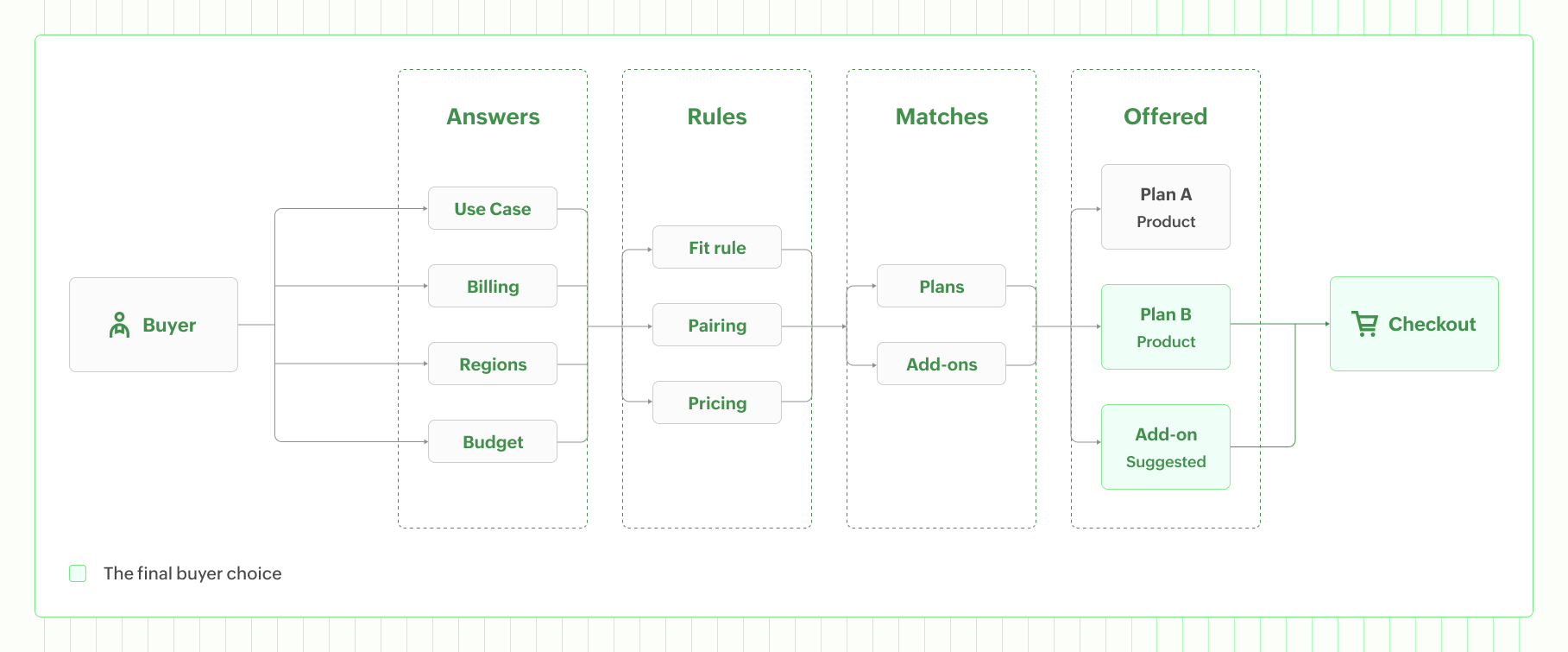
It starts with the questions
The questions work best when written in the buyer's vocabulary, since that is the vocabulary the rep hears on the call. A few examples:
What problem is the buyer trying to solve first?
Which regions or currencies does the quote have to cover?
Is there an existing tool being replaced?
Add anything that you know your customers would use to arrive at a purchasing decision.
Then the rules narrow the catalogue
Once the buyer states what they need, that requirement is matched against the catalogue to come up with the right recommendation. In a CPQ tool, during the configuration process, the "suggested add-ons, value packs" and eligible coupons can be assigned, so the sales representative isn’t left trying to remember which extras belong with which plan.
Where does the extra revenue come from?
Most revenue growth is a build up of small moments in the deal that used to leak and no longer do. This table maps a few of them:
Table
There is also a longer-term angle, and it is a hypothesis that you can test with your own data. A buyer who was sold what they needed on day one might be less likely to downgrade during the first renewal. If that holds, guided selling affects retention as much as it affects the first deal size.
Speed matters as well. Deals cool down while quotes are being reworked, and a shorter gap between the call and the quote keeps the buyer's interest warm.
How it assists the sales representatives
There is a common perception that guided selling pushes sales reps out of the purchase cycle picture. In practice, it takes over the searching and cross-checking that used to eat into the call. The part that needs a human, which is listening to the buyer and earning their confidence, stays right where it was. This just helps reps stay confident during recommendations and keep the attention on the buyer rather than scanning the screen while on the call.
Moreover, the rep still makes the call, since a recommendation is only a starting point that they can accept, adjust, or set aside when they know something the rules don't. New reps benefit too, because they begin from the answers that experienced reps have already worked out and build their own judgment on top.
What should you have in place before setting it up?
A few preparations make the difference between a tool reps trust and one they route around.
A clean catalogue: Duplicate products and retired plans confuse the rules and the reps alike.
A clear owner for the rules: Product and sales operations usually need to share this. A rule written once and left alone will go stale before long.
A starting point: Pick the product families that get mismatched most often and begin there, rather than modelling the entire catalogue on day one.
A system that can carry these out without demanding fragmented tools is essential. Zoho Billing helps you build a clean catalogue with product add-on hierarchies where you can mandate or suggest add-ons. A huge advantage here is that the sales and finance teams get an opportunity to work from the same data source that is produced and maintained in Zoho Billing.
Building a smooth buyer flow with Zoho Billing
A growing catalogue is a good problem to have until it grows past a point where buyers are overwhelmed and a new rep has a whole rule book to memorize before their first call. Guided selling gives that knowledge a home in the quoting flow, which people can draw from when a purchase happens. Down the line, this reduces purchasing time dramatically, plugs revenue leaks that happen due to mistakes in the initial stages, and also yields invaluable insights into buyer behavior and hidden opportunities.
Learn how you can leverage Zoho Billing to streamline the whole process, from configuring catalogue and bundles to billing and retention.
Frequently Asked Questions
Guided selling is the part of CPQ that aims to simplify and speed up the purchase process. It helps narrow the catalogue to the product, add-ons, and coupons that fit the buyer requirements. That gives the rep, or the buyer, a short and sensible list to quote from instead of the whole catalogue.
It can be used in both. The same questions and rules that guide a rep on a call can sit behind a customer or partner portal, so buyers who prefer to research on their own still land on a sensible recommendation. Reps can then pick up from that point rather than start from scratch.
No, it takes over the part of the job reps tend to dislike: remembering which add-ons go with which plan and rebuilding quotes after a missed detail. That frees them to spend the call on the buyer’s actual situation, which is where judgment still matters.
Compare the numbers from before and after you switched it on. The useful ones are average deal size, add-on attach rate, time from first call to quote, and how often a quote is revised after it is sent. If the retention idea in this article holds for you, early downgrades at the first renewal are worth tracking too.
Review them whenever the catalogue changes, such as adding a new plan, retiring an add-on, or updating pricing. You can also review them on a fixed schedule like once a quarter. Rules that nobody owns tend to go stale quietly and start recommending products that no longer fit.