

- HOME
- Billing basics
- What is usage-based billing? Models, benefits, and examples
What is usage-based billing? Models, benefits, and examples
A straightforward example of usage-based billing is to think about how you pay for electricity at home. You don't pay a flat fee regardless of how much power you draw from the grid, and you're not expected to guess your annual usage upfront either. You simply pay for what you consume. Usage-based billing (UBB) borrows this exact logic and brings it into today's dominant industry–software and digital services.
Instead of every customer on a "Pro plan" paying the same amount, irrespective of how much they actually use the product, usage-based billing ties the invoice to consumption: API calls, storage, minutes, transactions, or whatever unit reflects value for that specific business.
This isn't a passing trend. It came from a growing discomfort with flat and seat-based pricing, since they punish light users while under-monetizing the heaviest ones. According to McKinsey, the number of software companies using consumption-based pricing more than doubled between 2015 and 2024, a shift the firm links directly to the rise of AI-driven products, where usage no longer scales neatly with just headcount, a model that heavily supported SaaS of that age.
This article breaks down what usage-based billing actually means, the models businesses commonly build around it, the benefits and trade-offs worth knowing, and a few recognizable examples to make the concept concrete.
What is usage-based billing?
Plainly, usage-based billing is a pricing approach where customers are charged based on how much of a product or service they consume, rather than a fixed recurring fee. What counts as "usage" depends entirely on what a business sells.
A cloud storage company may charge per gigabyte stored.
A messaging platform may charge per SMS or email sent.
An AI company may charge per token or per API call.
An IoT business may charge for sensor data events across devices.
The principle stays the same across all of these. The bill reflects the value a customer actually extracted.
Why enterprises are leaning into it
Subscription pricing, a flat monthly or annual fee, has been the default for the software industry for a long time. It brings predictable revenue for businesses while also being simple to deliver for customers. But that predictability for the vendor often came at the cost of a value mismatch for the customer. Someone who logs in twice a month and someone who runs their entire operation through the platform end up paying the exact same amount, which starts to feel unfair the moment they notice it.
Usage-based billing is fixing this mismatch. And as the previous McKinsey research on the topic pointed out, AI is accelerating the shift further: Since AI workloads (tokens, compute, inference calls) don't map cleanly onto a "per seat" logic, more software companies are being pushed to rethink pricing around actual consumption rather than headcount.
Common usage-based billing models
Not all usage-based pricing looks the same. Depending on the product and how much revenue predictability a business wants to retain, enterprises typically pick from the following models, or combine a few of them.
Pure pay-as-you-go
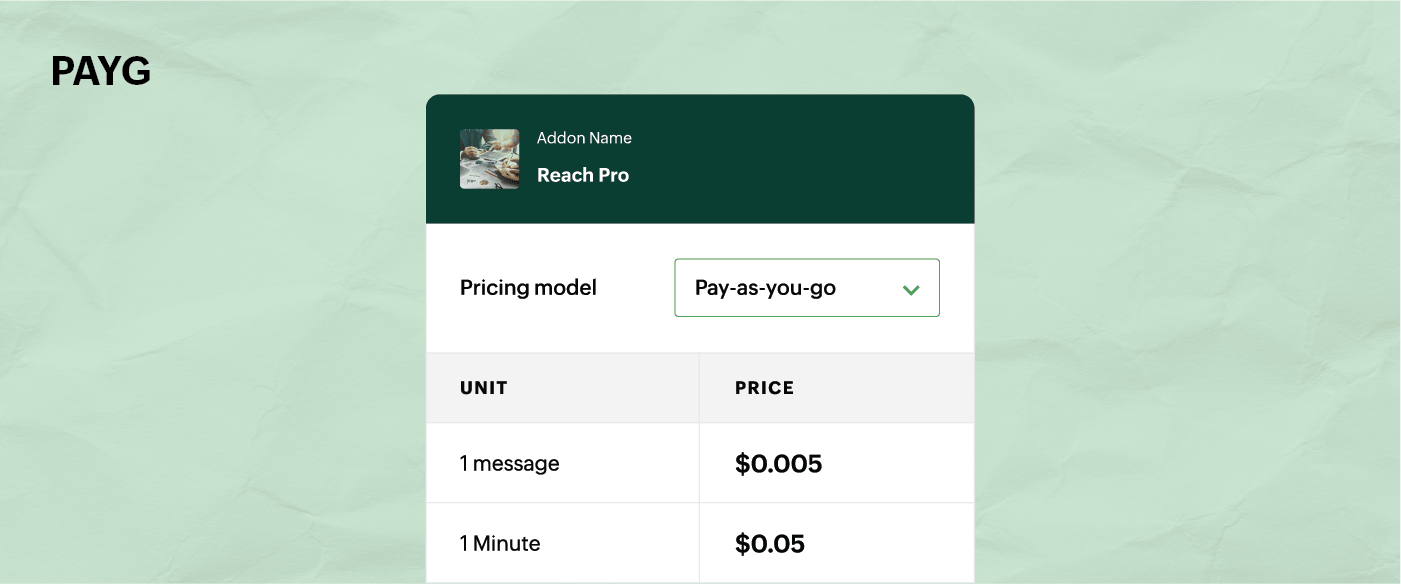
Customers are billed strictly for what they use, with no base fee and no included allotment. This is the purest form of usage-based billing. Think cloud compute billed by the second, or a messaging API billed per message sent.
Best suited for: Businesses selling infrastructure-like services, where usage can spike or drop unpredictably, and a flat fee would either overcharge light users or undercharge the heaviest ones. This does affect the revenue predictability on a large scale.
Tiered usage-based pricing
The price per unit changes as consumption crosses certain thresholds. The first 1,000 units might be priced higher per unit than the next 10,000, which rewards higher usage with a better rate.
Best suited for: Businesses that want to reward scale, similar to how buying in bulk lowers the per-unit cost in retail.
Volume-based pricing
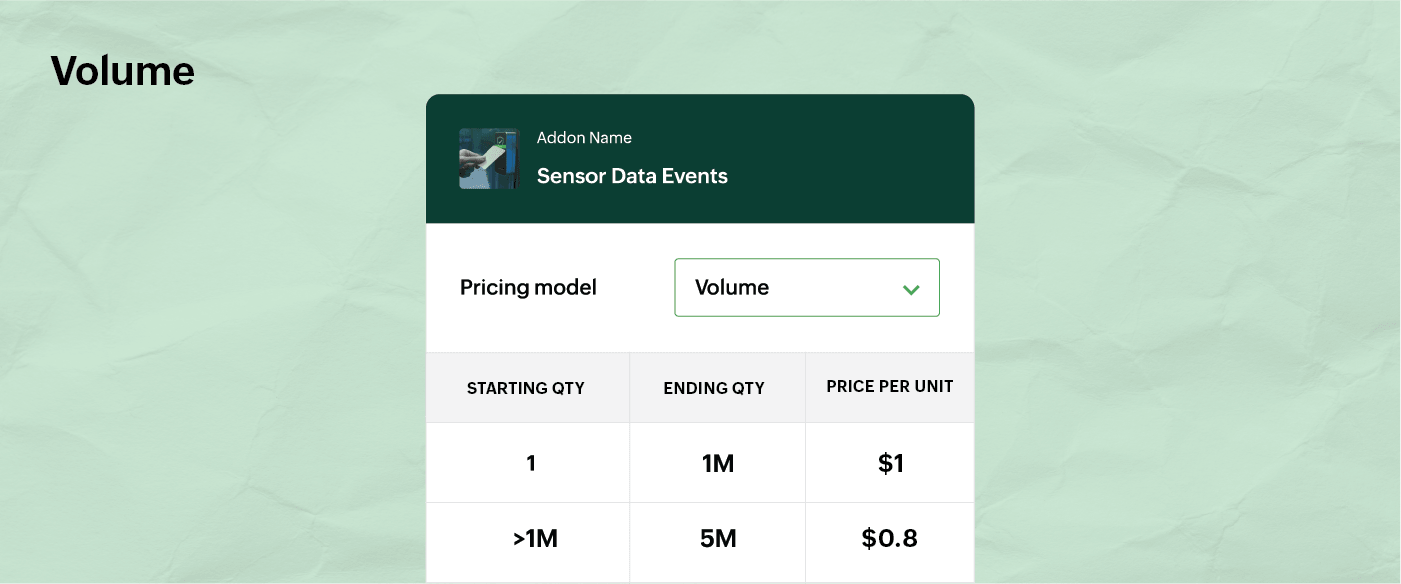
This works a little differently from tiered pricing. A single rate applies to all units once a volume threshold is crossed, rather than each tier being priced separately. If a customer crosses into the next bracket, the new rate applies retroactively to their entire usage for that period.
Best suited for: Businesses that want to keep the math simple for the customer while still rewarding scale.
Credit or prepaid-based billing
Here, customers buy a bundle of credits upfront and draw from that balance as they use the product. Unused credits may roll over, expire, or renew automatically once a threshold is reached. Overages are either billed later, or the business can restrict them and the customer can resume services upon purchasing a top-up plan.
Best suited for: Products with multiple unit types (say, one credit could equal one email or five SMS), giving the business flexibility internally without confusing the customer with too many separate line items.
Hybrid pricing
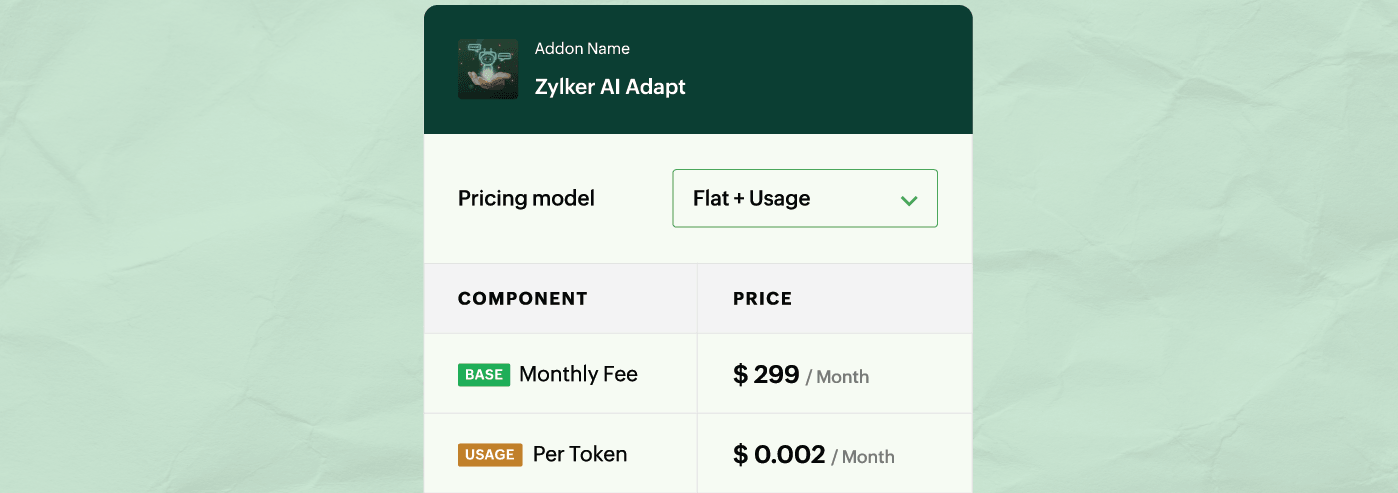
As the complexity of value provided by solutions grows, this has arguably become the most common structure among businesses today. A fixed base fee includes a set allotment of usage, and anything beyond that is billed on top. This gives the vendor predictable minimum revenue while still letting the bill grow with adoption.
Best suited for: Most B2B SaaS companies, since it balances the predictability customers want for budgeting with the expansion potential that usage-based billing brings.
A quick side by side comparison
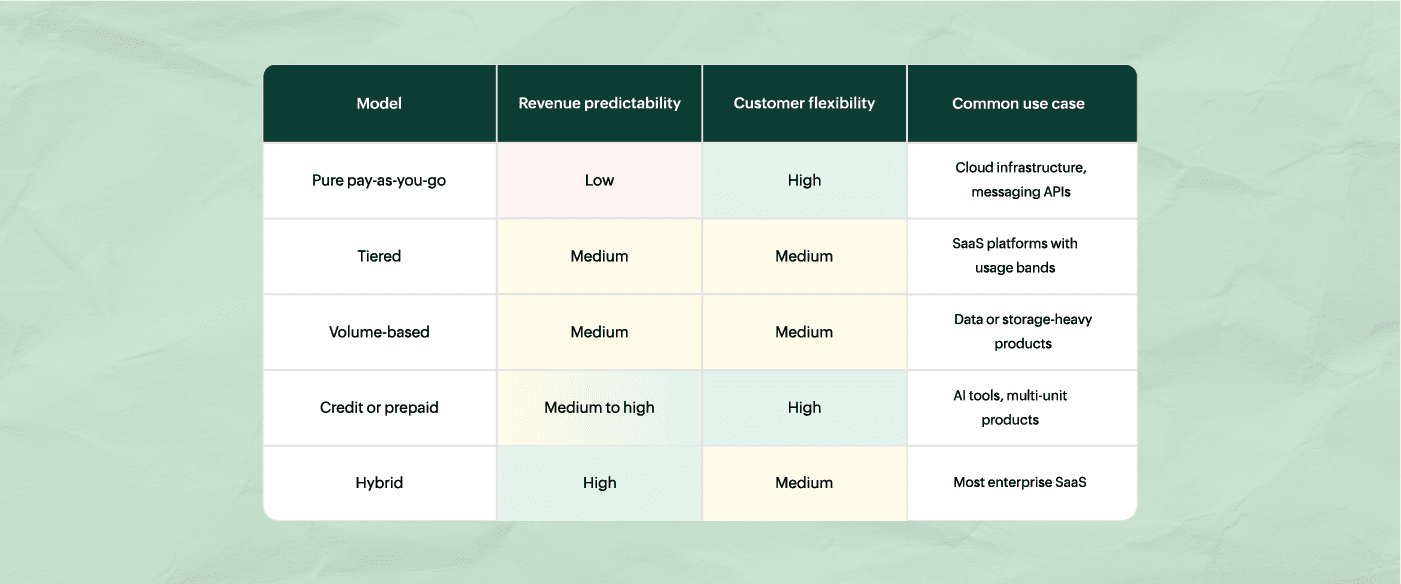
Benefits of usage-based billing
For the business
Revenue grows organically alongside product adoption, rather than depending solely on new sales.
There's a lower barrier to entry for new customers, since they aren't asked to commit to a large flat fee before they've realized any value.
Genuine usage patterns become visible, which product and customer success teams can use to catch expansion or churn signals early.
For the customer
They pay in proportion to the value they actually extract, which feels fairer, especially for lighter users.
Budgeting becomes usage-driven rather than a guess made a year in advance.
No more pressure of paying for a plan they're locked into but rarely use fully.
The trade-off you should know
Usage-based billing isn't without friction. Revenue becomes harder to forecast compared to flat subscriptions, since it moves up and down with customer activity rather than sitting still. It also asks more of the billing system itself: accurate usage capture, correct proration, and invoicing that reflects consumption without errors creeping in. This is exactly why hybrid models remain more popular than pure usage-based models. They hold onto a layer of predictability while still letting revenue expand alongside usage.
Examples of usage-based billing in practice
AI and data platforms
Pricing here is increasingly built around tokens, outcomes, API calls, or compute cycles consumed, since per-seat pricing rarely maps well to how these tools actually get used. Read how AI businesses can think about monetization here.
Cloud computing
Providers commonly bill for compute, storage, and bandwidth based on exact consumption, sometimes down to the second or the byte.
OTT and media
Streaming platforms increasingly price around watch time, concurrent streams, or bandwidth delivered, especially in enterprise and B2B licensing deals, rather than a flat subscription applied evenly across every account.
Telecom
Messaging and email delivery services often charge per message, call minute, or email sent.
IoT
Connected device platforms commonly bill per active device, per data packet transmitted, or per sensor reading ingested, since it's the number of devices in the field that drives cost, rather than the number of people managing them. The pattern holds across every example above. The unit being billed is meant to reflect the unit of value the customer is actually getting.
The shift towards usage-based pricing by AI businesses
If there's one category forcing this shift faster than any other, it's AI. And the reason is more about survival economics rather than just a trend or preference.
Traditional software has always enjoyed this advantage: Once it's built, serving one more customer costs the business next to nothing. A CRM doesn't get meaningfully more expensive to run because 500 more people log into it. AI products totally break that assumption. Every prompt, every inference, every token generated pulls real compute cost off a real GPU somewhere.
The most interesting part about this revolution is that pricing isn't just the finance team's responsibility, that is, it is not just about the revenue. Product teams are now taking the reins alongside finance teams because usage-based pricing gives them a more honest picture of what customers are actually doing with the product. One of our customers, Clodurai.ai, had its product team lead the Zoho Billing implementation.
In Zoho Billing's usage-based billing webinar, Hrishikesh Kale, the product manager of Clodura.ai who designed the pricing for the product and led the operational aspect of it, said, "Pricing is a product decision." For an industry still figuring out how to price something as unpredictable as AI output, their involvement is turning out to be a valuable currency.If you are an AI business looking to implement or refine your usage-based pricing strategy, watch this webinar where Kale shared key lessons on designing the right usage-based model for their GenAI go-to-market platform.
Getting the operational side right
The idea behind usage-based billing is simple enough to explain in an article like this. Running it well is a different story. As already mentioned, it requires a clear understanding of what value means for your business and a system that captures usage accurately, applies the right pricing logic, generates invoices without manual reconciliation, and gives finance leaders visibility into revenue which is becoming increasingly unpredictable.
This is why the billing platform itself becomes a strategic decision rather than a purely operational one. Enterprises exploring usage-based pricing need a system built to handle that complexity in the background, so the pricing experience itself can stay simple and fair on the customer's end.
If your enterprise is exploring a shift toward usage-based or hybrid pricing, explore how Zoho Billing can support the entire journey, from usage capture to invoicing and revenue recognition.
Frequently Asked Questions
Usage-based billing or consumption-based billing is a pricing model where customers are charged based on how much they use, not a flat fee. Common units include API calls, tokens, GB, seats, or events. It's the standard for AI, SaaS, IoT, and cloud infrastructure businesses where usage varies significantly across customers.
Drawdown is the process of deducting from a prepaid credit balance as a customer consumes. When a customer buys 10,000 tokens upfront, each API call draws down from that balance. Drawdown logic defines the order — which credits are consumed first, across which services, and at what rate.
Feature gating restricts access to specific features based on a customer's plan or credit balance. In usage-based billing, gates are tied to entitlements — a customer on the Starter plan may only access 3 models, while Pro unlocks all. Gates enforce plan limits without manual intervention.
Rollover allows unused credits at the end of a billing period to carry forward to the next. Expiry defines when credits become void — at period end, after a fixed duration, or never. Most businesses configure expiry to protect margins and rollover as a retention lever for higher-tier plans.
UBP fits when your customers' consumption varies significantly, when value delivered correlates directly to usage, or when you want to lower the barrier to entry. If your cost-to-serve scales with usage and you want pricing that grows with your customers, usage-based is the right direction. It's not ideal when usage is unpredictable for the customer and creates billing anxiety.
Unit economics measures the revenue and cost associated with a single unit of your product. Your base unit is the smallest measurable action that delivers value: a token, an API call, a GB, a transaction. Find it by mapping what your customer actually consumes to what it costs you to serve. The unit that most directly correlates to value delivered is your billing unit.