Advanced Analytics for Shopify
Advanced Analytics for Shopify helps you understand your customer's preferences, identify the underlying trend, keep track of key metrics like average order value, customer retention rate and forecast sales performance. It enables you to devise robust business strategies to boost your store sales and to stay ahead of your competitors.
This connector is bundled with 100+ pre-built reports and dashboards which gives a deep insight on your store in great detail.
- Prerequisites
- Setting up the Integration
- Handling Data Synchronization Failure
- Managing Data Sources
- Data Modeling & Preparation
- Data Visualization/Analysis
- Sharing & Collaboration
- Help & Support
Prerequisites
To set up the Shopify Advanced Analytics connector, you must provide a Client ID, Client Secret, and Store Domain from Shopify. The following prerequisite steps are designed to help you create the necessary Shopify App and obtain these credentials.
Before you begin, ensure you have a Shopify Partners Account. If you do not have one, login to Shopify Partners portal and create a Partner Organization.

Step 1: Access the Shopify Development Dashboard
- Log in to your Shopify Partner account.
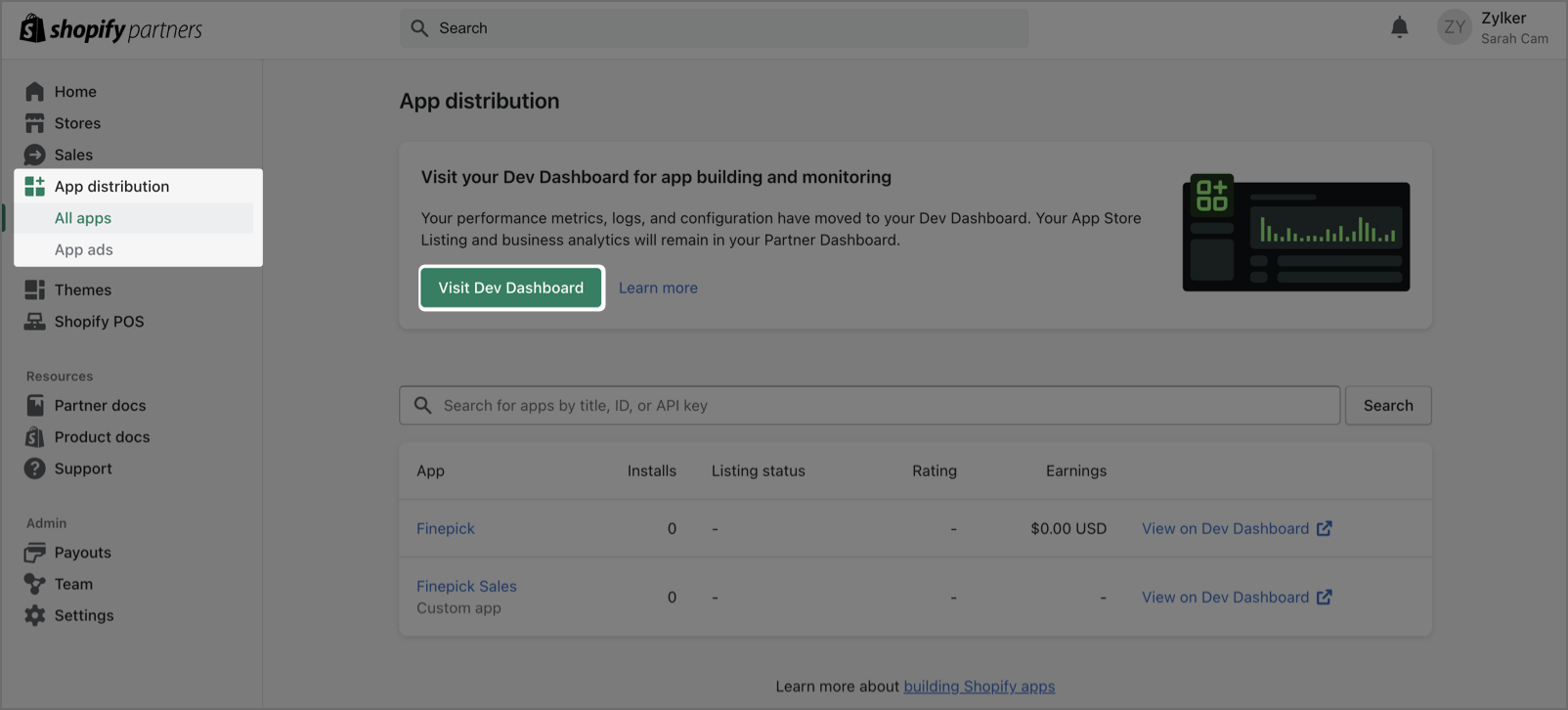
- From the left-hand navigation pane, select App distribution > All Apps.
- In the App distribution page, click the Visit Dev Dashboard button.
Step 2: Create and Configure the App
- In the Dev Dashboard page, click the Create App button.
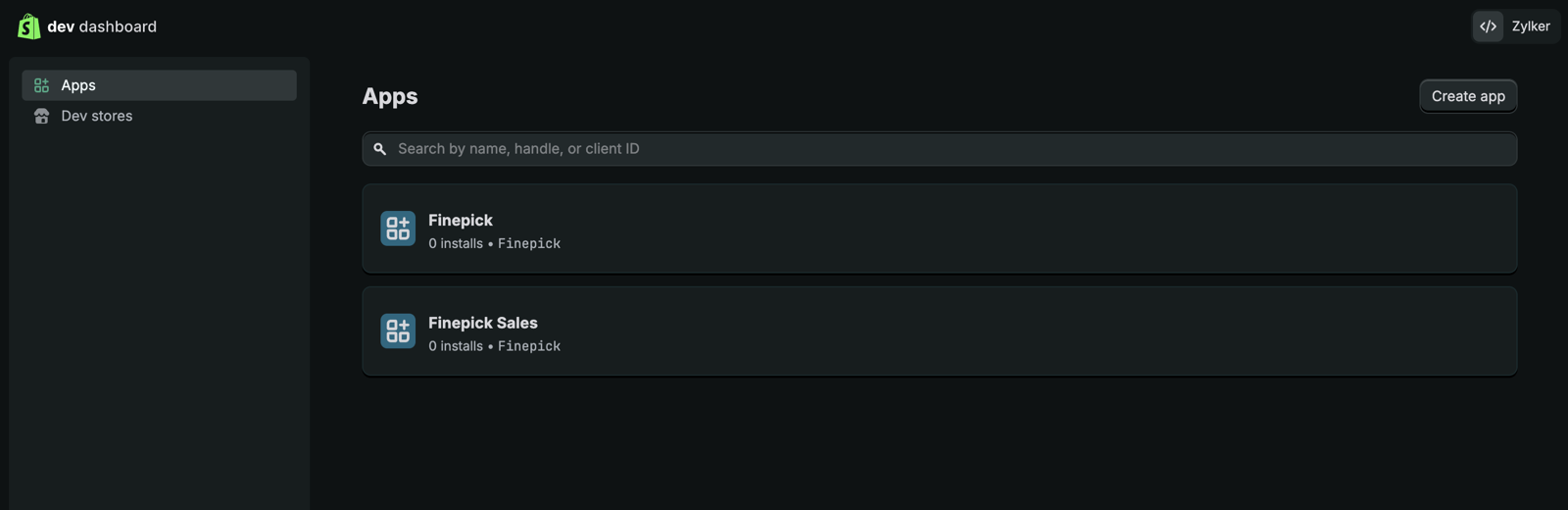
- In the Create an app page, in the Start from Dev Dashboard section, enter a name for your app and click Create.
- In the App URL field, enter your application's base URL if required.
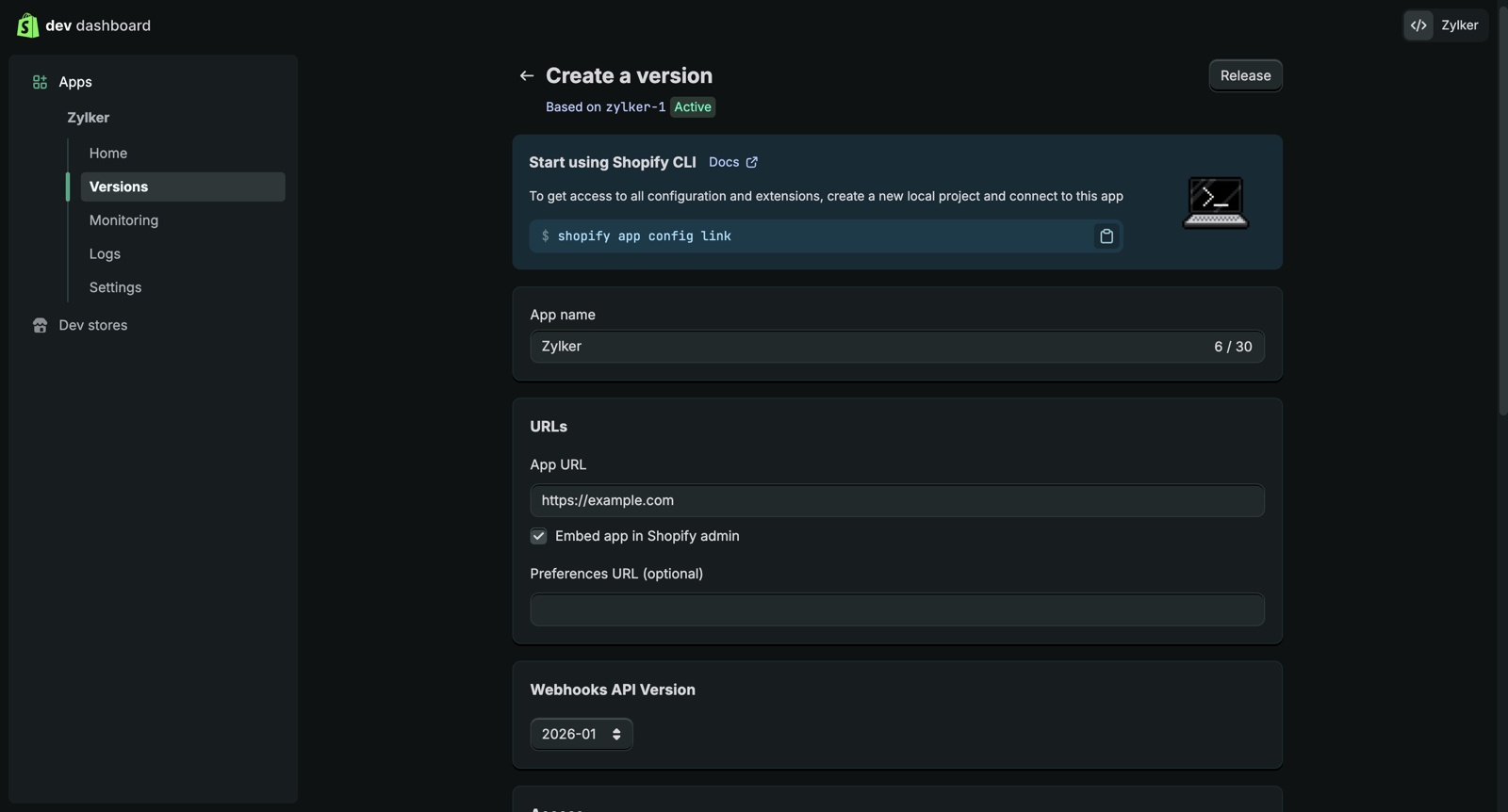
- Configure Scopes:
- Navigate to the Access section.
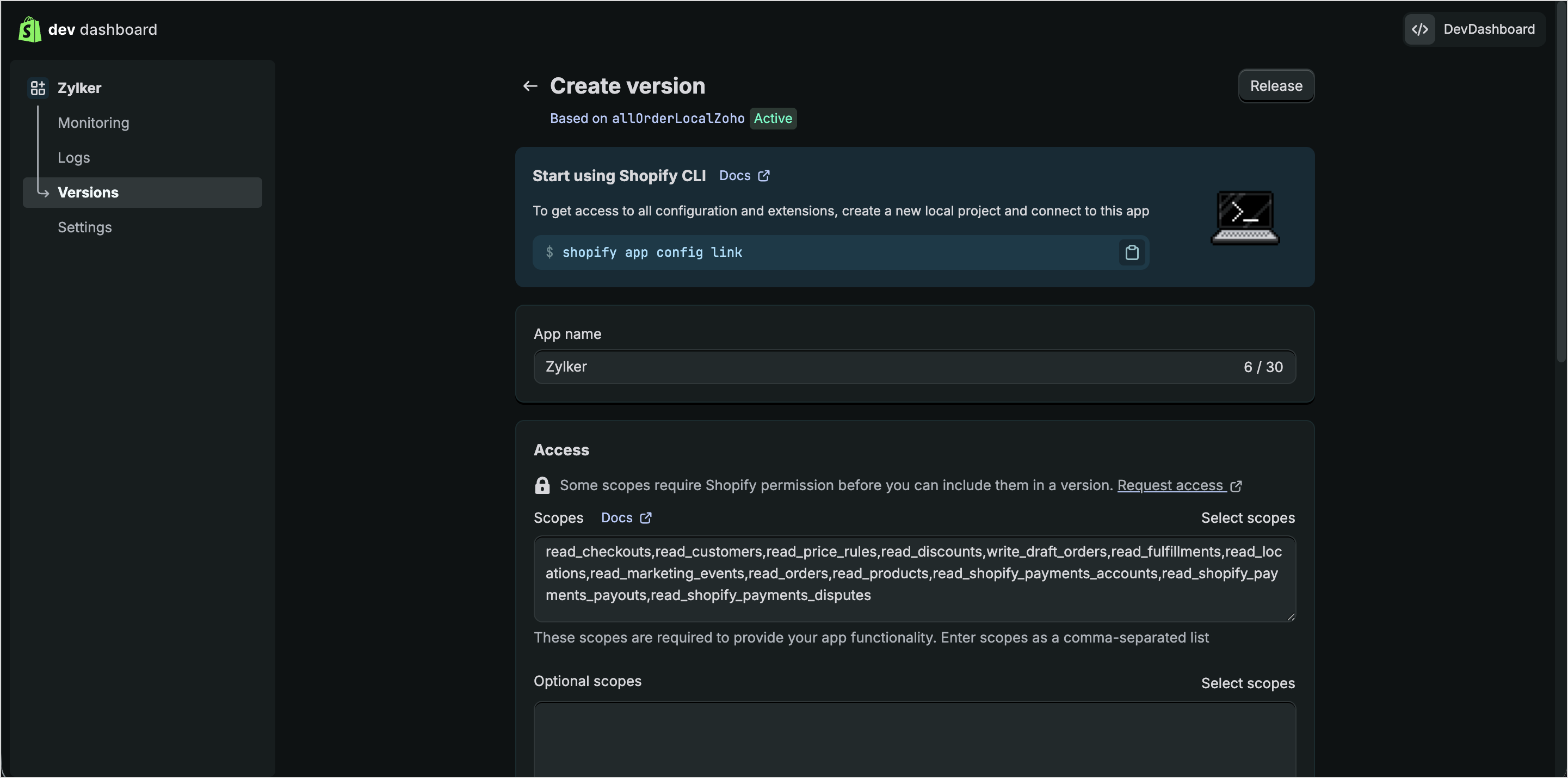
- Under Scopes, select the scopes listed below.
- read_orders
- read_products
- read_customers
- read_draft_orders
- read_locations
- read_fufillments
- read_price_rules
- read_marketing_events
- read_shopify_payments_payout
- read_shopify_payments_disputes
- read_shopify_payments_accounts
- read_discounts
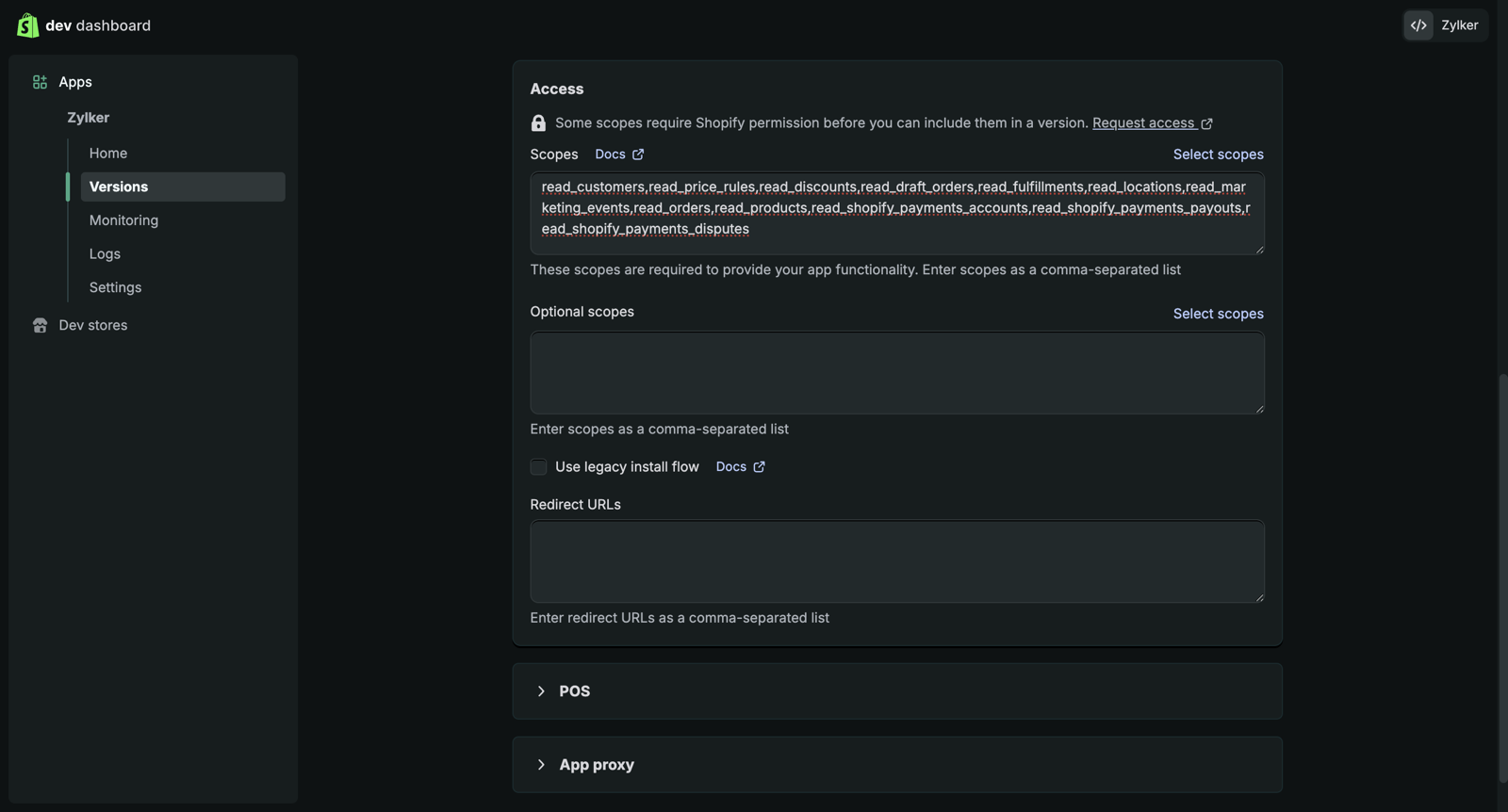
- Set Redirect URL:
- Open your Analytics account in a separate browser tab.
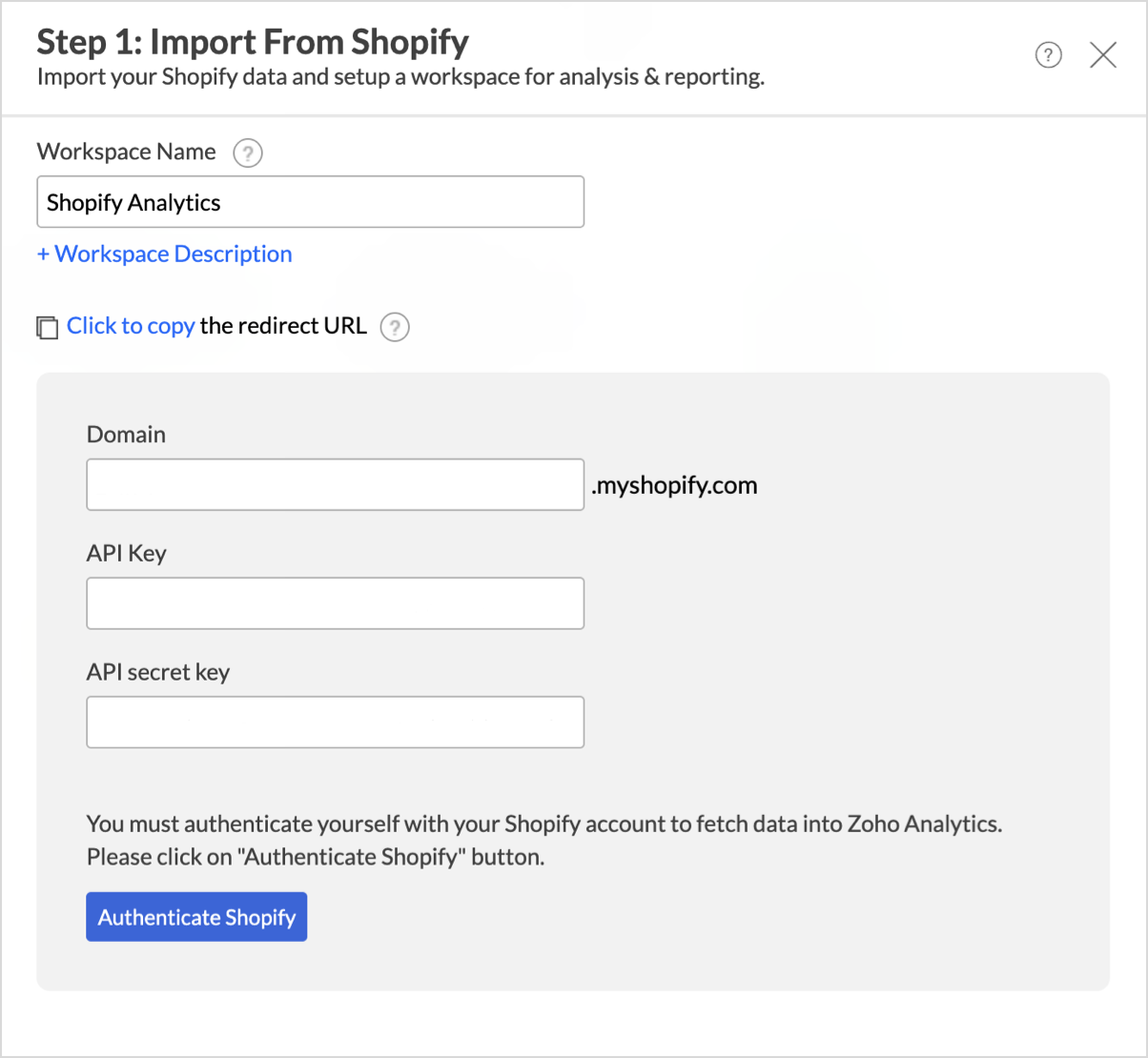
- Navigate to Import Your Data > Shopify.
- Copy the Redirect URL provided in the Step1: Import from Shopify dialog box.
- Return to the Shopify Dev Dashboard and paste this into the Redirect URL field.
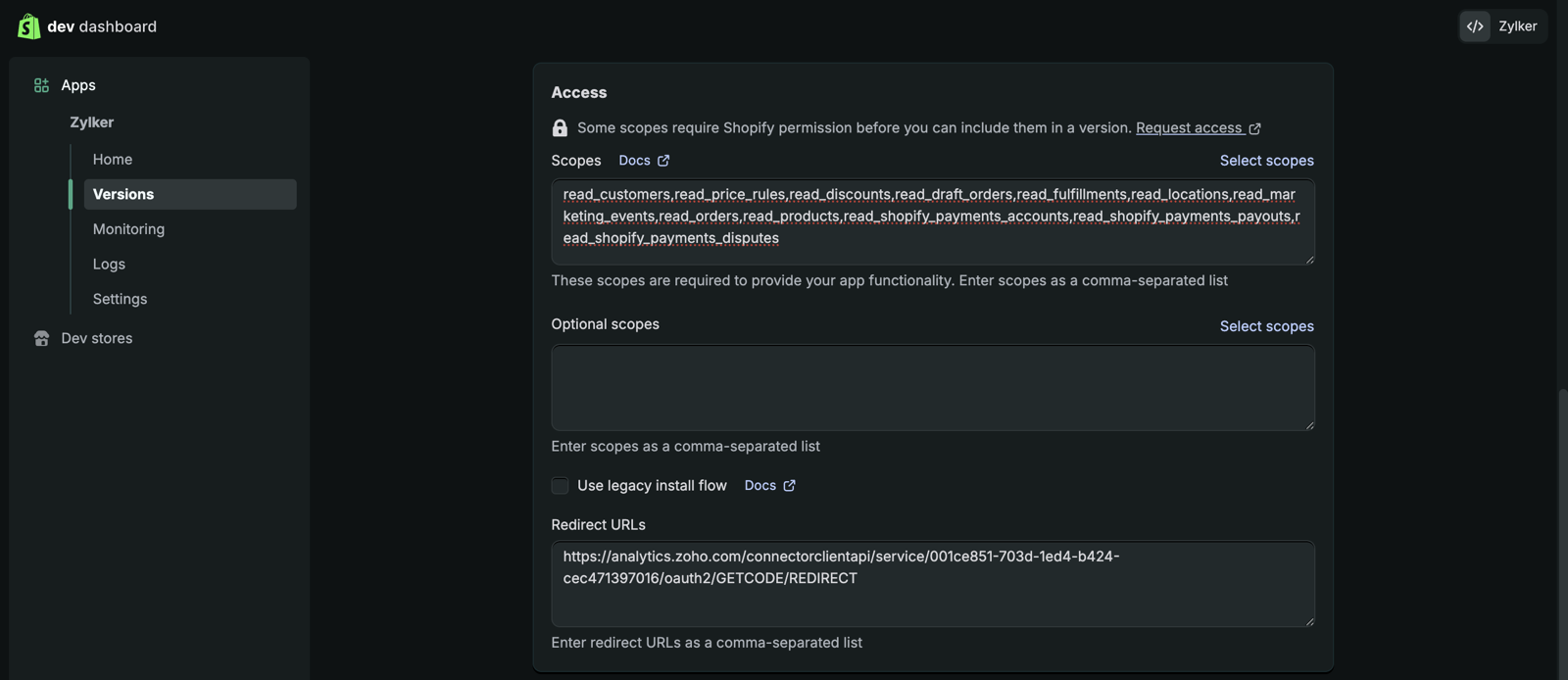
- Click Release to finalize the configuration.
Step 3: Install the App
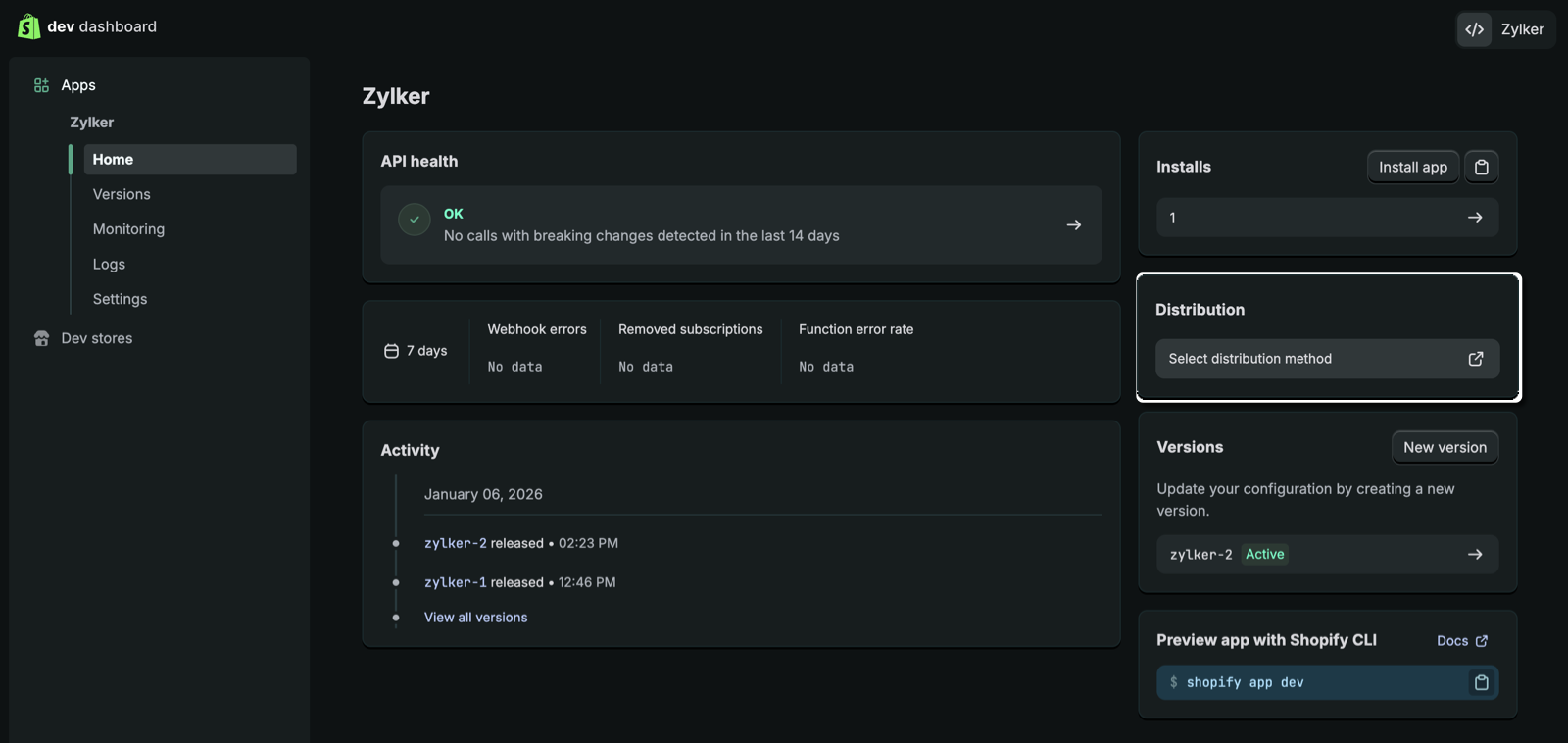
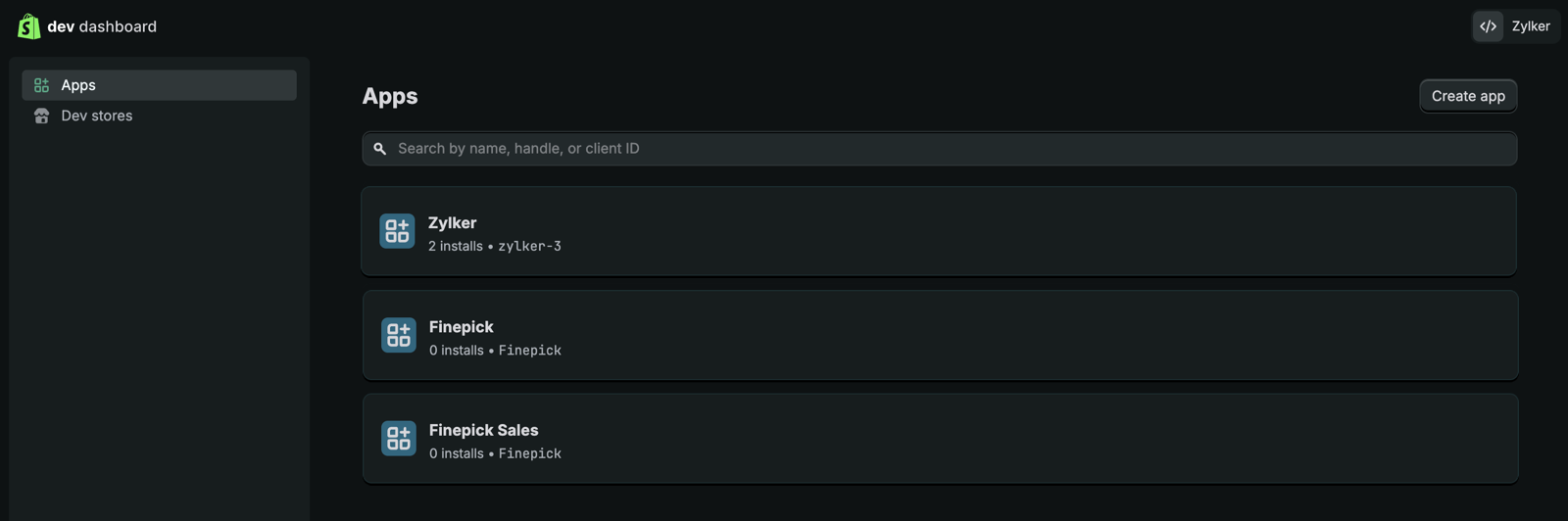
- The newly created app in the Dev Dashboard.
- From the Home tab, navigate to the Distribution section on the right and click Select Distribution Method.
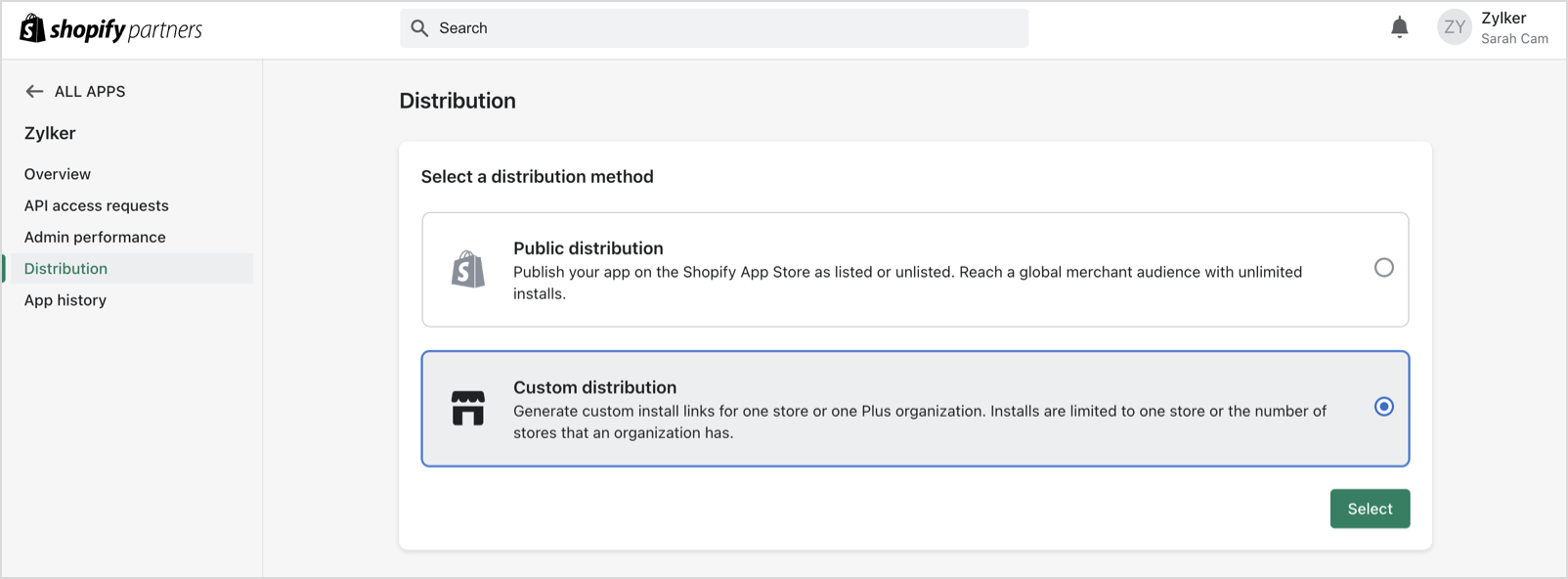
- In the Distribution page that opens, choose Custom Distribution as the distribution method.
- Enter your Store domain in the given format.
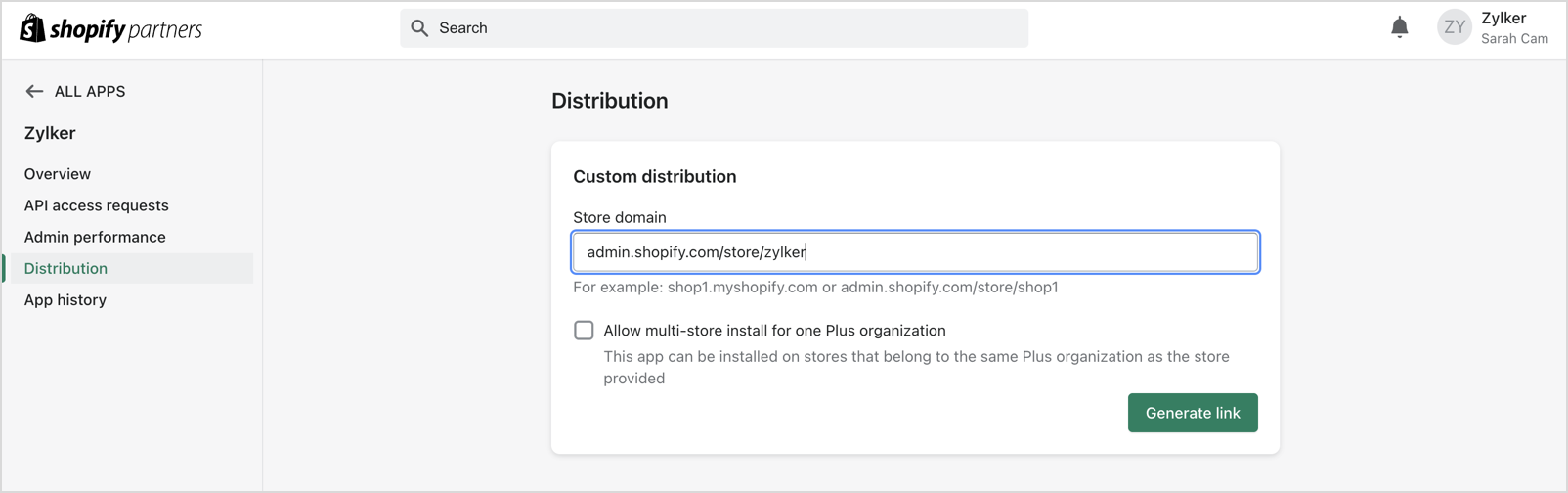
- Ensure Allow multi-store install for one Plus organization is unchecked and click Generate Link.
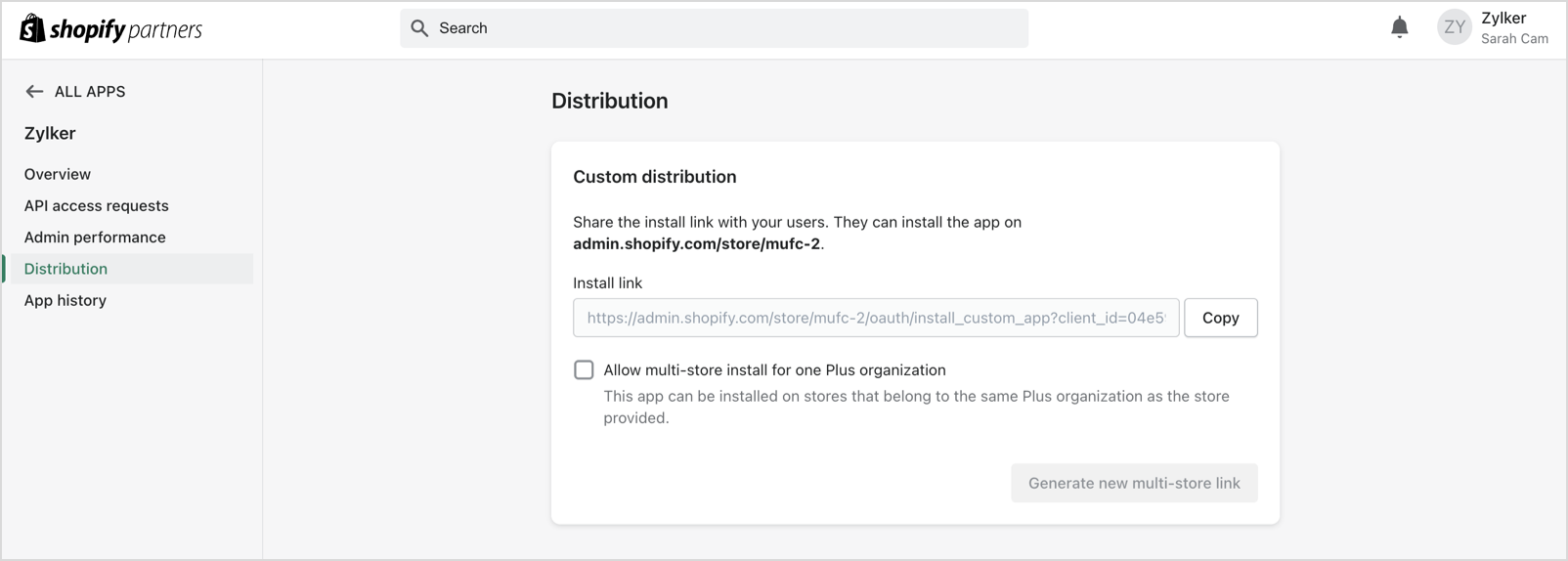
- An Install link will be generated. Copy the link and open it in a new tab.
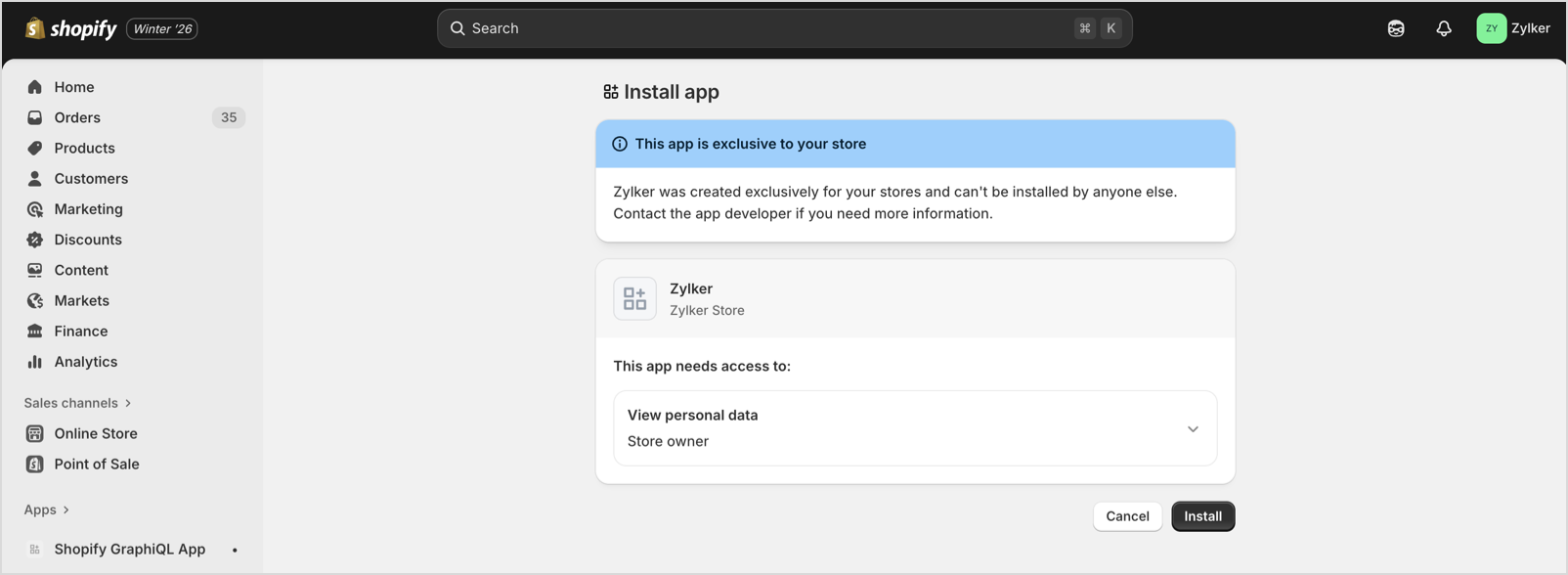
- The Install app page will open. Click Install to complete the installation process.
Step 4: Obtain Your Credentials
Once the app is installed, follow these steps to collect the information needed to finalize the connector setup:
- Log in to your Shopify Partner account, go to the App distribution section, and open the Development Dashboard.
- Click the newly created app.
- In the left-hand navigation pane, click the Settings tab.
- Locate the Client ID and Client Secret fields and copy their values.
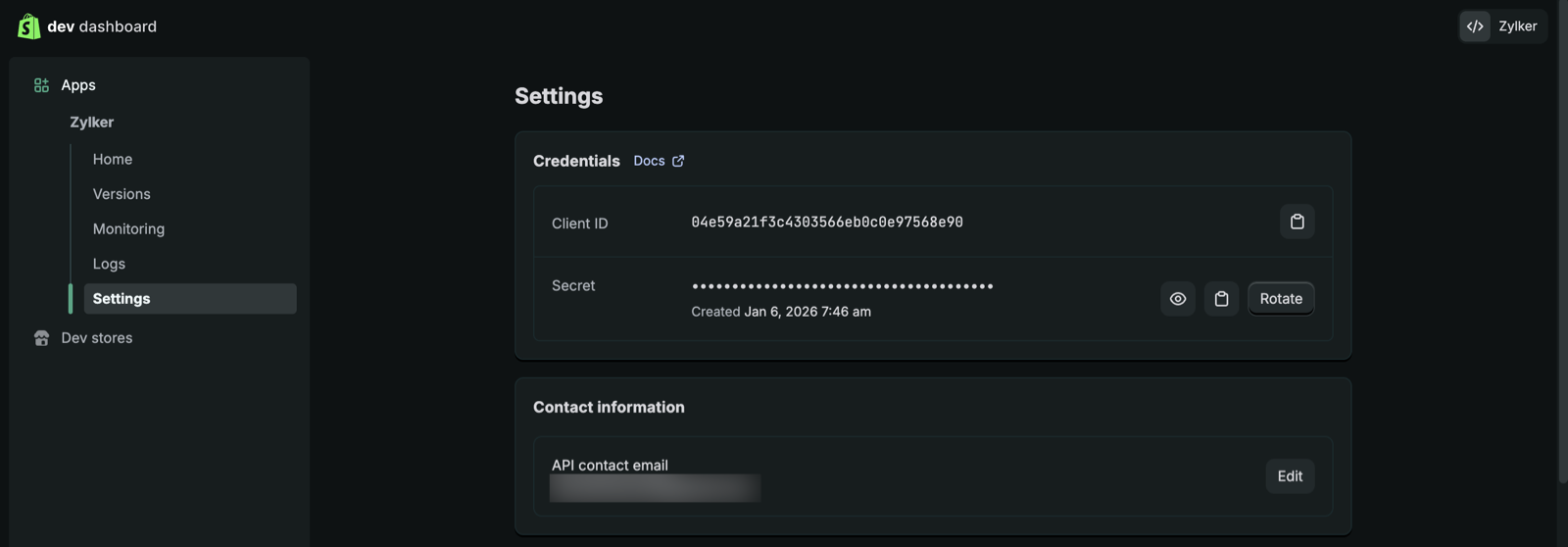
With the Client ID, Client Secret, and Store Domain now available, you can return to the Advanced Analytics setup page in Zoho Analytics to setup the Advanced Analytics connector for Shopify.
How to Access Data Older Than 60 Days?
By default, the read_orders scope fetches only the last 90 days of data into Zoho Analytics. To import data older than 90 days, you must request additional scopes and APIs.
Steps to request access to older order data:
- Access the app that you have installed
- Go to Versions. Navigate to the Access section and click Request access.
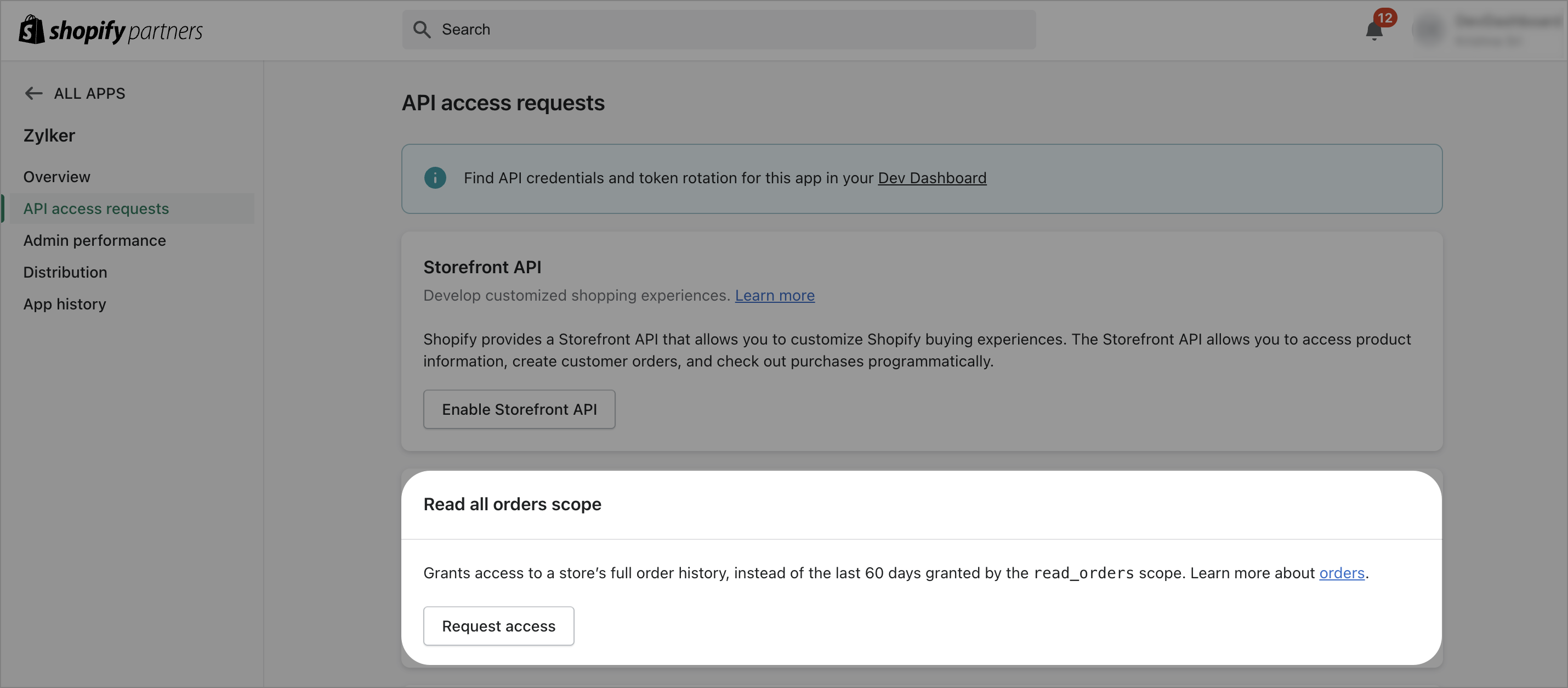
- Locate the Read all orders scope and click Request access.
- Provide a valid reason explaining why access to older data is required.
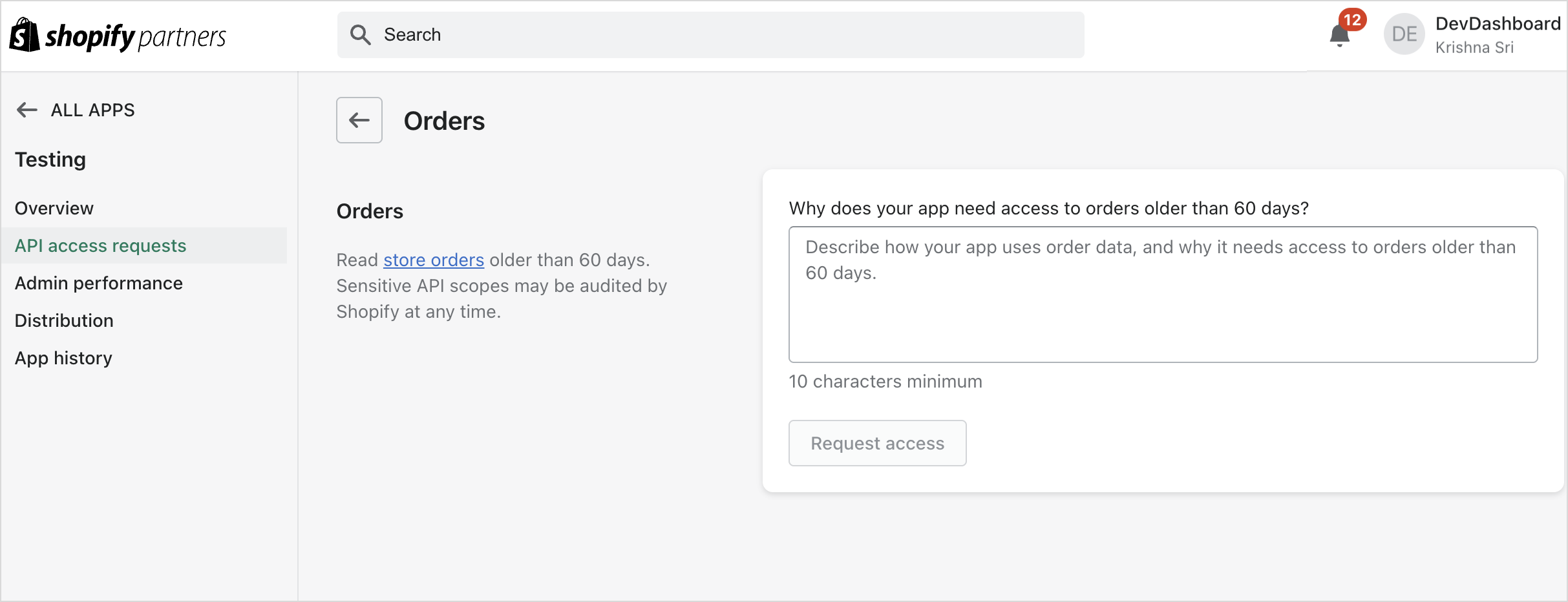
- Once your request is approved, the Read all orders scope will appear in the Access tab.
- Select the scope and save your app to apply the changes.
Reauthenticate the Shopify integration from the Data Source page in Zoho Analytics, then click Full Data Fetch to retrieve all historical order data. Refer to the reauthentication section to learn more.
Setting up the Integration
A Zoho Analytics user with administrator privileges (Account admin, and Org admins) can configure the integration.
Follow the below steps to import your Shopify data into Zoho Analytics seamlessly:
- On the Zoho Analytics home page, click Import Your Data.
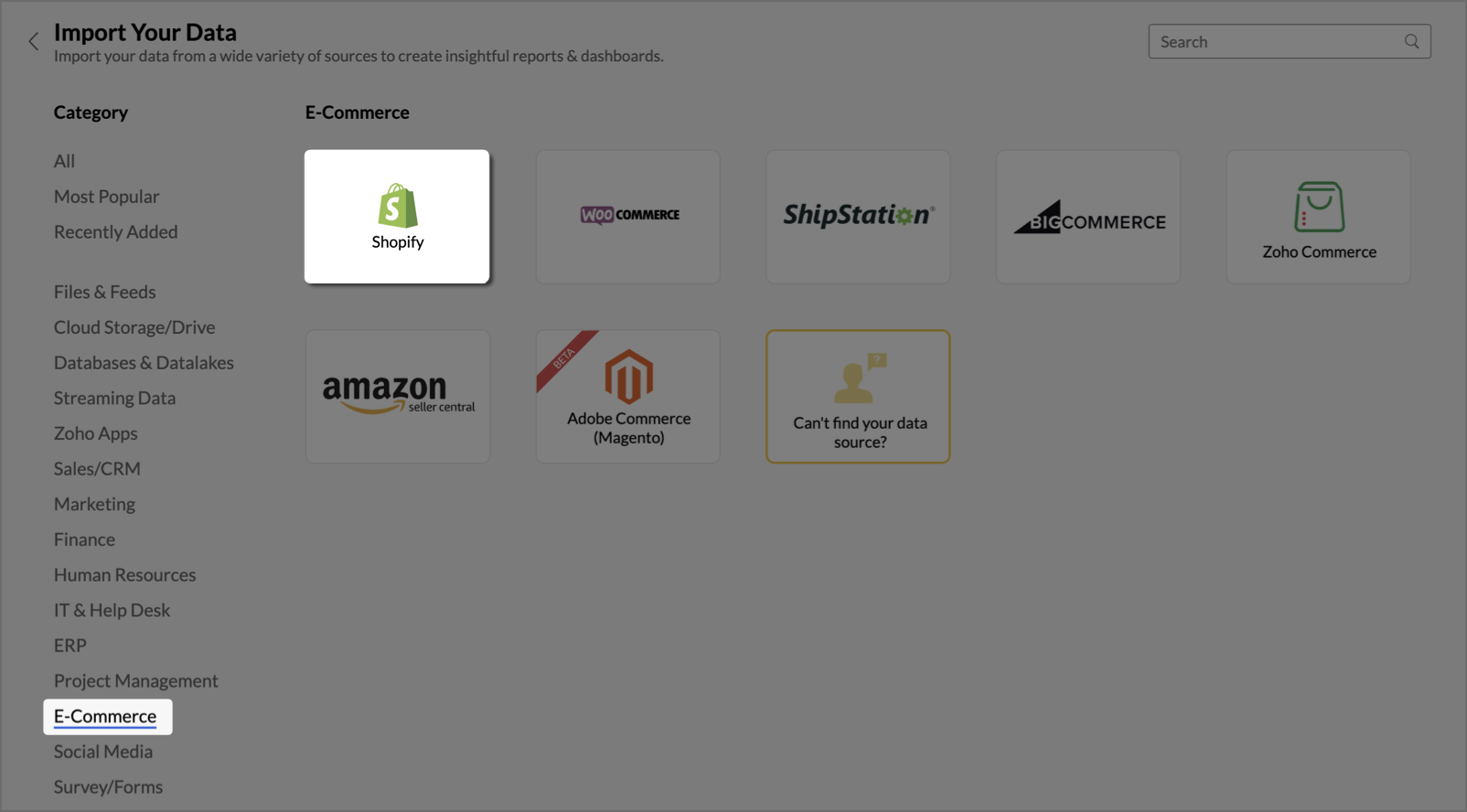
- Navigate to the E-Commerce tab and select Shopify from the available data sources.
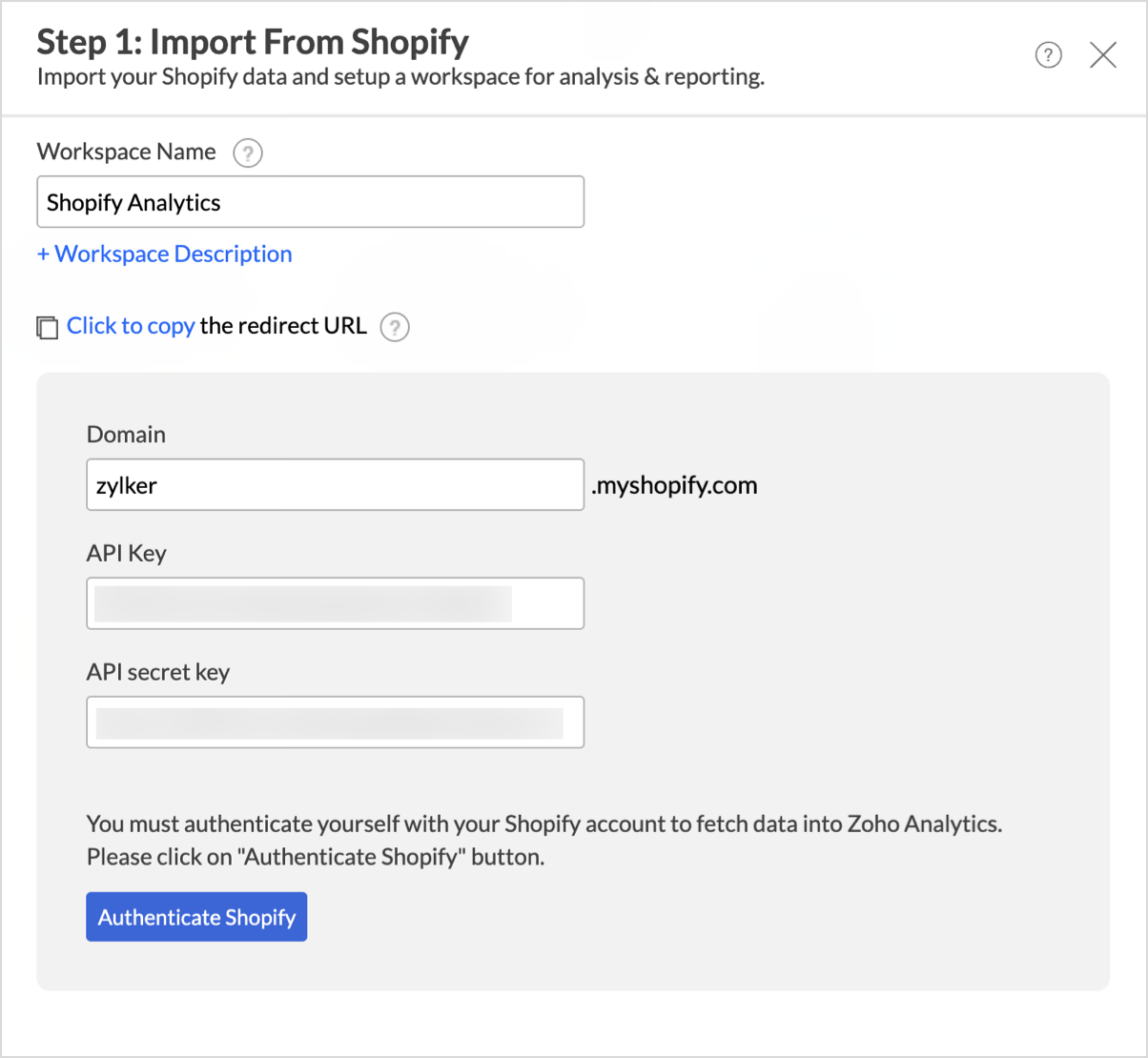
- The dialog box Step 1: Import from Shopify will appear.
- Enter the Workspace Name and Workspace Description (Optional).
- Enter the Domain, API Key, and API Secret Key obtained from your Shopify Account. Please refer to the steps above for more details.
- Click Authenticate Shopify. You will be redirected to Shopify and click Update to complete authentication.
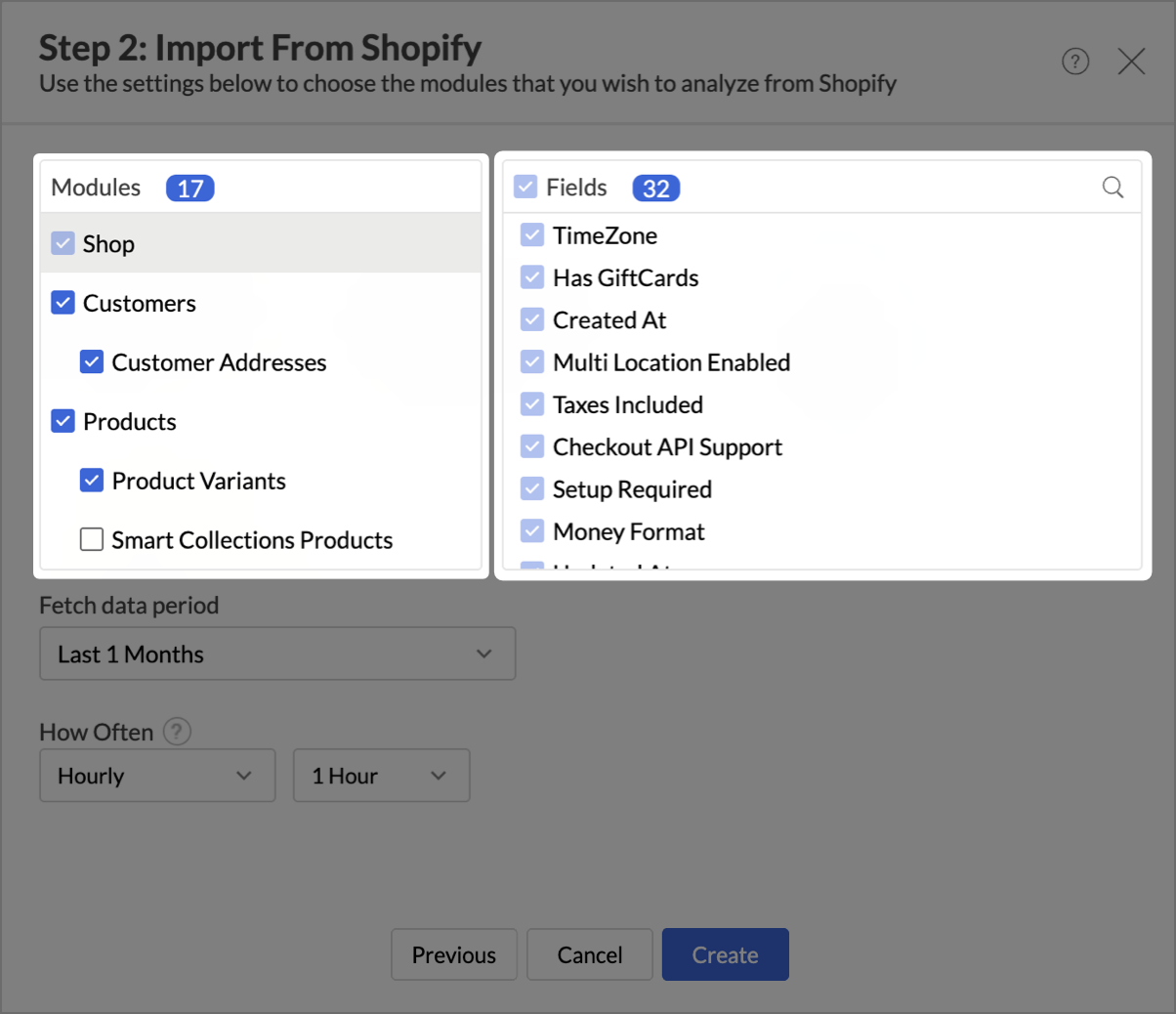
- In the next step, select the Modules and Fields from which you intend to import data.
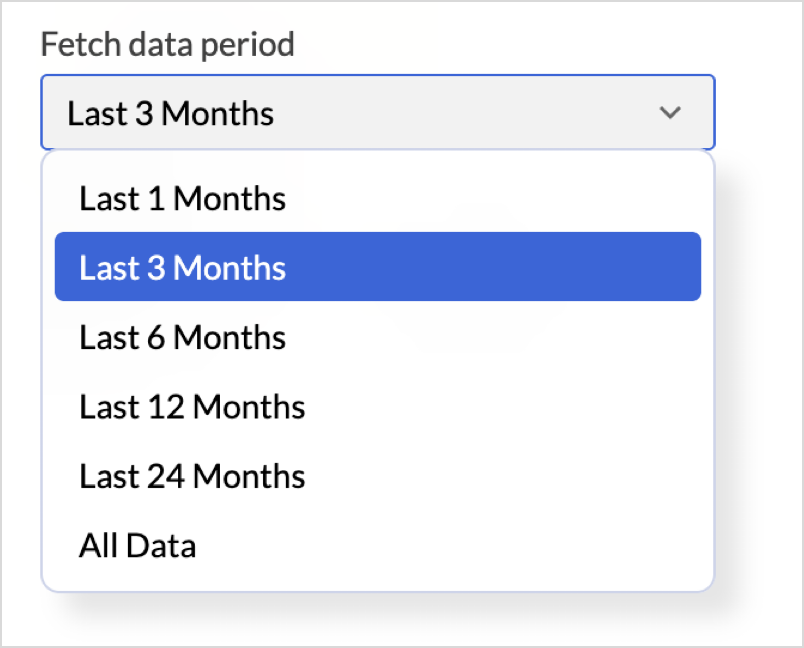
- In the Fetch data period section, choose the specific timeframe for which you want to import your data.
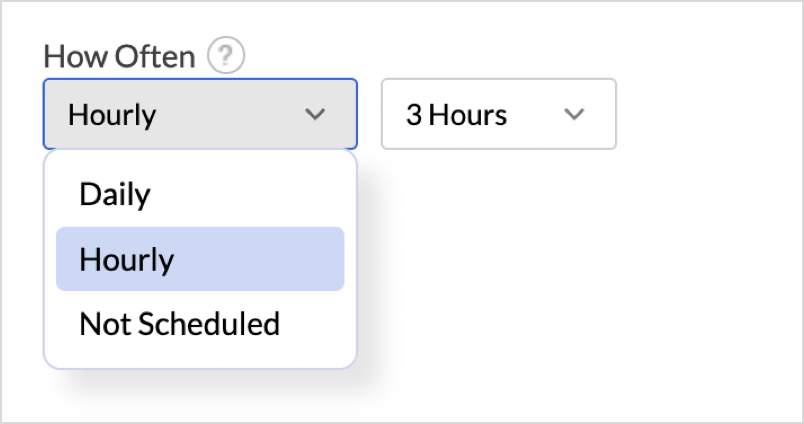
- In the How Often section, set up a schedule to import data at regular intervals. Refer to the Data Sync frequency section to learn more.
- Click Create.
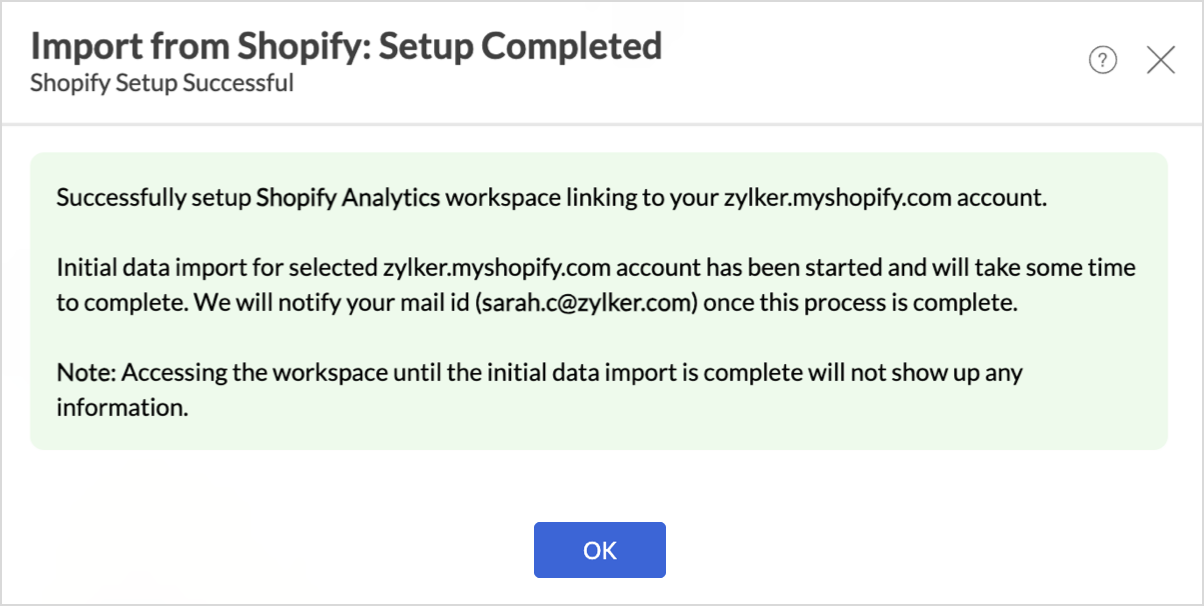
- The data import process will be initiated and may take a few minutes depending on the data being imported. You’ll receive an email and in-app notification once the initial data fetch is complete.
Note:
- The initial fetch might take a few minutes depending on the volume of the data to be imported. An email and an in-app notification will be sent, once the initial fetch is complete.
- The setup process can sometimes fail for a variety of reasons. In this case we request you to access the Data source tab and click the Retry link to import again. If the issue persists then write to support@zohoanalytics.com.
Modules & Fields (What are the modules and fields in Shopify that will be synchronized in Zoho Analytics Workspace?)
The below table lists the modules and fields that will be synced to Zoho Analytics.
| Modules | Fields |
| Shop | Shop ID, Store Name, Email ID, Store Domain, Phone, Primary Locale, Created At, Updated At, Currency, Customer Email, TimeZone, Store Owner, Money Format, Weight Unit, Taxes Included, Tax Shipping, County Taxes, Plan Name, Has Discounts, Has GiftCards, Shopify Domain, Google Apps Domain, Eligible For Payments, Requires Extra Payments, Password Enabled, Has StoreFront, Finances, Primary Location ID, Checkout API Support, Multi Location Enabled, Setup Required, Force SSL, Pre Launch Enabled |
| Customer | Customer ID, Email, Accepts Marketing, Created At, Updated At, First Name, Last Name, State, Note, Verified Email, Multipass Identifier, Tax Exempt, Phone, Tags, Currency, isDefault Address ID |
| Customer Address | Address ID, Customer ID, First Name, Last Name, Company, Address Line 1, Address Line 2, City, Province, Country, ZIP, Phone, isDefault |
| Product | Product ID, Product Name, HTML Body, Vendor, Product Type, Created At, Handle, Updated At, Published At, Template Suffix, Tags, Published Scope |
| Product Variants | Variant ID, Product ID, Variant Name, Price, SKU, Position, Inventory Policy, Compare At Price, Fulfillment Service, Inventory Management, Created At, Updated At, Taxable, Barcode, Weight in grams, Inventory Item ID, Inventory Quantity, Requires Shipping |
| Discounts | Discount ID, Value Type, Value, Customer Selection, Target Type, Target Selection, Allocation Method, Allocation Limit, Once Per Customer, Usage Limit, Starts At, Ends At, Created At, Updated At, Code, Prerequisite Quantity, Entitled Quantity, Prerequisite Quantity Range, Prerequisite Subtotal Range, Prerequisite Shipping Range |
| Discount Entitled Products | Discount ID,Product ID |
| Discount Entitled Collections | Discount ID,Collection ID |
| Discount Entitled Country | Discount ID,Country ID |
| Discount Entitled Variants | Discount ID,Variant ID |
| Discount Prerequisite Collection | Discount ID,Collection ID |
| Discount Prerequisite Customers | Discount ID,Customer ID |
| Discount Prerequisite Product | Discount ID,Product ID |
| Discount Prerequisite Saved Searches | Discount ID,Saved Search ID |
| Discount Prerequisite Variants | Discount ID,Variant ID |
| Order | Order ID, Email, Closed At, Created At, Updated At, Number, Note, Token, Gateway, Total Price, Subtotal Price, Total weight, Total Tax, Tax Included, Currency, Financial Status, Confirmed, Total Discount, Total Line Items Price, Cart Token, Accepts Marketing, Name, Referring Site, Landing Site, Cancelled At, Cancel Reason,Total Price USD, Checkout Token, Reference, User ID, Location ID, Source Identifier, Source URL, Processed At, Device ID, Customer Locale, App ID, Landing Site Ref, Order Number, Customer ID, Payment Gateways, Processing Method, Source Name, Fulfillment Status, Tags, Contact Email, Order Status URL, Presentment Currency, Total Line Items Price Shop Amount, Total Line Items Price Shop Currency, Total Line Items Presentment Currency, Total Line Items Presentment Amount, Total Discount Shop Currency, Total Shipping Presentment Currency, Total Shipping Presentment Amount, Subtotal Price Set Shop Amount, Subtotal Price Set Shop Currency, Subtotal Price Set Presentment Currency, Subtotal Price Set Presentment Amount, Total Price Shop Amount, Total Price Shop Currency, Total Price Presentment Currency, Total Price Presentment Amount, Total Tip Received, Billing First Name, Billing Address Line 1, Billing Phone, Billing City, Billing Zip, Billing Province, Billing Country, Billing Last Name, Billing Address Line 2, Billing Company, Billing Latitude, Billing Longitude, Shipping First Name, Shipping Address Line 1, Shipping Phone, Shipping City, Shipping Zip, Shipping Province, Shipping Country, Shipping Last Name, Shipping Address Line 2, Shipping Company, Shipping Latitude, Shipping Longitude, Client Browser IP, Client Accept Language, Client User Agent, Client Session Hash |
| Order Line Items | Line Item ID, Order ID, Variant ID, Title, Quantity, Price, SKU, Vendor, Fulfillment Service, Product ID, Requires Shipping, Taxable, Gift Card, Variant Inventory Management, Product Exists, Fulfillable Quantity, Weight, Total Discount, Fulfillment Status, Price Shop Money, Price Presentment Money, Price Shop Currency, Price Presentment Currency, Discount Shop Money, Discount Presentment Money, Discount Shop Currency, Discount Presentment Currency |
| Order Line Item Properties | Order ID, Order Line Item ID, Name, Value |
| Order Line Items Tax | Lines Order ID, Order Line Item ID, Title, Price, Rate, Tax Shop Amount, Tax Presentment Amount, Tax Shop Currency, Tax Presentment Currency |
| Order Note Attributes | Order ID, Name, Value |
| Order Line Items Discount Allocations | Order ID, Order Line Item ID, Amount, Amount Shop Money, Amount Shop Currency, Amount Presentment Money, Amount Presentment Currency, Discount Application Index |
| Order Discount Applications | Order ID, Discount Allocation ID, Type, Value, Value type, Allocation Method, Target Selection, Target Type, Code, Description |
| Order Shipping Lines Shipping | Line ID, Order ID, Price, Code, Source, Phone, Title, Requested Fulfillment Service ID, Discounted Price, Price set Shop Money, Price set Presentment Money, Price set Shop Currency, Price set Presentment Currency, Discount set Shop Money, Discount set Presentment Money, Discount set Shop Currency, Discount set Presentment Currency, Carrier Identifier |
| Order Shipping Line Tax Lines | Order ID, Order Line Item ID, Title, Price, Rate, Tax Shop Amount, Tax Presentment Amount, Tax Shop Currency, Tax Presentment Currency |
| Fulfillments | FulFillment ID, Order ID, Status, Created At, Updated At, Service, Tracking Company, Shipment Status, Location ID, Tracking Number, Tracking URL, Name, Testcase, Authorization |
| Fulfillments Line Items | Order ID, Fulfillment ID, Line Item ID, Variant ID, Title, Quantity, Price, SKU, Vendor, Fulfillment Service, Product ID, Requires Shipping, Taxable, Gift Card, Variant Inventory Management, Product Exists, Fulfillable Quantity, Weight, Total Discount, Fulfillment Status, Price Shop Money, Price Presentment Money, Price Shop Currency, Price Presentment Currency, Discount Shop Money, Discount Presentment Money, Discount Shop Currency, Discount Presentment Currency |
| Fulfillment Tracking Numbers | Order ID, Fulfillment ID, Tracking Number |
| Fulfillment Tracking URLs | Order ID, Fulfillment ID, Tracking URL |
| Smart Collections | Smart Collection ID, Collection Name, Collection Handle, Updated At, HTML Body, Published At, Sort Order, Template Suffix, Disjunctive, Published Scope |
| Collections | Collection ID, Collection Name, Collection Handle, Updated At, HTML Body, Published At, Sort Order, Template Suffix, Published Scope |
| Refunds | Refund ID, Order ID, Created At, Note, User ID, Processed At, Restock |
| Refund Order Adjustments Order | Adjustment ID, Order ID, Refund ID, Amount, Tax Amount, Kind, Reason, Amount Shop money, Amount Shop currency, Amount Presentment money, Amount Presentment currency, Tax Shop money, Tax Shop currency, Tax Presentment money, Tax Presentment currency |
| Order Transactions | Transaction ID, Order ID, Kind, Gateway, Status, Message, Created At, Test, Authorization, Location ID, User ID, Parent ID, Processed At, Device ID, Source Name, Amount, Currency, Refund ID |
| Refund Line Items | Order ID, Refund Line Item ID, Refund ID, Quantity, Order Line Item ID, Location ID, Restock Type, Subtotal, Total Tax, Subtotal Shop Money, Subtotal Shop Currency, Subtotal Presentment Money, Subtotal Presentment Currency, Total Tax Shop Money, Total Tax Shop Currency, Total Presentment Money, Total Presentment Currency |
| Order Line Items Discount Allocations | Order ID, Order Line Item ID, Amount, Amount Shop Money, Amount Shop Currency, Amount Presentment Money, Amount Presentment Currency, Discount Application Index |
| Tender Transactions | Transaction ID, Order ID, Amount, Currency, User ID, Test, Processed At, Remote Reference, Payment Method, Payment Credit Card Number, Payment Card Company |
| Collection Products | ID, Collection ID, Product ID, Created At, Updated At, Position, Sort Value |
| Events | Event ID, Subject ID, Created At, Subject Type, Action, Body, Message, Author, Description, Path |
| Countries | Country ID, Name, Tax, Tax Name, Code |
| Shop Location | Location ID, Shop Name, Address Line 1, Address Line 2, City, ZIP, Province, Country, Phone, Created At, Updated At, Legacy, Active |
| Provinces | Country ID, Province ID, Name, Tax, Tax Name, Code, Tax Type, Tax Percentage |
| Draft Orders | Draft Order ID, Note, Email, Taxes Included, Currency, Subtotal Price, Total Tax, Total Price, Invoice Sent At, Created At, Updated At, Tax Exempt, Completed At, Name, Status, Shipping First Name, Shipping Address Line 1, Shipping Phone, Shipping City, Shipping Zip, Shipping Province, Shipping Country, Shipping Last Name, Shipping Address Line 2, Shipping Company, Shipping Latitude, Shipping Longitude, Billing First Name, Billing Address Line 1, Billing Phone, Billing City, Billing Zip, Billing Province, Billing Country, Billing Last Name, Billing Address Line 2, Billing Company, Billing Latitude, Billing Longitude, Invoice URL, Applied Discount Description, Applied Discount Value, Applied Discount Title, Applied Discount Amount, Applied Discount Value Type, Order ID, Shipping Line Handle, Shipping Line Title, Shipping Line Price, Shipping Line Custom, Tags, Customer ID |
| Draft Order Line Items | Draft Order Line Item ID, Draft Order ID, Variant ID, Product ID, Title, SKU, Vendor, Price, Quantity, Requires Shipping, Taxable, Gift Card, Fulfillment Service, Weight, Name, Custom, Applied Discount Title, Applied Discount Description, Applied Discount Value, Applied Discount Value Type, Applied Discount Amount |
| Draft Order Tax Lines Draft | Order ID, Title, Price, Rate |
| Draft Order Note Attributes | Draft Order ID, Name, Value |
| Draft Order Line Items Tax Lines | Draft Order Line Item ID, Price, Title, Rate, Draft Order ID |
| Draft Order Line Item Properties | Draft Order Line Item ID, Name, Value, Draft Order ID |
| Customer Saved Searches | Saved Search ID, Name, Created At, Updated At, Query |
| Abandoned Checkouts | Checkout ID, Token, Cart Token, Email, Gateway, Accepts Marketing, Created At, Updated At, Landing Site, Note, Referring Site, Is Taxes Included, Total Weight, Currency, Completed At, Closed At, User ID, Location ID, Source Identifier, Source URL, Device ID, Phone, Customer Locale, Name, Source, Abandoned Checkout URL, Source Name, PResentment Currency, Total Discount, Total Line Item Price, Total Price, Total Tax, Subtotal Price, Billing First Name, Billing Address Line 1, Billing Phone, Billing City, Billing Zip, Billing Province, Billing Country, Billing Last Name, Billing Address Line 2, Billing Company, Billing Latitude, Billing Longitude, Shipping First Name, Shipping Address Line 1, Shipping Phone, Shipping City, Shipping Zip, Shipping Province, Shipping Country, Shipping Last Name, Shipping Address Line 2, Shipping Company, Shipping Latitude, Shipping Longitude |
| Abandoned Checkout Note Attributes | Checkout ID, Name, Value |
| Abandoned Checkout Shipping Lines | Checkout ID, Code, Price, Source, Checkout Shipping Line ID |
| Abandoned Checkout Line Items | Checkout ID, Key, Line Item ID, Destination Location ID, Fulfillment Service, Is Gift Card, Weight, Origin Location ID, Product ID, Quantity, Requires Shipping, SKU, Is Taxable, Title, Variant ID |
| Abandoned Checkout Discount Codes | Checkout ID, Code, Amount, Discount Type |
| Abandoned Checkout Tax Lines | Checkout ID, Price, Rate, Title |
| Abandoned Checkout Line Items Tax Lines | Checkout ID, Checkout Line Item ID, Price, Position, Rate, Title, Source, Zone, Compare At |
| Abandoned Checkout Line Items Applied Discounts | Checkout ID, Checkout Line Item ID, Discount ID, Description, Created At, Amount |
| Abandoned Checkout Line Items Properties | Checkout ID, Checkout Line Item ID, Name, Value Billing First Name |
Data Sync Frequency
Zoho Analytics offers flexible sync schedules to ensure that your data is always up-to-date for effective analysis. These schedules allow you to automate the process of updating your data, ensuring that your analyses are based on the latest information.
- 1 Hour (Enterprise plan only)
- 3 Hours
- 6 Hours
- 12 Hours
- Every day
Handling Data Synchronization Failure
Data synchronization can fail,
- If the data type of a field is changed in the Shopify Application.
- If the Modules and Field selected for analysis are deleted in the source application.
- If the user who configured the integration no longer has permission to access the modules.
In any of the above mentioned cases, the data sync will be paused. You will be notified via email and in- app notification with the exact reason for failure along with the solution.
To resolve the sync failure, delete or restructure the views, or restore the specific modules and fields from the source application. Refer to Data Sync failure and solutions article for more details.
Once you have made the changes, click the Sync now option in the data source tab to resume data sync. If the issue persists, contact support@zohoanalytics.com
Managing Data Sources
The Data Sources tab provides essential information to monitor and manage the integration setup. It also allows you to edit the settings as needed. Users with administrator privileges will be able to view and modify the connection settings.

Data Source Permalink
The Data Source Permalink helps you easily access the data source tab. Only the Organization Admin and Account Admin can make changes in the Data sources page, other users can know the synchronization details like whether the last data sync was successful or not, when the last data sync happened, when the next sync is scheduled to happen, etc. This link can also be pasted in dashboards so that everyone accessing the dashboard can know about the sync status.

Edit Setup
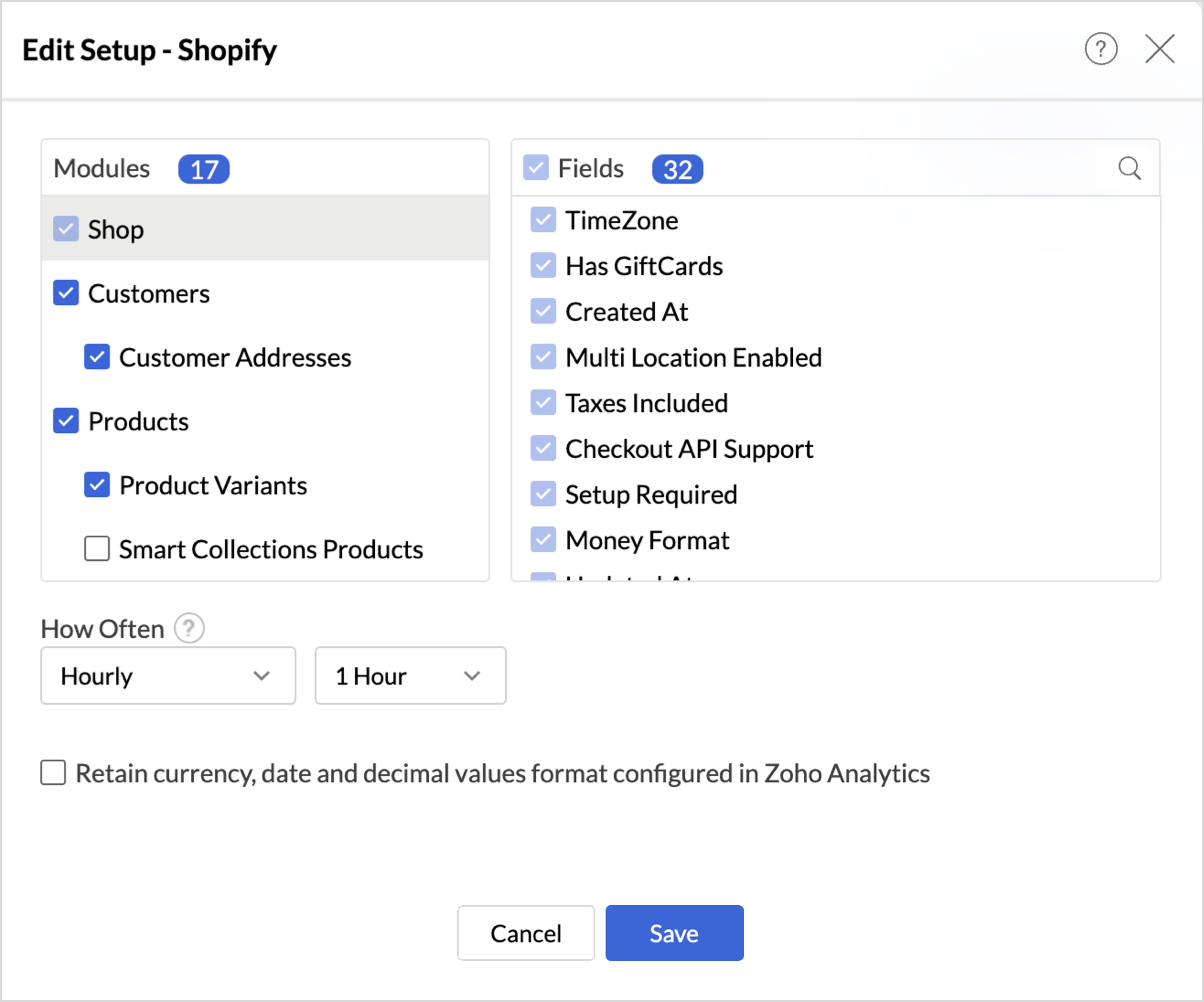
The Edit Setup tab allows you to add or delete modules or fields, change the schedule interval, and modify other settings specific to the business application.
To modify the settings,
- Click Data Sources > Edit Setup.
- The Edit Setup - Shopify dialog will open. Modify the settings as needed and click Save.
Re- Authenticate
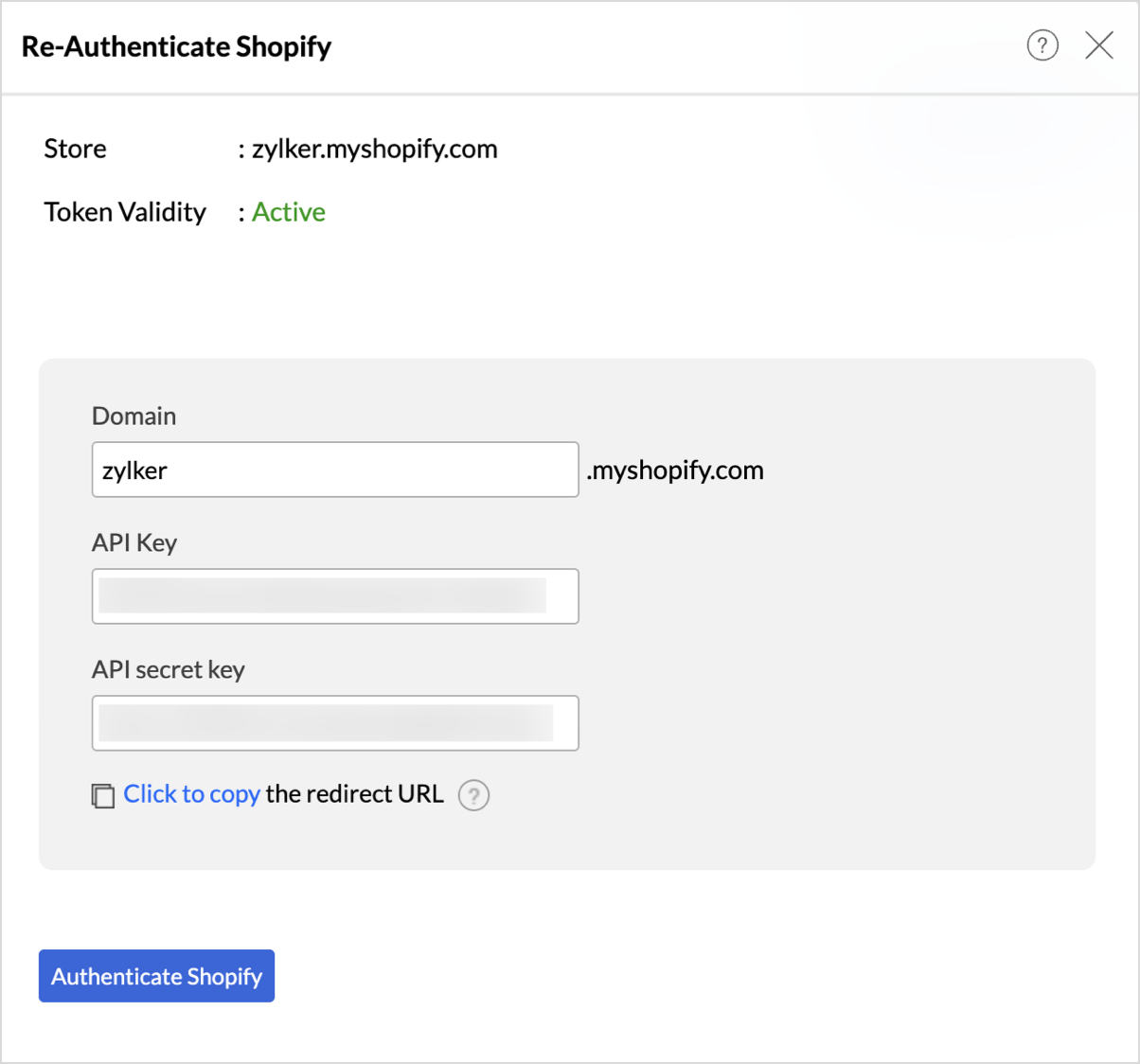
Re-authentication will be helpful when the API key or password is changed. In this case, the data sync will be paused, and the administrator who configure the connector setup must re-authenticate to resume the data sync.
To reauthenticate the setup,
- Click Data Sources > Re-Authenticate.
- The Re-Authenticate - Shopify dialog will open. Enter the credentials and click Authenticate Shopify.
Sync History
The Sync History tab provides details about the data sync for the last 45 days. A successful data sync is marked in green, and a sync failure is marked in red.
To view the Sync history,
- Click Data sources > Sync History.
- A calendar with the Sync History of the last 45 days will open. The date when the data sync has happened will be highlighted. Hover to view the number of times the data had got synced on a specific date.
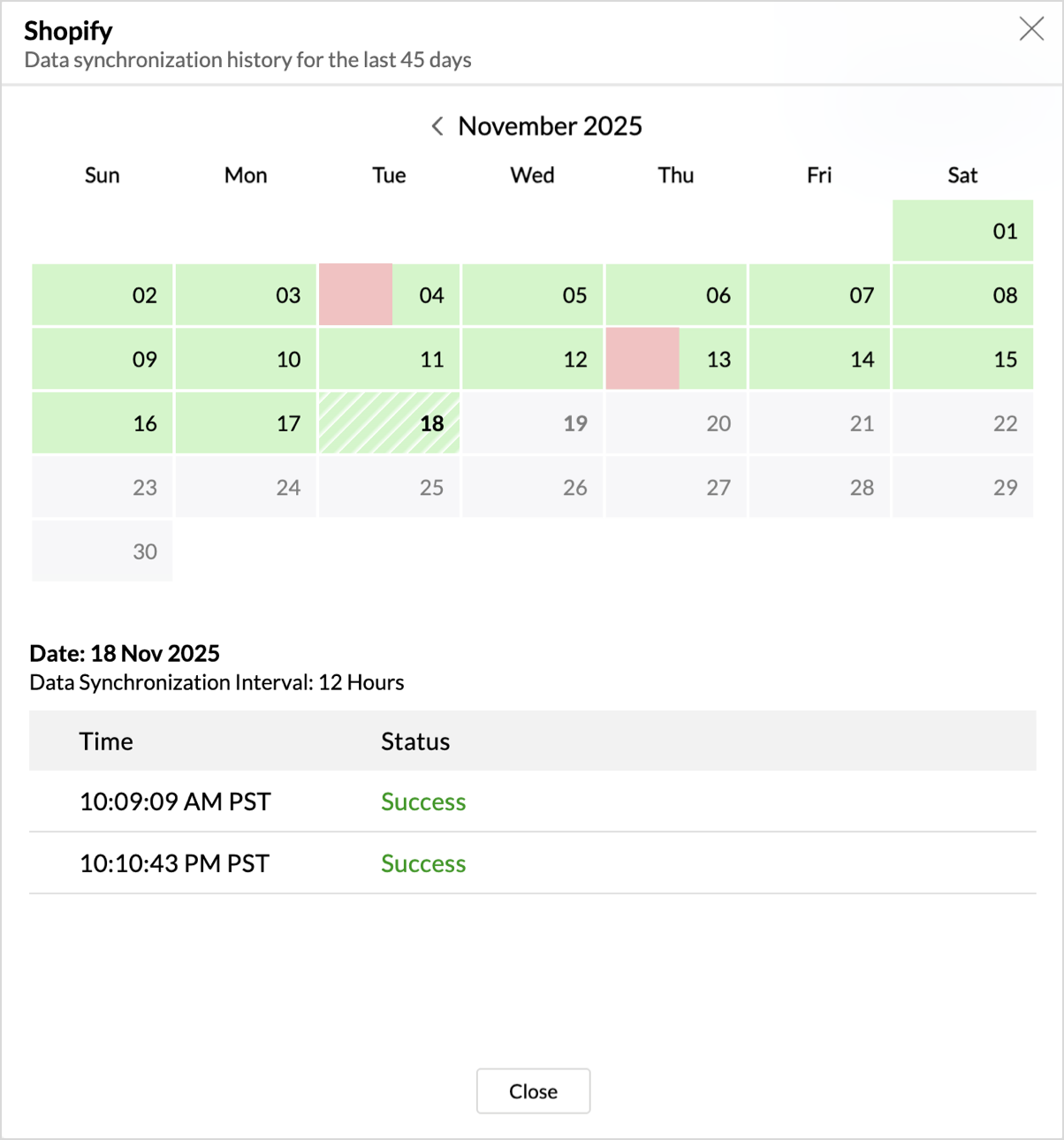
- Click the date to view more details.
- Time - Displays the time when the data is synced.
- Status - Shows whether the sync was a success or a failure.In case of failure, the reason will be displayed. Refer to this page to learn how to resolve the issue and avoid further failure.
Audit History
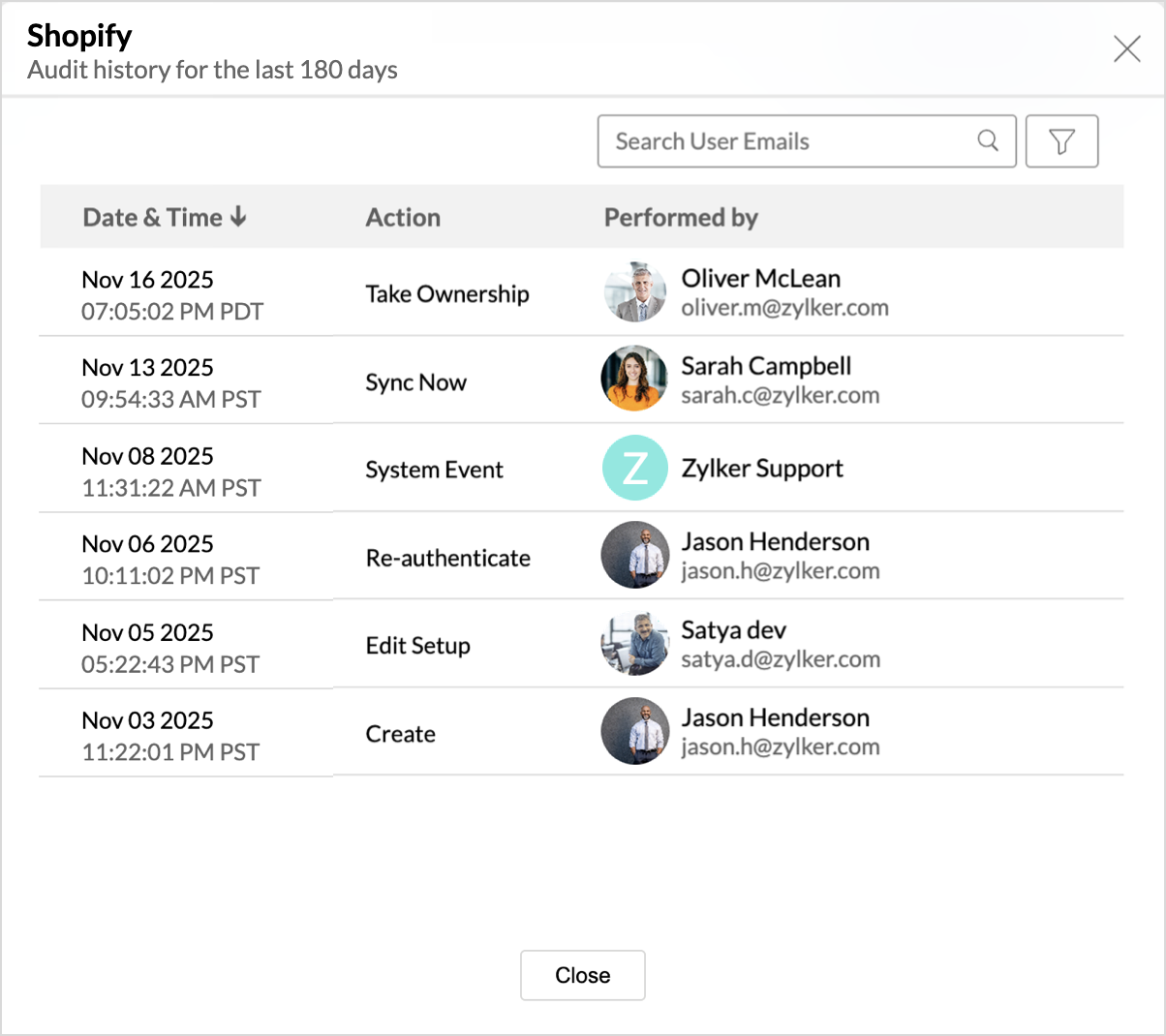
Zoho Analytics logs all the user activities and system events within the Shopify workspace. The following actions that are logged in Zoho Analytics,
- User Action: Create, Modules Added, Modules Removed, Fields Added, Fields Removed, Schedule Change and Entities Modified, Delete, Take Ownership, Re-authenticate, Sync Now, Retry.
- System Action: Plan upgrade or downgrade.
To view the audit history,
- Click Data Sources > Audit History.
- A dialog with the activities for the last 180 days will open.
Full Data Fetch
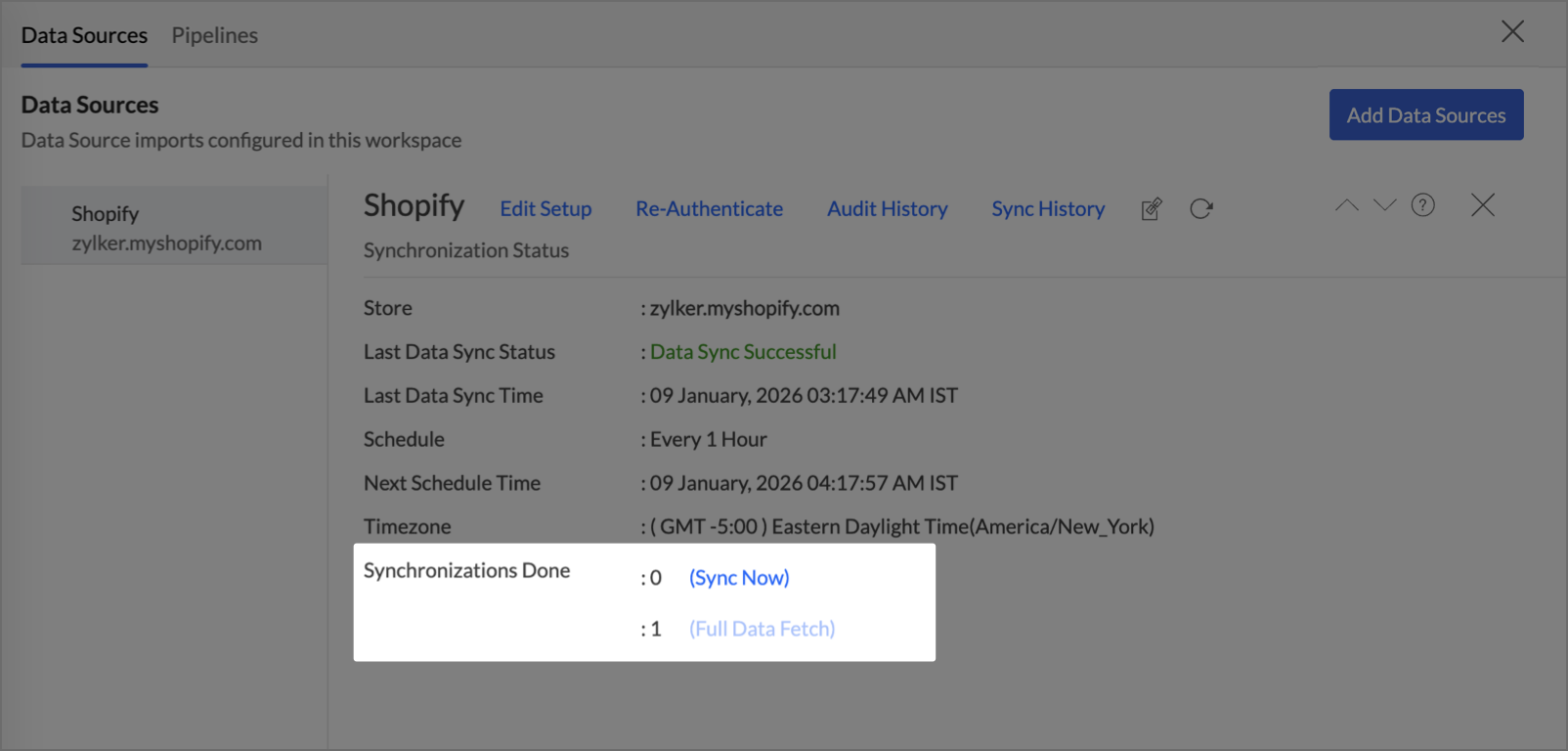
- The Full Data Fetch option can be used to sync all the changes made in the Shopify application, like datatype changes, or to resolve temporary sync issues.
- The Sync Now option helps import data without having to wait until the next scheduled interval.
To initiate a full data fetch,
- Access the Data Sources tab.
- Click Full Data Fetch adjacent to the Synchronization done field.
- Click Sync now to import data without having to wait till next sync schedule.
Remove Data Source
Zoho Analytics allows you to remove the integration if needed. Removing the integration will suspend further data synchronization. The data tables and the reports will be available.
Click the Settings icon in the Data Sources tab, and select Remove Data Source from the drop-down menu.

Data Modeling & Preparation
Zoho Analytics allows you to combine data from various sources such as Files, Feeds, Databases and Business Applications for an in-depth analysis. Query Tables allows you to combine data from different tables to create reports.
While blending data from other data sources, Zoho Analytics automatically identifies similar columns and provides suggestions for lookups. Refer to the Joining Tables article for more details.
Data Visualization / Analysis
Chart Types in Zoho Analytics
The below table lists the range of visualizations supported in Zoho Analytics.
| Visualization | Types |
Bar | Stacked bar, Histogram, Horizontal bar |
Stacked Bar | Horizontal Stacked bar, 100% vertical and horizontal stacked bar |
Area | Area with markers, Smooth Area, Smooth area with Markers |
Line and Bar Combination chart | Bar with Line, Bar with Bubble, Bar with Scatter, Bar with Area, Area with Bubble, Line with Bubble and Custom Combination |
Bubble Chart | Bubble Pie, Packed Bubble, Word Cloud |
Stacked Area | Stacked area with markers, Smooth stacked area, Smooth stacked area with markers |
Map | Heat Map, Map Scatter, Map Bubble, Map Pie, Map Bubble Pie, Map Filled, Geo Heat Map |
Pie | Pie, Ring, Semi Pie, Semi Ring |
Tree map | Default View |
| Sankey | Default View |
Sunburst | Default View |
Race Chart | Default View |
Doughnut | Default View |
Matrix View | Pivot table |
Tabular | Summary and Tabular view |
Dashboards and KPI widgets | Single Numeric Widget, Dial Chart Widget Bullet, Chart Widget |
Sharing and Collaboration
- Share data and reports with your colleagues & friends with fine-grained permission
- Enable real-time commenting on a shared view to efficiently collaborate with your users
- Publish reports for wider consumption. Embed reports/dashboards within your websites, web applications, and blogs.
- Export, Email, and Print reports in a variety of formats.
- Use Zoho Analytics mobile apps (optimized for both IOS and Android platform) and access the reports and dashboards on the go.
Help & Support
We offer 24x5 technical support (Monday to Friday). In case if you need our assistance kindly do mail us your questions to support@zohoanalytics.com.
You can also reach out to us on our toll-free numbers.
United States: +1 (888) 900 9646
United Kingdom: +44 (20) 35647890
Australia: +61-2-80662898
India: +91 44 6965 6060